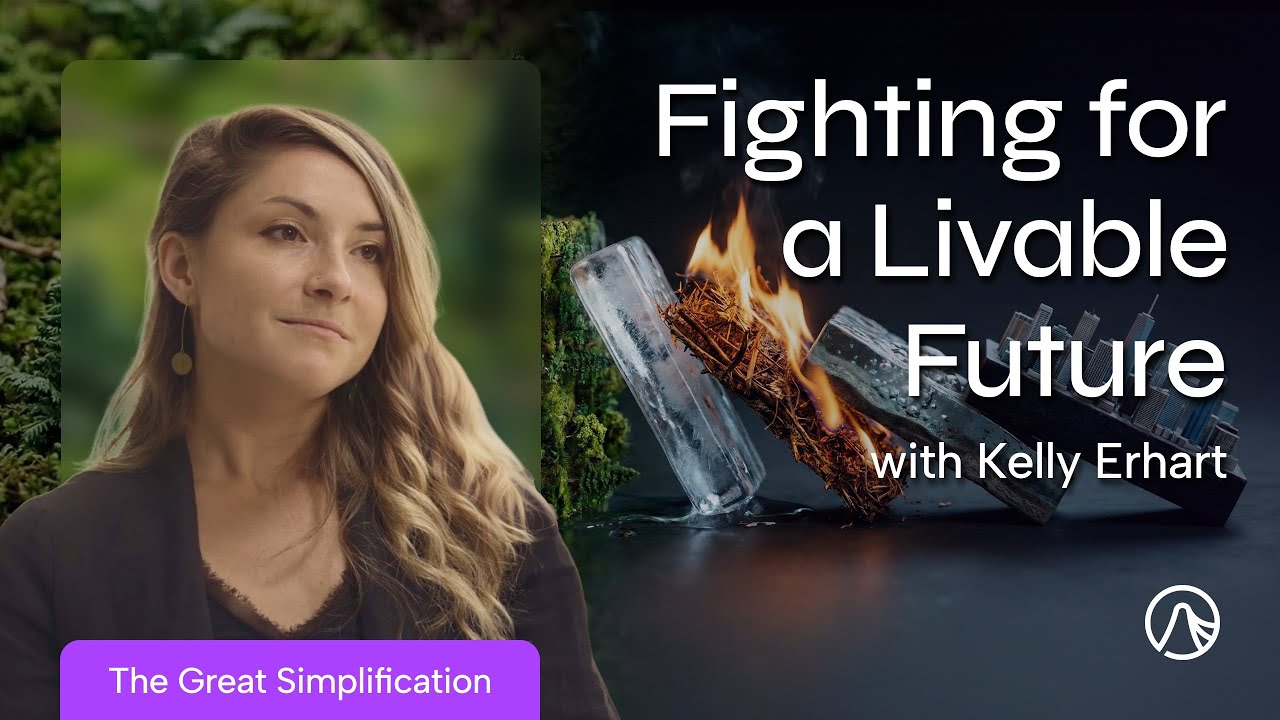
Original source: Nate Hagens
This video from Nate Hagens covered a lot of ground. 14 segments stood out as worth your time. Everything below links directly to the timestamp in the original video.
The renewable energy boom is real, but a closer look at the underlying climate physics suggests the scorecard is far more complicated than the headlines imply.
Climate Science Dashboard Shows Green on Renewables, Red on Tipping Points
Clean energy investment crossed $1 trillion in 2023, more than double fossil fuel spending, and 90% of new energy capacity coming online in the United States is now renewable. Yet Kelly Erhart, who directs a climate philanthropy, argues this progress registers as only a yellow light on what she calls a climate dashboard, because emissions are not actually falling — new clean capacity is being built on top of fossil infrastructure rather than replacing it. The red lights, she contends, are flashing across the underlying science: climate sensitivity appears higher than earlier models assumed, industrial pollution cleanup is inadvertently unmasking warming that aerosols had been suppressing, natural systems are beginning to emit their own greenhouse gases, and tipping points such as collapsing ice sheets and Amazon dieback now fall within a human-relevant time horizon.
The dashboard framing captures a structural tension at the core of the human enterprise: energy throughput continues to climb even as its composition shifts, and the biophysical feedbacks set in motion by decades of accumulated warming are beginning to operate independently of anything on the emissions ledger. The tragedy Erhart identifies is systemic — cascading ecological disruption will erode the very geopolitical stability on which ambitious mitigation and adaptation depend, creating a compounding drag on the solutions themselves.
"The red lights are really where I focus — this is a category of risks that all act as accelerants and force multipliers to cascading effects in our systems."
Thwaites Glacier Collapse Now Considered Inevitable, Timeline Remains Unknown
Glaciologists studying the Thwaites Glacier in West Antarctica — informally known as the doomsday glacier — have concluded that its collapse is no longer a question of whether but when. Warm ocean water has been infiltrating beneath the previously land-bound ice sheet, initiating a feedback loop of basal lubrication that is accelerating the glacier's seaward movement independently of surface air temperatures. A full collapse could deliver up to 2 meters of sea level rise globally, enough to render roughly one third of the world's coastal population — from Bangladesh to Jakarta to New York — effectively unadaptable. Critically, Erhart notes, this risk carries a probability range that glaciologists cannot narrow: estimates run anywhere from a 1% to a 99% chance of collapse this century, and the scenario is not yet incorporated into IPCC projections.
The Thwaites situation is a near-perfect illustration of what complexity science calls a fat-tailed risk — low confidence in timing, catastrophic in magnitude, and structurally outside the reach of conventional adaptation measures like sea walls. The biophysical constraints here are absolute: there is no economic or infrastructural response to 2 meters of rapid sea level rise at civilizational scale. That IPCC models continue to omit this uncertainty means the official planning envelope for the coming century is systematically underestimating the outer boundary of possible harm.
"When you talk to glaciologists today, they say it's no longer a matter of if Thwaites collapses, it's a matter of when."
Methane From Thawing Permafrost Is Accelerating Warming — And Is Absent From Climate Models
Methane and other so-called super pollutants — including black carbon and fluorinated gases — account for roughly half of the warming the planet is experiencing today, despite existing in far lower atmospheric concentrations than carbon dioxide. Erhart describes methane as both the fastest lever available for near-term mitigation and one of the most dangerous accelerants already in motion. The atmosphere's capacity to chemically scrub methane is finite, meaning that as emissions rise the gas lingers longer, compounding warming. Around 2010, atmospheric methane concentrations began rising sharply after years of relative stability, a trajectory now linked to warming-induced emissions from thawing permafrost and tropical wetlands and peatlands — sources that current IPCC models do not include. Livestock, particularly pasture-raised ruminants, remain the single largest anthropogenic methane source, with only about 10% of those emissions currently addressable through available technology.
The absence of natural methane feedbacks from official climate modeling is not a minor accounting gap — it represents a structural blind spot in the planning framework that governments and investors rely upon. Once a warming planet begins generating its own emissions, the relationship between human activity and climate outcome becomes nonlinear in ways that render linear policy responses inadequate. The human superorganism has, in effect, lit a secondary fuse that operates on its own timetable.
"Natural feedback loops are now adding to the problem — thawing permafrost, tropical wetlands and peatlands are releasing methane, and these sources aren't even factored into climate models right now."
Earth Lost Half a Percent of Its Reflectivity in 25 Years, Spurring Geoengineering Research
Over the past 25 years, studies show that Earth's albedo — its natural reflectivity — has declined by roughly half a percent, a loss that Erhart describes as equivalent in warming impact to an additional 138 parts per million of carbon dioxide in the atmosphere. For context, current atmospheric CO₂ stands at approximately 420 parts per million, meaning the hidden warming effect of albedo loss is already equivalent to roughly one third of the entire industrial-era accumulation. This erosion of one of the planet's primary cooling mechanisms is a key driver behind growing scientific interest in stratospheric aerosol injection, or SAI — a form of solar geoengineering first proposed in a 1965 report to President Lyndon Johnson and revived seriously in research through the 1990s — which would introduce sulfate particles into the upper atmosphere to reflect more incoming sunlight. Volcanic eruptions such as Mount Pinatubo serve as natural analogues for the basic mechanism.
The albedo finding reframes solar geoengineering not as a fringe proposal but as a response to a measurable and ongoing degradation of a natural system. Reflectivity loss creates a self-reinforcing feedback: warming reduces ice and cloud cover, which reduces reflectivity, which accelerates warming. SAI research is attempting to model whether deliberately restoring some fraction of that reflectivity could interrupt the loop — though Erhart is clear that it addresses none of the chemical consequences of atmospheric carbon and carries its own regional uncertainties that remain poorly understood.
"That drop in reflectivity is a hidden second layer of warming on top of the greenhouse gases we already talked about — less reflectivity, more warming, more warming, less reflectivity."
Ocean Alkalinity Enhancement Could Remove Gigatons of Carbon — But Current Deployment Is Measured in Thousands of Tons
The IPCC has called for roughly 10 gigatons — 10 billion tons — of carbon dioxide removal annually to meet its stated climate targets. Current deployment of durable carbon removal methods sits in the tens of thousands of tons, a gap Erhart compares to having a few drops when a swimming pool is required. Among the approaches she finds most promising is ocean alkalinity enhancement, which involves adding alkaline minerals such as olivine to seawater, allowing wave energy to dissolve them and drive a chemical reaction that converts atmospheric CO₂ into bicarbonate ions rather than the carbonic acid that has already acidified the ocean by approximately 30% since the industrial revolution. Unlike closed-system approaches such as direct air capture, which require large dedicated infrastructure and significant energy inputs, ocean alkalinity enhancement works through open-system chemistry at scales that could theoretically reach gigaton targets — though the ecological safety thresholds and precise deployment logistics remain active research questions.
The chasm between current removal capacity and what the IPCC considers necessary is itself a systems-level signal. Carbon dioxide is a long-lived gas: even a hypothetical instant halt to all emissions would leave enough CO₂ in the atmosphere to continue warming the planet for a century. Closing the gap from drops to swimming pool, as Erhart frames it, would require not just technological development but a reorientation of economic incentives — pricing structures, capital allocation, and political systems — on a scale that sits well outside the current operating logic of quarterly-return markets.
"We're only deploying in the tens of thousands of tons of durable carbon dioxide removal. That's a few drops in what needs to be a swimming pool."
Researchers Explore Pumping Water and Thermosiphons as Possible Glacier Stabilization Tools
Alongside better observation and modeling of glacier dynamics, a small cluster of research organisations is exploring active interventions designed to slow or reverse the collapse of vulnerable ice sheets. Two approaches have attracted particular attention: pumping meltwater out from beneath glaciers to reduce the basal lubrication that accelerates seaward flow, and deploying thermosiphons — passive heat-exchange devices — that draw heat from the base of the ice and cycle cold air from the surface downward, potentially refreezing the glacier to its bed. Paleoclimate records provide some natural precedent; large ice streams have historically arrested and refrozen without human intervention. The Thwaites Glacier, which glaciologists say has already entered a self-sustaining collapse dynamic, would require on the order of 10,000 borehole installations to attempt thermosiphon intervention at meaningful scale.
These proposals occupy an unusual position in climate strategy — they are neither mitigation nor conventional adaptation, but a form of direct physical intervention in a system that, if left unaddressed, produces consequences impossible to adapt to at civilisational scale. The research represents an early attempt to work upstream of a tail risk that IPCC models do not yet quantify. Whether such interventions are technically feasible or governable at the scale required remains deeply uncertain, but the opening of this action space reflects a broader recognition that the existing toolbox of emissions reduction and coastal defence is structurally insufficient against the outer boundary of plausible sea level rise scenarios.
"There are interventions that we can look at — pumping water out from underneath the glacier to reduce basal lubrication and slip, or thermosiphons that can actually refreeze the glacier by removing heat from the bottom."
Solar Geoengineering Governance Lags Far Behind Deployment Risk, Researchers Warn
Stratospheric aerosol injection is technically feasible only at nation-state scale — the quantities of sulfate aerosol required to meaningfully cool the planet are too large and the sustained logistics too complex for any private actor to execute unilaterally, Erhart argues, countering a persistent public narrative that a single billionaire could trigger the process. But the governance architecture to manage that nation-state-level capability does not yet exist. Erhart points to two organisations working to build the foundations: the Alliance for Just Deliberation on Solar Geoengineering, which engages civil society in the Global South in informed conversations about potential consequences, and the Degrees Initiative, which funds researchers in the Global South to conduct regional impact studies. The central challenge, she notes, is that effective governance of a technology requires understanding what it will do — and that understanding is precisely what current research gaps prevent.
The political context sharpens the urgency. With scientific research budgets facing severe cuts at the US federal level, Erhart concludes that solar geoengineering deployment is more likely than ever to happen in an uninformed and dangerous way. The gap between what the research community knows and what a government might choose to deploy under crisis conditions is itself a governance failure in progress. Managing a technology that would alter precipitation patterns and temperature distributions across entire regions, with differentiated consequences for countries that had no say in the decision, represents what Erhart calls a challenge that would rival the most complex multilateral diplomatic achievements in human history.
"With the current political sentiment around scientific research, I think it's more likely than ever that solar geoengineering would be done in a dangerous and uninformed way."
US Federal Science Cuts Open Space for Global South Climate Leadership
Severe cuts to environmental and climate science at the US federal level have prompted Erhart to consider whether the centre of gravity in global climate research and advocacy may be shifting. Multilateral institutions outside the United States continue to advance significant work, and Erhart identifies what she sees as an opening for countries — particularly those in the Global South — to step into leadership roles that American funding and institutional dominance have historically occupied. She frames this not simply as a loss for US science but as a potential correction: a move away from the paternalism embedded in a system where one country sets the primary terms of global climate engagement. Momentum in US-based science from private and philanthropic sources has not collapsed, she notes, but the structural dependency on federal support represents a real vulnerability.
The broader implication runs deeper than funding flows. Climate risk is distributed far more acutely across the Global South than across the wealthy nations that have historically dominated both the science and the governance of the problem. A shift in research leadership toward the regions bearing the heaviest biophysical costs could produce more regionally granular models, more equitable risk assessments, and governance frameworks grounded in the perspectives of those with the most at stake — closing some of the distance between where the harm falls and where the decisions are made.
"I think there is an opportunity for other countries now to step forward and move away from the paternalism of the United States being the primary actor on many of these things."
Climate Change's Nonlinearity Demands a Planning Horizon That Immediate Crises Crowd Out
The tension between managing present-day crises — wars, famine, poverty, systemic injustice — and investing in long-horizon climate risk is, Erhart argues, one of the defining structural problems of the current moment. Conventional resource allocation logic, calibrated to near-term returns and electoral cycles, systematically underweights risks that compound over decades. Climate change has now crossed into a nonlinear regime, meaning that the relationship between incremental warming and consequential harm is no longer proportional: small additional increments of temperature or feedback intensity can trigger disproportionate, potentially irreversible system responses. A linear policy response to a nonlinear physical reality is, by definition, structurally insufficient.
This framing has direct implications for how climate investment is justified. The suffering already visible in floods, droughts, and displacement is not an argument to deprioritise long-horizon action — it is evidence that the underlying system dynamics are accelerating. Failing to invest now in understanding and addressing tail-end risks means that the near-term crises competing for attention today will be joined, and amplified, by the cascading consequences of a destabilised natural system. The human enterprise runs on energy and ecological stability simultaneously; undermining the latter forecloses options for managing the former.
"Climate change is nonlinear now, and that means we need to take a nonlinear approach to solving it — and really invest more in the future so that the types of suffering we see today do not become even more exacerbated."
Climate Community Abandons Adaptation Taboo as 1.5°C Threshold Is Crossed
For years, the word adaptation was treated as close to heresy within climate advocacy circles — a concession that mitigation had failed and a potential justification for slowing emissions reduction efforts. That position has now shifted decisively. Erhart argues that the crossing of, or approach to, the 1.5°C overshoot threshold has made adaptation not a moral hazard but a practical necessity, because devastating impacts on human communities and ecosystems are already unfolding and will continue regardless of the emissions trajectory. The shift mirrors how adaptation itself was once controversial before being incorporated into mainstream climate planning, and Erhart suggests the next evolution — expanding the toolbox further to include carbon dioxide removal, glacier intervention, and solar geoengineering research — follows the same logic.
The conceptual move from mitigation-only to mitigation-plus-adaptation-plus-intervention tracks the physical reality of overshoot: once a system has crossed a threshold, managing consequences requires a different set of instruments than preventing the crossing would have. Overshoot is not a planning failure exclusive to climate — it characterises the broader relationship between the human superorganism's resource demands and the biosphere's carrying capacity. The climate community's evolving vocabulary reflects a hard-won, if uncomfortable, convergence between what the models say and what the physical world is already delivering.
"It's definitely not too late to continue mitigation efforts — we must pursue far more ambitious mitigation targets than we ever have. And because that's going to be tough, we are now understanding that adaptation is necessary as well."
Cognitive Dissonance on Climate Rooted in Primal Fear for Future Generations, Erhart Argues
The barrier to public engagement with climate risk is not primarily an information deficit, Erhart contends — it is existential. At the centre of climate denial and avoidance is something older and more visceral than political identity: the refusal to believe that the world one is building will not be safe for one's children. This primal orientation toward generational continuity, she argues, is precisely what makes climate change so psychologically threatening and so resistant to fact-based persuasion. Confronting the possibility that civilisational choices have compromised the inheritance of future generations triggers a protective cognitive response that facts alone cannot override.
The implication for climate communication is structural, not rhetorical. Strategies premised on delivering better information to fill a knowledge gap are addressed to the wrong problem. The gap that matters is not between what people know and what the science says — it is between what people know and what they are willing to integrate into their sense of the world and their place in it. Erhart's framing, drawn from direct engagement with a broad range of audiences, suggests that closing this gap requires not more alarming data but a different relationship to fear: one that neither denies the disruption ahead nor surrenders to paralysis in its face.
"There is something primal about believing that the world you're building and living in is not going to be safe for your children — and the idea that we're threatening that is a very threatening idea to confront."
Philanthropy Funding Frontier Climate Research Calls for Expanding the Planetary Toolbox
Kelly Erhart, who directs a climate philanthropy and maintains close working relationships with leading scientists across glaciology, atmospheric chemistry, and ocean science, argues that even the most ambitious plausible combination of emissions mitigation and conventional adaptation leaves a residual category of risks that existing tools cannot address. Her organisation funds scientists directly and Erhart attends research conferences to maintain real-time engagement with findings that have not yet entered mainstream policy discussions. The position she articulates — that the climate toolbox must be urgently expanded beyond mitigation and adaptation to include carbon removal, glacier intervention, and solar geoengineering research — follows the same logic by which adaptation itself was once rejected and is now considered indispensable.
The argument reflects a broader systems-ecology principle: complexity has costs, and the costs of the complexity humanity has added to the atmosphere are now exceeding the capacity of first-order responses to contain. Responsible stewardship of a planetary system under stress requires working at multiple leverage points simultaneously, accepting that some of those leverage points are unfamiliar, technically uncertain, and politically uncomfortable. The philanthropic sector's willingness to fund research at the frontier of what is considered acceptable represents one of the few mechanisms currently capable of generating the knowledge that governance frameworks will eventually require.
"At this juncture in planetary history, responsible stewardship of this planet and the people and ecosystems on it demands that we urgently explore and assess all options."
Warming of 2 to 4°C by 2100 Remains Plausible Range, With Feedbacks the Key Variable
Erhart places her personal estimate of warming by 2100 somewhere between 2 and 4 degrees Celsius, a range wide enough to encompass outcomes as different as managed disruption and civilisational destabilisation. The breadth of that range is itself the signal: the primary uncertainty is not what humans will emit but how well researchers can bound the natural system feedbacks — permafrost methane, wetland emissions, ice sheet dynamics — that are already operating and remain poorly quantified. She points to atmospheric methane removal as one area where deliberate intervention could shift the trajectory, including research into accelerating the natural chemical processes that break methane down in the upper atmosphere, or restoring wetland systems that currently function as emission sources.
A 2-degree outcome and a 4-degree outcome are not merely different points on a temperature scale — they represent qualitatively different states of the Earth system, with nonlinear differences in agricultural viability, sea level trajectory, storm intensity, and ecosystem integrity. The fact that researchers cannot currently narrow the probability distribution more precisely reflects the structural incompleteness of the models on which planning depends. That incompleteness is not random noise; it is skewed toward underestimating feedbacks that push outcomes toward the higher end of the range.
"I think it could be anywhere from two degrees to four degrees — and a lot of that depends on how well we are able to better bound these big uncertainties in the climate system and then take action."
Choosing Parenthood Under Climate Uncertainty as a 'Radical Act of Investment'
Erhart, who works daily with the most alarming findings in contemporary climate science, says she intends to have children — not from naivety about what those children will face, but as what she describes as a deliberate investment in the future under conditions of genuine uncertainty. She draws on a short piece by the writer Octavia Butler, which argues against confident prediction and in favour of directional orientation, illustrating the point with the example of Cold War-era children performing nuclear bomb drills who could not have imagined the relative peace that followed. The framing is explicitly not optimism in the conventional sense — it acknowledges that the coming decades will be deeply disruptive — but rather a refusal to treat uncertainty as equivalent to foreclosure.
The choice Erhart describes carries a systems-level implication beyond the personal. Societies that lose confidence in the future tend to underinvest in it, producing a self-fulfilling contraction of the very adaptive capacity that difficult circumstances demand. The psychological posture she articulates — clear-eyed about harm, committed to action, resistant to both denial and despair — is structurally important not only for individual decisions but for sustaining the long-horizon civic and scientific effort that biophysical constraints make necessary. The gap between what we know and what we do is not only technical; it is also motivational.
"It is a radical act and an investment in the future — not blind hope, but being real about where we are and choosing to step forward into it."
Summarised from Nate Hagens · 1:06:25. All credit belongs to the original creators. Nate Haggens summarises publicly available video content.