🌐 This page is also available in Spanish.
Every week, millions of hours of video are published on YouTube. Podcasts, interviews, lectures, panel discussions — each one is genuinely worth watching. And each one asks for an hour of your time before you can decide whether it was worth it.
That is the problem Streamed.News exists to solve.
The attention economy was named, not invented
In 1971, the economist Herbert A. Simon wrote something that has only grown more true with time: "A wealth of information creates a poverty of attention." His point was precise — information does not simply accumulate, it competes. Every piece of content you encounter makes a claim on your attention, and attention is the one resource you cannot expand.
Simon was writing about early computer networks. He could not have imagined YouTube. But the logic holds: when supply is infinite, the scarce thing is not content. It is the decision of what to pay attention to.
Video is a terrible format for deciding
This is not a criticism of video. Long-form conversation, in particular, produces ideas that no article could replicate — the nuance, the tangents, the moments where a guest says something that surprises even themselves. That is worth preserving.
But video is a linear format. To evaluate a two-hour conversation, you must consume it in two hours. Or play it faster... There is no scanning, skimming is jumpy, no way to read ahead. The thumbnail and title tell you almost nothing about whether the insight you care about appears at minute six or minute ninety. Or worse... you are bombarded by a myriad of flashy captions as a hook.
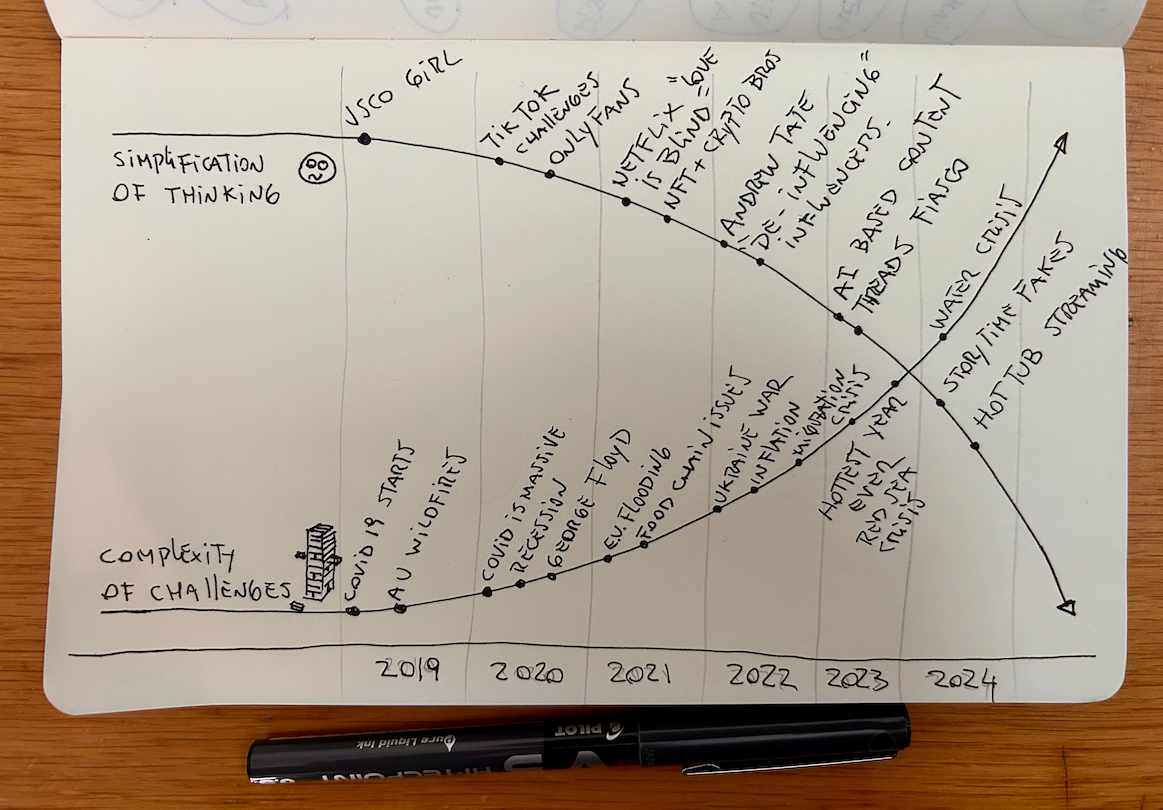
We are treated as dumb fishes trying to understand which prey is worth pursuing, increasing the noise, polluting our brains.
Research by the Nielsen Norman Group, based on eye-tracking studies of thousands of users, confirms what most people already do intuitively: when reading text online, people scan. They move quickly across headlines, pause at what interests them, skip what doesn't. This is not laziness — it is rational information-seeking behaviour. Newspaper design has exploited this for over a century, placing the most important information first, structuring content so the decision to read deeper is made at each step.
Video offers none of this. You commit first; you evaluate later.
What Streamed.News does
For each video, Streamed.News identifies the moments worth your time — the specific segments where something new, surprising, or useful was said. Each segment is written up as a short journalistic piece: a headline, two paragraphs, a direct quote, and a timestamp link back to the exact moment in the original video.
The result is something you can scan in two minutes. If a segment catches your attention, the link takes you directly there — not to the beginning of a two-hour video, but to the moment itself. You decide whether to go deeper, not before.
The editorial judgment — which segments matter, which don't — is human. The original ideas belong entirely to the creators. Streamed.News is a surface, not a substitute.
A traditional answer to a modern problem
There is something worth noting about the form. The newspaper was not designed arbitrarily. Decades of reader research shaped the inverted pyramid structure, the section front, the headline hierarchy. These conventions exist because they match the way people actually process information — quickly, selectively, non-linearly.
The internet largely discarded those conventions in favour of feeds, autoplay, and algorithmic recommendations. Streamed.News borrows them back. Not out of nostalgia, but because they work.
Simon's observation from 1971 is now the central tension of the digital age. The answer is not more content. It is better navigation.
That is what this site is for.
This site is the product
What you just read is not a description of a tool — it is the output of one. Every article on Streamed.News is generated by the same pipeline we offer to publishers and media organisations. The editorial judgement (what matters, what doesn't), the source links, the structured summaries — all of it runs on the same system, on a publication you own and control.
If you publish or aggregate video content and want to turn it into a readable, searchable publication your audience actually engages with — see how the service works →