🌐 Lee esto en Spanish →
Original source: Marcos Ruperez Cerqueda
This article is an editorial summary and interpretation of that content. The ideas belong to the original authors; the selection and writing are by Streamed.News.
This video from Marcos Ruperez Cerqueda covered a lot of ground. 6 segments stood out as worth your time. Everything below links directly to the timestamp in the original video.
Should decisions defining a continent's energy future be based on the vision of engineers or the expectations of financial markets? This analysis raises a crucial question about who holds the real power in the energy transition.
Expert Warns European Energy Decisions Driven by Investors, Not Engineers
Antonio Turiel, an energy researcher and expert, argues that major decisions regarding energy projects in Europe, such as hydrogen and biomass plans, are not made by engineers with technical expertise but by investors or politicians. This dynamic, according to Turiel, leads to what he describes as financial 'windfalls' without a solid technical foundation, resulting in nonsensical plans disconnected from reality. Turiel criticizes the disconnect between political ambition and technical reality, illustrating how Spain's National Integrated Energy and Climate Plan (PNIEC) does not align with the actual decline in electricity consumption since 2008. He advocates for a more 'humble and realistic' approach to avoid an energy collapse, instead of pursuing large-scale projects without validating their long-term viability.
"Those plans are never designed by an engineer. They are designed by an investor... who doesn't have a clue."
▶ Watch this segment — 1:22:28
Europe Seeks to Turn Southern Regions into Energy 'Sacrifice Zones,' Says Antonio Turiel
Antonio Turiel, an energy expert, asserts that Europe is disoriented and isolated in its renewable energy transition strategy. According to his analysis, the continent has begun to lower its own environmental targets while heavily investing in biogas and biomass through processes he deems inefficient and polluting. Turiel argues that this strategy intends to transform Southern Europe, particularly Spain, into 'sacrifice zones.' In these areas, cheap gas and fuels would be mass-produced using resources like biomass inefficiently and contaminatively, with the goal of supplying the rest of the continent, at the expense of local territorial degradation.
"What Europe wants is to turn Southern Europe, and Spain in particular, into sacrifice zones to produce cheap biogas and fuels for the rest of the continent."
Expert Warns of European 'Colonial Wars' Plans in Africa to Secure Resources
Antonio Turiel, an energy researcher, suggests that Europe, aware of its limited natural resources and lesser military power compared to other major players, is contemplating a geopolitical strategy that would include 'colonial wars' in North Africa. These conflicts, it is speculated, would primarily aim to secure access to vital resources in countries like Algeria, Libya, and Niger. Simultaneously, Turiel argues that Europe seeks to convert southern nations, such as Spain, into 'sacrifice zones' to produce energy through biogas and biomass via inefficient processes, leading to the degradation of their territories. This dual plan would reveal a desperate European strategy for energy security, willing to externalize human and environmental costs.
"Europe's plan clearly contemplates colonial wars in North Africa to secure resources, while converting southern countries like Spain into sacrifice zones to produce energy with biogas and biomass through inefficient processes."
Prime Ministers in Davos Admit Global Fracture: 'One Thing Is to Be a Content Vassal, Another Is to Be an Unhappy Slave'
Antonio Turiel comments on the speeches by the Prime Ministers of Canada and Belgium at the World Economic Forum in Davos, where they acknowledged that the world has entered a phase of 'rupture.' According to their statements, this new era is characterized by the unilateral imposition of criteria by the United States, breaking with the previous fiction of stability and multilateralism. The Belgian Prime Minister, in particular, summarized Europe's precarious situation with a forceful statement: 'One thing is to be a content vassal, another is to be an unhappy slave.' This declaration underscores growing frustration and the perception of diminished European sovereignty, revealing the discontent of some leaders with the current global power dynamic.
"One thing is to be a content vassal, another is to be an unhappy slave."
Expert Warns of 'Technically Unfeasible' Biogas Plans Driven by Investors
Antonio Turiel vehemently criticizes inflated biogas production estimates in Europe, arguing they are 'technically unfeasible.' He explains that the low conversion fraction of organic matter to methane and the enormous logistical and performance challenges involved in scaling up industrial production make these plans devoid of engineering sense. Turiel compares the situation to problems experienced by Gamesa and the wind industry when attempting to rapidly increase wind turbine power without proper learning and testing phases. He emphasizes that these major energy decisions are not made by engineers but by investors who, oblivious to technical and scaling complexities, promote unsustainable projects seeking financial 'windfalls'.
"Those plans are never designed by an engineer. They are designed by an investor... who doesn't have a clue."
▶ Watch this segment — 1:15:07
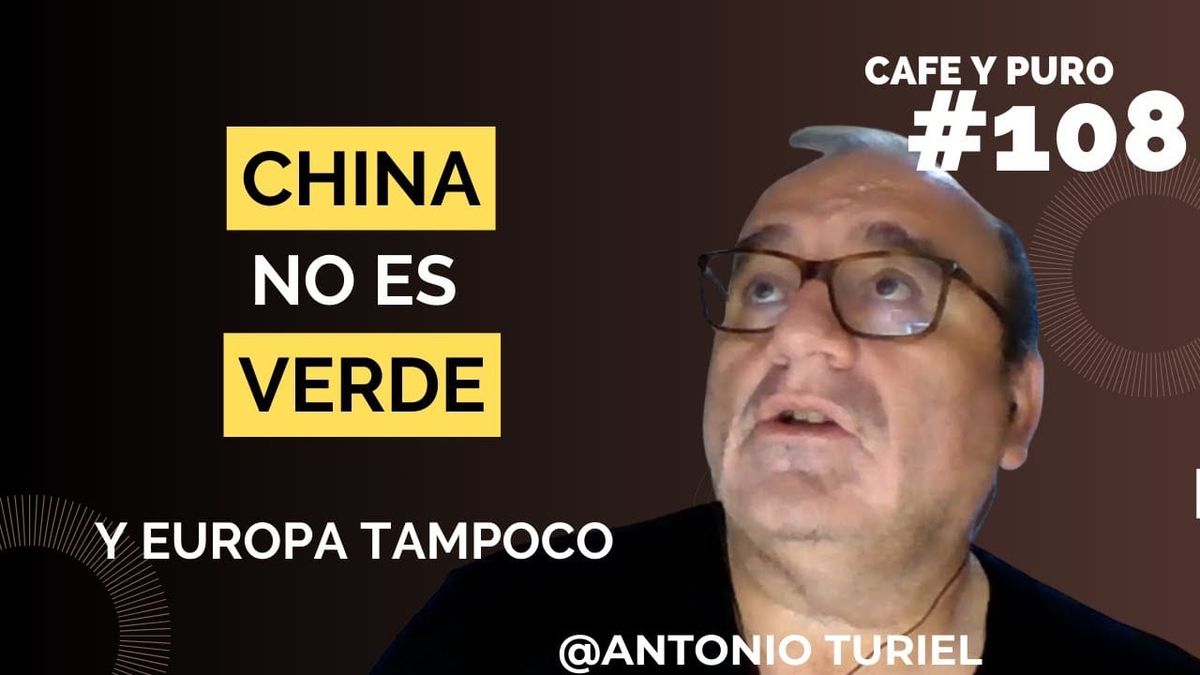
China Still Relies on Coal for 60% of its Energy Despite Renewable Investment
Antonio Turiel explains that despite its massive efforts and investments in renewable energy, China is not achieving a 'true' energy transition, as 60% of its total energy consumption still comes from coal. This mineral is crucial not only for electricity and heat production but also for intensive industrial processes like photovoltaic panel manufacturing and the chemical industry. The inherent intermittency of renewable sources, such as solar and wind, which do not always generate energy on demand, forces China to continue building coal-fired power plants to ensure the stability of its electricity supply. Although coal's percentage share has slightly decreased from 65% to 60%, its absolute consumption volume remains enormous, revealing the difficulty of decarbonizing a growing economy.
"Sixty percent of China's total energy consumption is coal. The main problem [with renewables] is that sometimes they produce, and sometimes they don't."
Also mentioned in this video
- Europa está desorientada en su transición energética, con una apuesta fallida… (0:00)
- El tema del Foro de Davos, leyendo un resumen sobre el cambio en el mensaje del… (2:42)
- Cómo Estados Unidos está adoptando un enfoque de poder duro e imperialista,… (4:53)
- Antonio Turiel discute la errónea percepción occidental de Rusia y China,… (8:14)
- Marcos y Antonio Turiel discuten si Alemania mantendrá su poder hegemónico en… (18:20)
- Antonio Turiel explica que Alemania ya no es competitiva industrialmente con… (22:53)
- Antonio Turiel critica el uso de purines para biogás, calificándolo de absurdo… (28:02)
- Antonio Turiel analiza los "combustibles orgánicos" de Repsol, diferenciándolos… (32:09)
- Marcos y Antonio Turiel discuten la inversión de Bill Gates en centros de datos… (39:02)
- Antonio Turiel expresa escepticismo sobre la burbuja de la inteligencia… (41:52)
- Antonio Turiel critica la desorientación de Europa, su falta de líderes con… (46:01)
- Antonio Turiel explica la división entre las élites económicas (industrialista… (48:50)
- Antonio Turiel discute que las élites europeas están desorientadas porque han… (53:05)
- Antonio Turiel plantea que Europa necesita prepararse para la escasez de diésel… (1:01:20)
- Antonio Turiel enfatiza que Europa debe asegurar un mínimo de recursos y… (1:09:51)
Summarised from Marcos Ruperez Cerqueda · 1:28:33. All credit belongs to the original creators. Streamed.News summarises publicly available video content.
Streamed.News
This publication is generated automatically from YouTube.
Convert your full video library into a digital newspaper.
Get this for your newsroom →