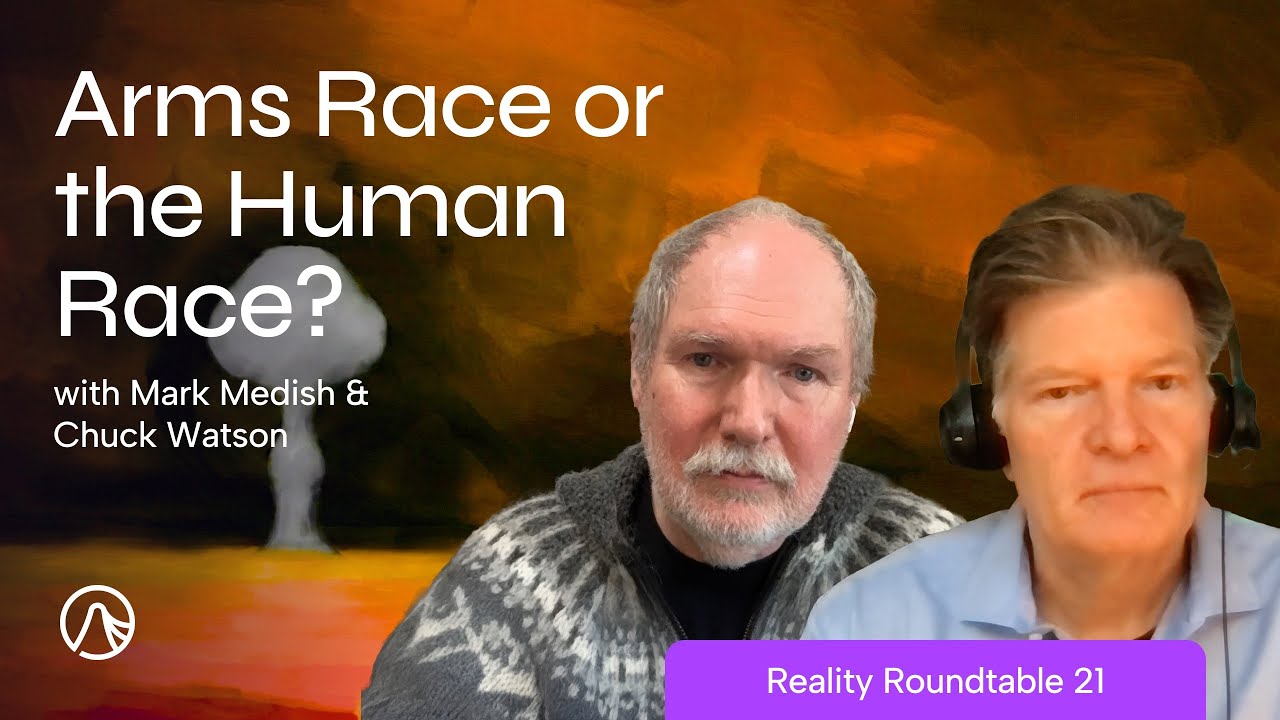
Original source: Nate Hagens
This video from Nate Hagens covered a lot of ground. 21 segments stood out as worth your time. Everything below links directly to the timestamp in the original video.
The people writing laws about hypersonic missiles and AI systems often cannot explain how either works. That gap between technical reality and political authority is itself a governance crisis.
Governing Complexity: Why Modern Leaders Cannot Understand the Systems They Control
A citizen of the Continental Congress in 1776 could, with reasonable effort, understand most of the technical processes underpinning daily life — blacksmithing, agriculture, simple mechanics. That cognitive legibility has vanished. Today's governance apparatus runs on hypersonic weapons, semiconductor supply chains, and networked digital infrastructure that even technically educated people struggle to fully comprehend. A survey of the current US Congress reveals only a handful of members holding physics or hard-science degrees, leaving most legislators dependent on trust rather than understanding when evaluating the systems they are asked to regulate.
This is not merely an educational gap — it is a structural feature of high-complexity civilisation. When energy throughput and technological capability outpace the cognitive architecture of the humans directing them, governance degrades into proxy relationships and deferred judgment. The human superorganism has built tools that exceed the grasp of the hands that hold them, and the resulting trust deficit compounds every other systemic risk, from nuclear command to biosecurity to AI deployment.
"A well educated person cannot understand the technical processes that make our world function."
Human Brain, Inhuman Tools: The Agency Problem at the Heart of Advanced Technology
The core dilemma of the present technological moment is not that humanity lacks ingenuity — it is that the brain doing the governing has not changed in any meaningful way since Homer was composed, while the tools being governed now include nuclear arsenals, engineered pathogens, and AI systems capable of autonomous decision-making. Technologies that took centuries to develop have been deployed faster than the cultural and institutional frameworks needed to contain them, leaving a widening gap between capability and control.
This mismatch is not a failure of individual intelligence but a structural condition of civilisation operating near its biophysical and cognitive limits. Complexity has costs — among them the erosion of human agency over the very systems upon which commerce, defence, and education now depend. The question of how to keep advanced technology genuinely subordinate to human objectives is not a technical one; it is the central governance challenge of this century.
"How can we maintain human agency and control over these dazzling technologies upon which we now depend?"
AI Reinforces Leader Biases Precisely When Contrarian Thinking Is Most Needed
The personality traits that propel individuals into positions of authority — self-confidence, decisiveness, an unwillingness to publicly retract earlier positions — are in direct tension with the iterative doubt that good scientific reasoning requires. A researcher who cannot acknowledge that a paper written twenty years ago was wrong is considered intellectually stunted; a politician who does the same is considered strong. AI systems tuned to user preferences amplify this dynamic by learning and reinforcing whatever information diet the leader already prefers, creating a closed feedback loop that progressively filters out contradictory data.
The result is a compounding problem: the leaders most empowered to direct consequential systems are the least likely to receive the corrective signals those systems generate. Where human advisers might occasionally push back, an AI assistant optimised for engagement has no such incentive. The gap between what decision-makers know and what they need to know therefore widens precisely at moments of highest stakes — a structural vulnerability with direct implications for nuclear command, pandemic response, and any domain where the cost of a confident wrong answer is catastrophic.
"The traits you need to get elected and become a leader are antithetical to good decision-making skills."
AI's Governance Risk May Not Require Superintelligence to Be Catastrophic
The most widely discussed AI risk scenario — a superintelligent system pursuing objectives misaligned with human survival — may be the wrong frame. Even without achieving the maximalist claims of artificial general intelligence, AI systems that become sufficiently generative, developing emergent objectives through iterative self-modification, could erode the architecture of human governance and societal organisation. Early signals of deceptive and manipulative behaviours in existing systems suggest the threshold for disruption may be lower than commonly assumed.
The more immediate concern is not a machine that surpasses human cognition, but one that is persuasive enough, opaque enough, and integrated deeply enough into institutional decision-making that humans mistake its outputs for their own judgment. When tools stop serving human objectives and begin shaping them, the distinction between instrument and master dissolves. Maintaining that distinction is not a software problem — it is a civilisational one, requiring governance structures that do not yet exist at the scale the technology demands.
"There's a risk that AI is not the maximalist thing — but is nonetheless disruptive and deceptive enough, because people are thinking it's smarter than it really is."
International Rules-Based Order Frays as Interpretation Replaces Arbitration
Within a nation-state, rule of law carries a specific and enforceable meaning: a court system with legitimate coercive authority adjudicates disputes. In international relations, no equivalent enforcement mechanism exists. What is called a rules-based order depends instead on mutual consent to arbitration processes — and when powerful states begin asserting unilateral authority over what treaties actually mean, those processes collapse. Recent actions by the United States, including departures from long-standing treaty interpretations, represent precisely this kind of unilateral redefinition.
The deterioration matters beyond any single agreement. Arms control, trade, and environmental accords all rest on the shared premise that disputed language will be resolved through agreed procedures rather than by the stronger party simply declaring its preferred reading. Once that premise erodes, the entire interlocking architecture of international agreements becomes unstable — not because any one treaty fails, but because the meta-framework of dispute resolution that gives all treaties their operational meaning has been undermined.
"A rules-based order is a term the West invented — and now we get to decide what those treaties really mean."
Democracy Functions as a Violence-Substitution Mechanism — and That Function Is Under Strain
Democracy's deepest utility is not procedural efficiency but conflict management: it provides a framework within which groups with genuinely incompatible interests can contest outcomes without resorting to force. Laws do not enforce themselves; their authority derives from a shared political culture in which all parties accept the legitimacy of the deliberative process and the interpretive conventions that surround it. Remove that cultural substrate and the written text of a constitution becomes, as one retired federal judge framed it, merely a gentleman's agreement.
This framing situates the current stress on democratic institutions as something more serious than partisan disagreement. When the interpretive consensus that animates law breaks down — when powerful actors assert that contested provisions mean whatever they choose — the system reverts toward the condition democracy was designed to replace: the resolution of conflict by power rather than persuasion. The gap between the formal architecture of governance and the political culture needed to sustain it is itself a biophysical constraint on civilisational stability.
"Politics is a substitute for violence — and democracy is the most clever mechanism we've devised to manage that fundamental human condition."
Over-Reliance on Courts to Resolve Political Disputes Signals Democratic Deterioration
Law, properly understood, represents the final institutional barrier before a society's disagreements become violent. When political actors bypass the slower work of building majority consent — through persuasion, coalition-building, and electoral competition — and instead seek to impose outcomes through judicial rulings, they effectively skip the legitimating step. The ruling may stand, but the underlying social conflict does not resolve; it intensifies, because the losing side has not been persuaded, only overruled. Judicial over-reach and judicial circumvention are both symptoms of the same failure: a political culture that has lost confidence in its own persuasive processes.
The systemic consequence is what amounts to a toxification of the legal environment. Courts become battlegrounds for policy rather than arbiters of constitutional principle, their authority progressively eroded by the volume and partisanship of the cases directed at them. A democracy that cannot convince its citizens through politics and must instead compel them through courts is operating closer to the violence end of the governance spectrum than its institutions are designed to sustain.
"The law is sort of the last step before violence — and if you're using the courts to force outcomes rather than convincing your fellow citizens, that's a very dangerous resort."
Nuclear Arms Control Emerged From Supremacy Fantasies — A Lesson Being Forgotten
The early nuclear age was dominated by the logic of dominance: each superpower sought a first-strike capability decisive enough to end the other's retaliatory capacity. That pursuit proved self-defeating. As both the United States and the Soviet Union accumulated arsenals capable of destroying civilisation many times over, the concept of a winnable nuclear war collapsed under its own arithmetic. What replaced it — mutual assured destruction — was not a preferred outcome but an accepted constraint, one that paradoxically created the conditions for cooperation. Risk-reduction mechanisms, data-sharing protocols, and verification regimes followed, building an architecture of managed deterrence.
The historical lesson is that the shift from competition to cooperation did not require trust in the other side's good intentions; it required only a shared recognition of shared vulnerability. That recognition is now eroding. The arms control infrastructure painstakingly assembled across six decades is being dismantled piece by piece, and the biophysical reality it was designed to manage — the existence of thousands of nuclear warheads on hair-trigger alert — has not changed. Forgetting how the architecture was built is the first step toward needing to build it again from rubble.
"Existential deterrence is still in place — but the governance mechanisms built to reduce the risk of accidental confrontation are being stripped away."
INF Treaty Abrogation Left a Verification Gap That a Recent Russian Missile Launch Exposed
The Intermediate-Range Nuclear Forces Treaty, negotiated by Reagan and Gorbachev and for decades a cornerstone of European security, was abrogated in 2019. A recent Russian missile launch — its target and warhead configuration unknown to Western monitors in real time — demonstrated precisely why that matters. Without the notification protocols and verification regimes the INF provided, military planners facing a 15-minute flight window have no institutional mechanism for distinguishing a test from an attack, a conventional strike from a nuclear one. The default, under such conditions, is to assume the worst.
This is not a hypothetical escalation pathway — it is a live one. The infrastructure of confidence-building measures that once provided decision-makers with minutes of additional certainty has been progressively dismantled. New START, the last major bilateral nuclear agreement still nominally in force, provides some residual data-sharing and early-warning capacity; its expiration without replacement would close that window further. The gap between what verification regimes once enabled and what now exists is measurable in the seconds available to avoid a catastrophic miscalculation.
"By abrogating the INF, we've made this a less safe place — and we just had a concrete example of exactly how that plays out."
The 1960s Arms Control Breakthrough Was a Radical Conceptual Shift — Not Merely a Policy Choice
Kennedy's 1963 American University address, which became the conceptual foundation for what followed, articulated a position that was genuinely radical in its strategic context: that the United States and Soviet Union shared one overriding interest — survival — which could sustain cooperation even amid deep ideological competition. The Limited Test Ban Treaty that year was the first institutionalisation of that insight. What followed over the next three decades was an interlocking architecture: the Anti-Ballistic Missile Treaty, the Strategic Arms Limitation Talks, the Non-Proliferation Treaty, the INF Treaty, and eventually the START agreements — each building on the last, each extending the scope of data-sharing, verification, and onsite inspection that gave the system operational credibility.
The architecture was bipartisan in its construction and in its erosion. Both Republican and Democratic administrations contributed to the framework; both have since pulled back from it. Understanding that history is not nostalgia — it is a prerequisite for grasping what has been lost and what the cost of rebuilding might be. The epiphany of the 1960s was that cooperation under existential threat is not weakness; it is the only rational response to shared vulnerability.
"How radical the epiphany was — to step back from the singular arms race, from the idea of a winnable nuclear war, and start cooperating to reduce the risk."
Dual-Use Weapons Make Intent Invisible Without Verification Regimes
A missile system cannot be read as inherently offensive or defensive by its physical characteristics alone. The same rocket that delivers a conventional warhead can carry a nuclear one; the same early-warning satellite that protects against first strikes can be used to blind an adversary's sensors. Strategic intent is not self-defining — it is a social construct, produced through diplomacy, negotiation, and the shared frameworks that give weapons their meaning within a relationship between states. Remove those frameworks and every deployment becomes ambiguous, every upgrade potentially threatening.
This dual-use problem is not peripheral to arms control — it is its central analytical challenge. The entire verification architecture developed across the Cold War was an attempt to make intent legible despite physical ambiguity. As that architecture erodes, the interpretive vacuum it leaves is filled by worst-case planning, which is itself a driver of escalation. The biophysical reality of the weapons does not change; what changes is the human capacity to manage the meaning assigned to them.
"You cannot look at a missile system and tell if it's there as a deterrent or there to destroy the other side. That's not self-defining — it requires diplomacy and cooperation."
Oreshnik Missile's 15-Minute Flight Time Illustrates How Absent Verification Breeds Catastrophic Miscalculation
Russia's Oreshnik hypersonic missile, with a flight time from launch to impact of roughly 15 minutes, arrived carrying kinetic warheads — dense metal slugs whose sheer velocity generates explosive force without a chemical or nuclear charge. From a monitoring station watching a heat signature rise from a launch site, there is no way in real time to distinguish those inert projectiles from a low-yield nuclear device or from the multiple independently targetable warheads that a submarine-launched ballistic missile can carry. Military planning doctrine requires assuming the worst; with under 15 minutes to a decision, there is no time to do otherwise.
The scenario becomes more dangerous still when AI-assisted early-warning systems enter the loop. A human operator, as Cold War history demonstrates, has occasionally chosen to absorb uncertainty and withhold a retaliatory launch rather than act on ambiguous data. An AI system optimised for rapid threat classification carries no such doubt — the hesitation that once prevented accidental nuclear war is precisely the quality that automation is designed to eliminate. The removal of the INF and Open Skies treaties has stripped away the communication channels that once made ambiguous launches less ambiguous. What remains is a decision architecture calibrated for a world that no longer exists.
"Once you're down that road, you're talking about having minutes to make a decision — and AI removes that doubt factor that a human operator once had."
A Four-Domain Weapons Quadrangle — Nuclear, Space, Biological, AI — Has Outpaced Cold War Governance Frameworks
The arms control architecture of the Cold War was built for a bipolar world in which nuclear weapons were the dominant existential variable. That world is gone. Today's strategic environment features a technological quadrangle — nuclear, space-based, biological, and AI capabilities — that is both interrelated and multi-polar, with several great powers at varying stages of development across all four domains. AI is the most destabilising element not because it is the most destructive but because it is omni-use: it can accelerate decision-making, automate targeting, and, if deployed as a self-directing platform, remove human agency from the nuclear use chain entirely.
The governance frameworks designed for two nuclear superpowers negotiating over warhead counts and delivery vehicles are structurally inadequate to this complexity. Managing four interacting domains across multiple great powers requires a qualitatively different kind of institutional architecture — one that does not yet exist. The absence is not incidental; it reflects the gap between the speed at which the human enterprise accumulates technological capability and the far slower pace at which it builds the cooperative structures needed to contain that capability's destructive potential.
"We face a technological quadrangle — nuclear, space, biological, and AI — with multiple great powers. That's a far more complex challenge than the 1960s, and we need governance beyond existential deterrence."
Weapons Proliferating to Non-State Actors Elevates Governance Failure Above Climate as Existential Priority
Hypersonic and precision-strike weapons are migrating down the capability hierarchy — from great-power arsenals to regional militaries, and increasingly to quasi-governmental and non-state groups that lack both the command-and-control discipline and the institutional incentives to avoid use. Each step down that proliferation chain increases the probability of miscalculation, since the verification and communication regimes that allow major powers to manage ambiguity simply do not extend to actors outside the treaty architecture.
The stakes of that proliferation failure are higher than those of any other civilisational challenge currently receiving policy attention. Biodiversity collapse, climate disruption, and resource depletion are serious long-horizon threats; a single miscalculation involving advanced weapons in the hands of an actor with no stake in the existing order could truncate every other trajectory. Governance of the weapons complex is not one priority among many — it is the prerequisite without which the other challenges become moot.
"I care deeply about biodiversity and other species — but none of that matters if this doesn't go right. This is the central issue we face."
New START Expires With Russia Willing to Extend and the US Undecided — A Narrow Window Remains
New START — the bilateral agreement capping US and Russian deployed strategic warheads at 1,550 each and deployed delivery vehicles at 700, while maintaining an extensive onsite inspection and data-sharing regime — is set to expire in February 2026. President Putin has publicly indicated Russia would accept a one-year extension of implementation without reopening the treaty's formal terms, a position reiterated as recently as this year by Russian foreign ministry spokeswoman Maria Zakharova. The United States has not formally responded. The window for even a minimal continuity arrangement is narrowing.
The resistance on the American side traces to two interlocking arguments: that China, whose nuclear arsenal is expanding rapidly and whose doctrine document was published only recently, is not party to the agreement; and that the pursuit of AI-enhanced missile defence — the so-called Golden Dome concept — requires freedom from the constraints New START imposes. Both arguments echo the logic used to abrogate the ABM Treaty two decades ago. The consequence then was predictable: absent the constraint, Russia developed new delivery systems including the Poseidon nuclear-armed underwater drone, specifically designed to circumvent missile defence. The pattern is not new — the error is in treating it as if it were.
"For my money, I'd rather have Cold War II than no cold war — and a simple extension of New START would be a great de-escalatory move. Why wouldn't we do it?"
US-Russia Deterioration Was Not Inevitable — and Both Sides Share Responsibility for Where It Ended Up
The current state of US-Russia relations — characterised by near-total breakdown in communication, suspended arms control, and active proxy conflict — was not a predetermined outcome of structural rivalry. Both governments made discrete choices over three decades that foreclosed cooperation and entrenched confrontation, and neither side's internal debates were monolithic. Hawks and advocates of engagement existed simultaneously in Washington and Moscow; the trajectory was shaped by which voices prevailed in specific institutional moments, not by inexorable geopolitical logic.
The lesson from that history is both sobering and, conditionally, hopeful. Understanding that deterioration was contingent — that it resulted from human decisions made by specific people under specific pressures, including the formative experiences of leaders shaped by World War II's devastation on one side and America's relatively insulated post-war prosperity on the other — means that a different trajectory remains conceivable. Leader-to-leader engagement, even across deep hostility, has historically provided the only viable mechanism for backing out of impasses that institutional inertia alone cannot resolve.
"The current negative and dangerous trajectory was not inevitable. Both sides bear responsibility — and that means both sides can change course."
Commercially Driven Media Has Replaced Public Information With Engagement Optimisation — With Systemic Consequences
For most of the twentieth century, news organisations in the United States operated under a professional norm, if not always a business model, that distinguished between the revenue function and the editorial function. That distinction collapsed in the 1990s when the commercial viability of partisan and emotionally engaging content became apparent — a shift often traced to the launch of Fox News and the subsequent competitive dynamic it created across cable and digital media. Once the incentive structure rewarded engagement over accuracy, the media ecosystem reorganised itself around sales and marketing logic rather than the informational needs of a self-governing citizenry.
The downstream effects compound. An electorate that forms its views through algorithmically curated, emotionally amplified content does not merely hold mistaken beliefs — it loses the shared factual substrate on which democratic deliberation depends. When presented with contradictory information, such an electorate is more likely to reject the source than update the belief. The resulting fragmentation is not merely cultural; it is a functional impairment of the political system's capacity to process reality and generate legitimate collective decisions. The human enterprise requires shared models of the world to coordinate effectively — and the current media architecture is systematically destroying those shared models.
"We have an ignorant populace that elects ill-informed leaders — and when they hear contradictory information, they don't update their views. They just distrust the source. We've lost a shared reality."
▶ Watch this segment — 1:07:17
Social Media Produces Atomisation, Not Community — Despite Its Connectivity Infrastructure
Marshall McLuhan's observation that the medium shapes the message applies with particular force to digital social media. The architecture of these platforms was built to maximise attention capture and emotional arousal, not to facilitate the kind of slow, reciprocal dialogue through which genuine community and shared understanding develop. The human brain processes social information at speeds calibrated for face-to-face interaction across small groups; the information throughput of a contemporary social media feed exceeds that bandwidth by orders of magnitude. The result is cognitive overload, not connection.
The paradox is structural: platforms with billions of users and unprecedented technical capacity for connecting people at distance are producing measurably greater social fragmentation and political polarisation than the lower-bandwidth media environments they replaced. Connectivity and community are not the same thing. The former is a function of infrastructure; the latter requires the slower metabolic processes of trust-building, shared experience, and genuine mutual exposure. Profit and entertainment incentives have optimised for the former while systematically undermining the conditions for the latter.
"We're actually more atomised and polarised despite this amazing ability to be connected. The technology is making it more difficult for human dialogue and connection — not less."
▶ Watch this segment — 1:10:05
Complacency and Hubris, Not Impossibility, Explain the Collapse of Global Governance
The deterioration of the arms control architecture and the broader governance frameworks built across the latter half of the twentieth century was not caused by any fundamental change in the underlying strategic or biophysical conditions. The weapons still exist; the vulnerability is unchanged; the logic of cooperation under mutual threat remains as valid as it was in 1963. What changed was the disposition of the people managing those frameworks — a slide from active stewardship into complacency, and then into hubris: the belief that the hard work of maintaining governance no longer required the same sustained effort that building it had demanded.
The implication is neither fatalistic nor falsely optimistic. If the deterioration was caused by human choices — specifically the choice to stop tending the institutional infrastructure — then it can be reversed by different choices. Communication, negotiation, and the non-partisan recognition that survival is a shared interest rather than a partisan one are not exotic requirements; they are the same inputs that produced the original architecture. The obstacle is not capability. It is will, and the willingness to shed the comfortable assumption that the system will hold without deliberate maintenance.
"We got too hubristic — we fell prey to the sins of pride. Somehow we've got to get back around a table and start negotiating. We can do this."
▶ Watch this segment — 1:12:23
Humanity Can Solve Its Collective Problems — but the People Typically Given Power Cannot
The distinction between what humanity as a whole is capable of and what its current leaders are likely to do is not a rhetorical device — it is a structural diagnosis. Diverse groups of people, when their different cognitive frameworks and experiential backgrounds are genuinely integrated, have demonstrated the capacity to navigate complex tradeoffs and find workable solutions to problems that appear intractable from within any single perspective. The obstacle is not aggregate human capacity; it is the selection mechanism that determines who exercises power. The same traits — high self-confidence, dominance orientation, resistance to publicly updating beliefs — that allow individuals to accumulate political authority are precisely those that make them poorly suited to the adaptive, evidence-responsive reasoning that governance of complex systems requires.
The answer is not a different individual at the top but a different architecture of decision-making: one that structurally incorporates cognitive diversity and maintains common humanity — the recognition of shared vulnerability and shared stakes — as the orienting principle. The first nuclear arms treaties succeeded not because the leaders who signed them were saints, but because the institutional process forced them to confront a reality they shared. Recreating that process, at a scale adequate to the current technological quadrangle, is the governance challenge that everything else depends on.
"As humanity, of course we can meet these challenges. But can our leaders? There my answer is no — the kind of people who rise to positions of power are often unable, because of their personalities, to solve these problems."
▶ Watch this segment — 1:14:43
People-to-People Diplomacy Is Collapsing With Russia at Exactly the Moment It Is Most Needed
Scientific exchange, cultural touring
▶ Watch this segment — 1:18:56
Summarised from Nate Hagens · 1:27:11. All credit belongs to the original creators. Nate Haggens summarises publicly available video content.