🌐 Lee esto en Spanish →
Original source: Marcelo Longobardi
This article is an editorial summary and interpretation of that content. The ideas belong to the original authors; the selection and writing are by Streamed.News.
This video from Marcelo Longobardi covered a lot of ground. 6 segments stood out as worth your time. Everything below links directly to the timestamp in the original video.
When a European ally who publicly backed Trump just weeks ago tells him today that he is heading toward another Vietnam-style defeat, something has broken within the Western coalition. Merz's reversal is not an isolated episode — it is a symptom of how far the United States' position in the Middle East has deteriorated.
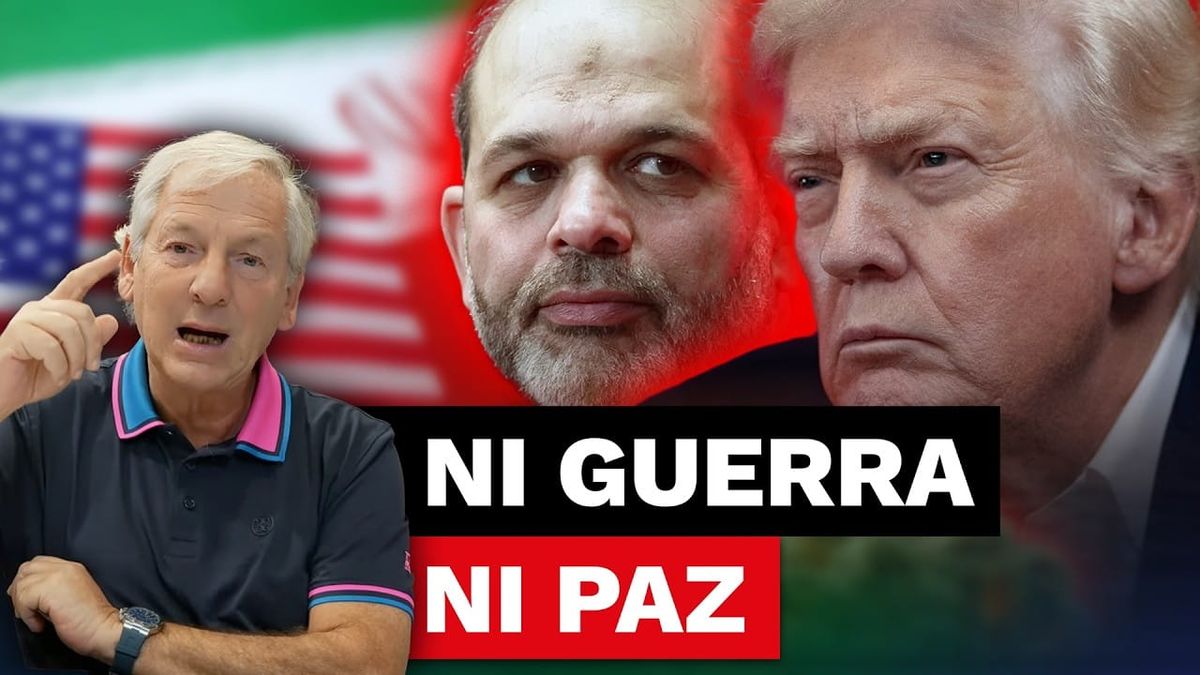
German Chancellor Merz accuses Trump of humiliation in Iran as Putin emerges as mediator
Negotiations between Iran and the United States have reached a stalemate that the New York Times described as "neither war nor peace," according to journalist Erika Solomon. The Strait of Hormuz remains blocked, oil prices continue to climb, and Argentine diplomat Carlos Pérez Lana — quoted this morning in Clarín — argues that real power in Tehran no longer lies with the clerics but with the Revolutionary Guard, and that no viable military solution to the conflict exists.
The most disruptive political development came from German Chancellor Friedrich Merz, who weeks ago visited the White House to express his support for Trump but yesterday made a dramatic about-face: he declared that the United States is being humiliated in Iran and warned that the absence of an exit strategy could lead to disasters comparable to Afghanistan or Iraq. The sense is that Merz's reversal, combined with Putin's emergence as a possible new guarantor in the conflict, has completely reshuffled the diplomatic landscape.
"The United States is being humiliated in Iran."
▶ Watch this segment — 1:12:35
Confidence in Milei's government drops 12% in monthly Di Tella University index
The government confidence index compiled monthly by Di Tella University registered 2.02 points on a scale of 0 to 5 in April, a 12% drop from the March reading. The average for Milei's administration so far stands at 2.42, placing the current reading half a point below that historical benchmark. For context: the highest average among all presidents tracked since Néstor Kirchner belonged to Kirchner himself, at 2.49; Macri averaged 2.27, and Alberto Fernández finished with the worst record in the series.
The decline correlates directly with consumption data: consultancy Sentia recorded a 5.1% year-on-year drop in March, the third consecutive month in negative territory. Whether this combination of falling consumption and falling confidence marks a trend or a temporary setback remains to be seen, but the sharply downward curve in the final stretch of the chart leaves little room for optimistic readings at this stage.
Iran offers to reopen Hormuz in exchange for keeping its nuclear program off the table; Trump rejects the proposal
Iran put forward a proposal to lift the blockade of the Strait of Hormuz as a gesture of de-escalation, but on the condition that its nuclear program remain outside any negotiation, according to Madrid-based newspaper ABC. Trump rejected the offer. Against that backdrop, the Iranian foreign minister met with Vladimir Putin in St. Petersburg — a photograph reproduced by La Nación and widely circulated worldwide — in what is presumably an attempt to bring Russia in as a guarantor of Iran's stockpile of enriched uranium, estimated at more than 400 kilograms, replacing Pakistan's failed mediating role.
Meanwhile, Israel expanded its strikes on Lebanon despite Trump's earlier proclamation that he had halted that front, and the United Arab Emirates launched a digital censorship drive — blocking websites and media accounts — amid fears that regional instability could harm a country whose economy depends heavily on mass tourism, with 110 million visitors a year in Dubai alone.
▶ Watch this segment — 1:22:01
Amnesty International submits report to IACHR on deteriorating press freedom in Argentina
On April 27, 2026, Amnesty International formally submitted a document to the Inter-American Commission on Human Rights denouncing the harassment, stigmatization, and criminalization of journalists in Argentina under the Milei government. The report, described as extensive and technically rigorous, catalogues a mounting pattern of official pressure against the press. This comes as the government maintains a ban on journalists entering the Casa Rosada, justified by espionage accusations against journalist Luciana Geuna and her reporter — accusations Geuna publicly rejected, taking full editorial responsibility for the report in question.
That an organization of such institutional weight has brought the Argentine case before the IACHR transforms what the government frames as an isolated incident into an international dossier. The sense is that the strategy of labeling journalists as spies carries a diplomatic cost that the administration has yet to fully reckon with.
Consumer spending in Argentina fell 5.1% year-on-year in March, consultancy Sentia reports
Mass-market consumption recorded its third consecutive monthly decline in March, falling 5.1% year-on-year, according to consultancy Sentia. The drop was broad-based: wholesalers fell 8.8%, supermarkets 7%, and independent convenience stores 5%. The sole exception was e-commerce, which grew 34.3% year-on-year — a phenomenon attributed to a structural shift in habits rather than any recovery in purchasing power. Pharmacies posted a modest 0.9% gain.
The data stands in direct contrast to the government's claim that consumption is at record levels, and it correlates with the 12% drop recorded in Di Tella University's government confidence index. Whether growth in the digital channel compensates for the decline or simply displaces physical-channel spending without adding net demand remains an open question.
Argentina's ARCA chief investigated for tax evasion; Central Bank fines ARS Cambios 18 billion pesos and orders closure
Argentina's judicial landscape is accumulating simultaneous flashpoints. Andrés Vázquez, head of the Revenue and Customs Control Agency (ARCA), faces an investigation for allegedly concealing properties in Miami and Buenos Aires and evading taxes — a notable aggravating circumstance given that his agency is responsible for policing exactly those kinds of conduct. In a separate case, prosecutor Franco Picardi summoned former official De Landis to testify over alleged corruption at the National Disability Agency (ANDIS), involving the purported disbursement of approximately 75 billion pesos of public funds to a narrow group of companies. The Central Bank also fined financial firm ARS Cambios — linked to the AFAGate case — 18 billion pesos and ordered it shut down.
Journalist Carlos Pagni suggested in a recent article, as quoted in the broadcast, that currency arbitrage schemes — buying dollars at the official rate and reselling them on the parallel market for gains estimated at up to 1.5 billion dollars — allegedly helped finance not only Sergio Massa's campaign but, in part, Milei's own.
Summarised from Marcelo Longobardi · 2:39:56. All credit belongs to the original creators. Streamed.News summarises publicly available video content.
Streamed.News
This publication is generated automatically from YouTube.
Convert your full video library into a digital newspaper.
Get this for your newsroom →