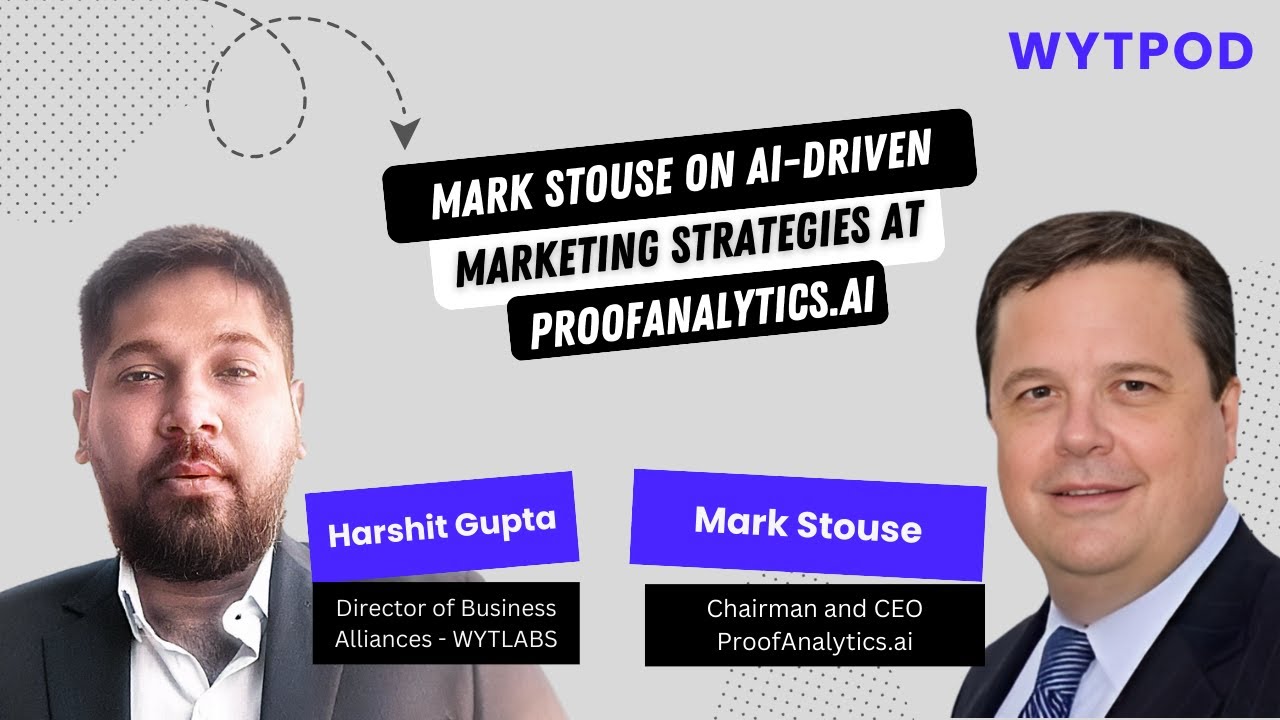
Original source: WYTPod
This video from WYTPod covered a lot of ground. 3 segments stood out as worth your time. Everything below links directly to the timestamp in the original video.
A data platform flagged COVID's effect on corporate events before most companies had heard the word. What Johnson Controls did next reveals how much money most organizations leave on the table by not trusting their own analytics.
Analytics Platform Detected COVID's Market Impact Before Public Awareness, Saving Johnson Controls $3 Million
Between November 2019 and February 2020 — weeks before COVID-19 registered as a public crisis — Proof Analytics began flagging an anomalous, non-seasonal decline in the performance of in-person events for Johnson Controls. The data offered no explanation, only a signal: something was wrong. Trusting that signal, Johnson Controls unwound event contracts early and recovered roughly $3 million. When the pandemic hit in full and finance moved to cut marketing budgets by 40%, the company was able to model the downstream revenue impact of that cut and present it to financial leadership, ultimately limiting the reduction to 15%. At Honeywell, the same analytical system had earlier accelerated average deal velocity by 5% — translating, on a $13 billion revenue base, into a material compression of the cash conversion cycle — while simultaneously expanding average deal size by approximately 30%.
What makes the Johnson Controls case structurally significant is not that analytics predicted COVID, but that it surfaced a causal pattern before anyone had a name for the cause. The real question is whether most marketing organizations have the institutional trust in their own data to act on an unexplained signal — and that gap between analytical capability and organizational confidence is precisely where budget decisions get made badly.
"Finance came to marketing at Johnson Controls and said we're going to cut you 40% — and they were able to model the impact of that budget cut and show it to finance, and finance was like, okay, not doing that, that would not be good for the company."
Proof Analytics Founder: UX for Non-Experts Was Harder to Build Than the Underlying Analytics Engine
Building Proof Analytics required three years of development before its 2019 launch — not because the computational architecture was elusive, but because making that architecture legible to non-data scientists proved far more demanding. An analytics platform, unlike most software products, cannot ship as a minimal viable product: if the system is incomplete, it produces no usable insight, and users walk away before trust is established. The harder challenge was designing screens that allowed a marketing executive with no statistical training to read a result and act on it with confidence. Stouse ultimately confronted a structural problem that is common but rarely named: deep expertise in a subject disqualifies the expert from accurately representing the experience of a novice. The features and interpretive displays that satisfied him consistently failed with test customers, and the gap between his own judgment and theirs was not a signal to override — it was the core product feedback.
This tension sits at the heart of democratizing any specialized discipline. The structural reality is that the moment a founder becomes expert enough to build a sophisticated tool, they lose the cognitive vantage point of the person who needs to use it. Stouse's eventual response — to stop litigating customer reactions and treat them as primary data — reflects a kind of intellectual discipline that runs against the grain of founder psychology, where conviction in a unique insight is simultaneously the fuel for the company and the primary source of blind spots.
"I'm so mature on this subject that I no longer represent our customer base at all — I can help them a lot, but I'm not them."
Proof Analytics Built Its Product Through 22 Paying Early Customers, Including Oracle and Intel
Before refining its platform for the market, Proof Analytics assembled a cohort of 22 early customers — among them Oracle, Intel, several agencies, and smaller businesses — each paying a modest fee that functioned less as revenue than as a structured exchange: money in return for product feedback. Stouse describes this arrangement with a precision worth dwelling on. When a customer delivers critical feedback that contradicts the founder's own view of the product, rejecting that feedback is economically equivalent to refusing payment. The insight reframes what is often experienced as frustrating criticism as a contractual obligation: you have taken their money, which means you have taken on the obligation to hear what they are telling you. What most people miss is that this framing resolves the ego problem not by suppressing it, but by redefining customer feedback as a form of compensation — a category founders are reliably motivated to receive.
The broader dynamic here is structural. Software founders, as Stouse notes, tend to build their conviction around a genuinely original insight, and that conviction is legitimate — it is what drives the company into existence. The problem is that the same conviction, left unchecked, creates a closed feedback loop where incoming information is filtered through the founder's prior thesis rather than allowed to revise it. The 22-customer cohort was effective not merely because of its size, but because the payment relationship created an accountability architecture that made dismissing feedback psychologically costly.
"They were really paying us in product feedback — and so if you reject the insights, you're effectively rejecting the payment. And that's stupid."
Summarised from WYTPod · 35:14. All credit belongs to the original creators. Streamed.News summarises publicly available video content.