🌐 Lee esto en Spanish →
Original source: Fast & Curious
This article is an editorial summary and interpretation of that content. The ideas belong to the original authors; the selection and writing are by Streamed.News.
This video from Fast & Curious covered a lot of ground. 6 segments stood out as worth your time. Everything below links directly to the timestamp in the original video.
Margins in MotoGP have become so razor-thin that an imperceptible variation in tyre pressure can be the difference between victory and obscurity.
In modern MotoGP, tenths of a bar in tyre pressure can decide a race
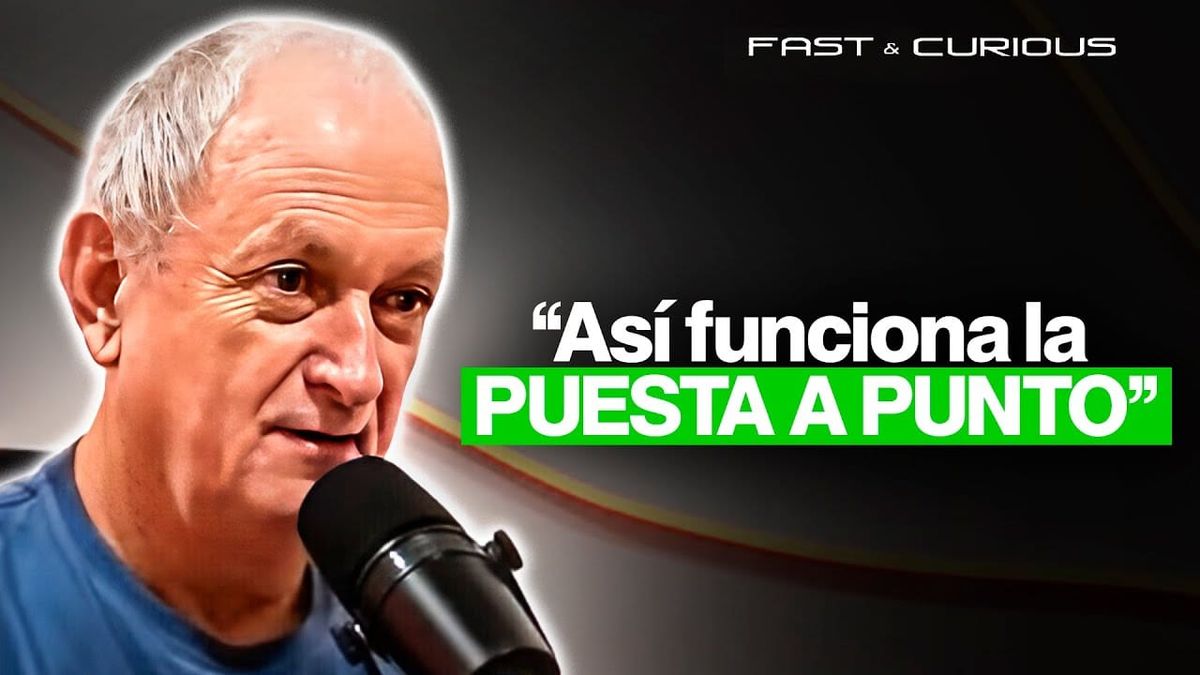
Ramón Forcada, MotoGP technical director, argues that in today's championship there is no technical detail any team can afford to overlook. The optimal pressure window for the front tyre spans just two hundredths of a bar — between 1.85 and 2.05 — and straying outside that range can cost a tenth and a half per lap, enough to lose a race against a rival who has nailed it.
Forcada stresses that communication between rider and engineer is as decisive as any mechanical adjustment. The ideal technical director is not one who receives instructions on which components to stiffen, but one who understands what the rider needs to go faster and translates that need into concrete solutions. In a championship where margins are this tight, that rapport can be just as decisive as the engineering itself.
"We're talking tenths, not hundredths of a bar, and that matters. Anything that's out of place will stop you from winning — that's a certainty."
The front tyre has become the critical limiting factor across all motorcycle racing categories
Ramón Forcada warns that MotoGP has reached a point where the tyre acts as an absolute ceiling: when two riders are simultaneously pushing against that limit, no further bike adjustment can make a difference. Front tyre pressure, which barely warranted discussion a decade ago, has become critical not only in MotoGP but also in Moto2, Moto3 and MotoE, with the optimal operating window sitting between 1.85 and 2.05 bar. Running outside that range translates into hundredths lost in every corner, compounding over a circuit with fifteen braking zones.
The effect is not purely chronometric: when a rider loses confidence in the front tyre, it shows in their lines. Insufficient pressure can turn a rider who once attacked a corner into one who no longer believes in it. In a championship decided by the smallest of margins, that simultaneous psychological and physical factor has become a variable as relevant as engine power.
"The tyre limit is like a wall: there comes a point where it has nothing more to give."
Artificial aerodynamic downforce explains the most spectacular crashes of the season
Ramón Forcada offers the technical explanation behind the most eye-catching accidents fans have witnessed this season. Modern bikes generate artificial load on the tyre through aerodynamic elements that, at high speed, press the machine to the ground with a force far greater than its own weight. The problem arises the instant that force disappears: the bike goes from being firmly planted on the asphalt to relying solely on its own weight, which at those speeds is insufficient to maintain grip, turning the motorcycle into a projectile. Turbulence generated by the bike ahead is a frequent cause of that sudden loss of downforce.
This new physical reality has forced suspension to be redesigned from the ground up. The springs used today are far stiffer than those of a decade ago because they must simultaneously support the rider's weight, the bike's weight, and aerodynamic load. Forcada also notes that aerodynamics is the least exact science in the paddock: unlike material strength, its behaviour varies non-linearly with speed, making it impossible to predict with precision without real on-track testing.
"We've seen crashes that are bone-chilling — riders losing the bike and it just becomes a projectile the moment they lose the force keeping it on the ground."
Forcada dismisses claims that Ducati 'sandbagged' Márquez's bike — it was standard safety protocol
The controversy surrounding Marc Márquez's engine failure had a mundane technical explanation, according to Ramón Forcada. Ducati did not strip performance components from the Spanish rider's bike for competitive or contractual reasons; it simply applied the standard protocol following any mechanical failure — identify which tuning configuration contributed to the breakdown and ban its use until further notice. According to Forcada, no manufacturer in the world would leave a bike in the same state after an engine failure and wait for it to happen again.
Forcada uses the episode to illustrate a fundamental difference between the two-stroke era and today. In four-stroke engines, electronics have absorbed much of what was once the rider's direct responsibility — clutch management, throttle control, gear changes — which has homogenised riding styles and reduced the scope for an exceptional rider to make a difference through pure skill alone. The advantage today goes to whoever has the best-calibrated electronics, not whoever best masters the engine's mechanics.
"What nobody can do is say: an engine has blown, let's carry on the same way and see if another one blows."
Forcada proposes fixing tyre pressure at the start to end the disqualification controversy
The case of Pedro Acosta, disqualified over a 0.02 bar drop in tyre pressure across 22 laps, illustrates the problem Ramón Forcada has long been trying to resolve with a concrete proposal: measure pressure on the grid at the start and make that the point of regulatory compliance, in the same way fuel load or bike weight are checked before the race. Once the lights go out, whatever happens to pressure thereafter — whether a rider runs in another's slipstream and the tyre heats up, or weather conditions change — would no longer be grounds for a penalty.
Forcada argues that the logic of the current system is unsustainable because tyre pressure depends on too many unpredictable variables: grid position, rivals' behaviour in the opening metres, ambient temperature. Engineers must make predictions about how the race will unfold before it begins, and a wrong call can cost a result even if the rider has raced with complete correctness throughout. Forcada's proposal would simplify enforcement without removing the technical demands.
"Start pressure is like the fuel tank: you measure it, it's 22 litres and not 22.1. Pressure the same — start pressure, everyone has the data, whoever is below the limit is disqualified, and after that the matter is closed."
Forcada confirms data espionage between teams of the same brand and calls for a four-bike-per-manufacturer limit
Ramón Forcada openly confirms that the exchange of telemetry data between teams competing under the same manufacturer banner — factory and satellite alike — has always existed in MotoGP, regardless of the information walls erected between garages. Factory engineers, whose goal is for the brand to win regardless of who achieves it, have historically had access to all their riders' data. That practice structurally benefits Ducati, which fields eight bikes on track: six riders feeding information into the development of the bike ridden by the seventh and eighth amounts to an analytical advantage that Yamaha, with just two bikes, cannot offset.
Forcada argues the regulations should cap each manufacturer at four bikes, as Formula 1 does with its teams, and acknowledges that the move to allow more bikes was driven at the time by circumstantial necessity — filling the grid when Suzuki withdrew or Yamaha lost its satellite team. The consequence of the current model is that the dominant manufacturer can sign the best riders at low cost because nobody wants to ride for a competitively inferior machine.
"Ducati has eight riders, of whom perhaps six are feeding data to the first one. A team with only two bikes, like Yamaha, has a much harder time of it."
Also mentioned in this video
- Forcada explica la importancia de la psicología en la relación técnico-piloto,… (5:18)
- Forcada identifica a Alex Barros y Carlos Checa como los pilotos con los que… (15:43)
- Se profundiza en cómo el técnico debe interpretar el lenguaje propio de cada… (18:11)
- Forcada compara el nivel general de los pilotos actuales con el de épocas… (22:29)
- Se analiza qué hace diferentes a los pilotos top como Martín y Bagnaia,… (25:17)
- Forcada narra sus inicios en el motociclismo desde pequeño en Moyà, cómo… (29:16)
- Se debate si la transición a los cuatro tiempos ha igualado más el nivel entre… (41:50)
- Forcada analiza las ventajas e inconvenientes de los dos tiempos en categorías… (44:43)
- Forcada reflexiona sobre las etapas más complicadas y satisfactorias de su… (1:02:44)
- Se analiza la época de Jorge Lorenzo, los rivales más duros como Valentino… (1:04:33)
- Se evalúa la categoría MotoE, señalando su potencial desaprovechado por falta… (1:11:13)
- En las preguntas de Telegram, Forcada explica los bajones de rendimiento de… (1:20:24)
- Forcada responde si en 1989 imaginaba el dominio español en MotoGP, atribuyendo… (1:22:11)
Summarised from Fast & Curious · 1:22:49. All credit belongs to the original creators. Streamed.News summarises publicly available video content.
Streamed.News
This publication is generated automatically from YouTube.
Convert your full video library into a digital newspaper.
Get this for your newsroom →