🌐 This article is also available in Spanish.
Original source: Jordan B Peterson
This article is an editorial summary and interpretation of that content. The ideas belong to the original authors; the selection and writing are by Streamed.News.
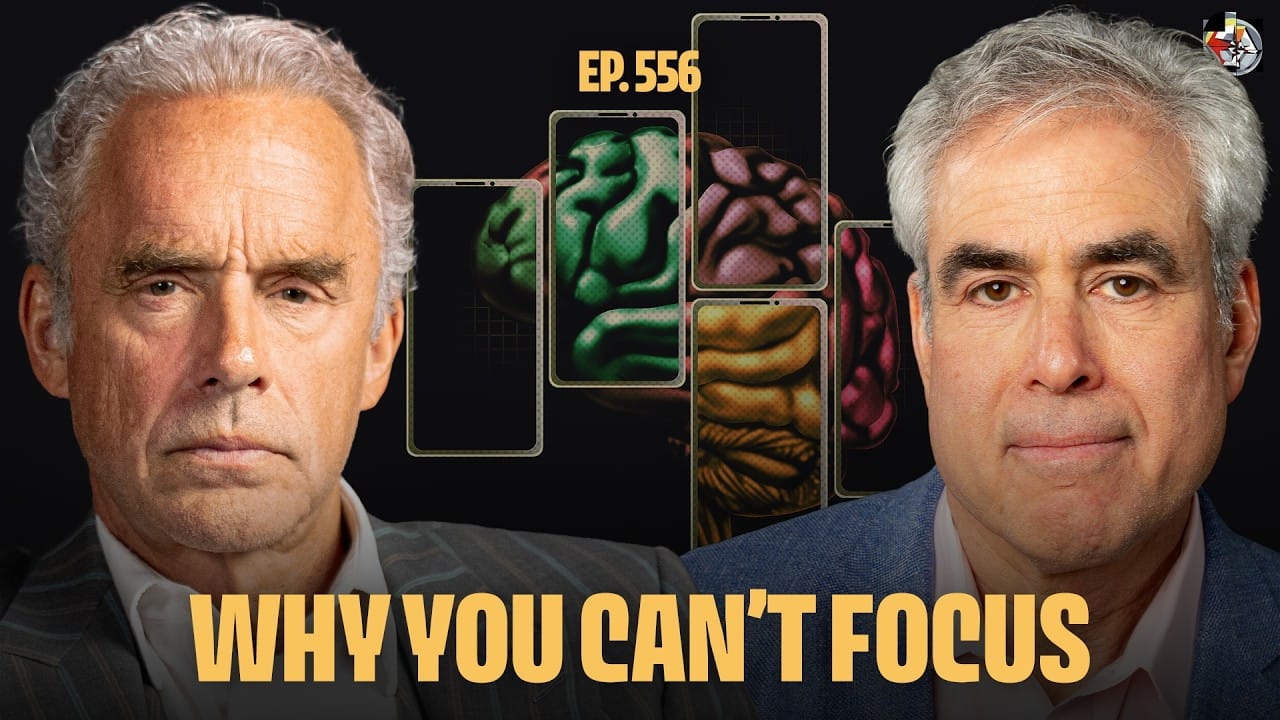
This video from Jordan B Peterson covered a lot of ground. 6 segments stood out as worth your time. Everything below links directly to the timestamp in the original video.
Australia has already passed a law banning under-16s from social media. A leading researcher says four concrete changes — some already spreading across schools and legislatures — could reverse a decade of declining youth wellbeing.
Australia Sets Global Precedent With Age-16 Social Media Law as Experts Push Four-Point Plan for Childhood
Social psychologist Jonathan Haidt argues that the core obstacle to protecting children from smartphones and social media is a collective-action problem: no single parent can opt out alone when every other child is already connected. His proposed solution rests on four societal norms — no smartphones before high school, no social media before 16, phone-free schools from bell to bell, and a deliberate restoration of unsupervised outdoor play. Australia has already moved from norm to law, legislating a minimum social media age of 16 that platforms themselves must enforce, with the measure taking effect in November. Haidt also noted that American test scores, which had risen steadily for decades, began declining in 2012 — the same inflection point seen in adolescent mental health data — suggesting the damage extends beyond mood into cognition.
The four-norm framework is significant because it distributes responsibility across parents, schools, legislatures, and the technology industry rather than placing the burden on individual families. Haidt was blunt about the limits of voluntary corporate change, arguing that the major platforms will only respond to legislation or litigation, while singling out Pinterest as a rare exception that has taken genuine steps to protect younger users. If widely adopted, the framework would represent the most substantial restructuring of childhood in the digital era.
"A phone-based childhood is not a human childhood. Kids are going to miss out on most of the things they need."
▶ Watch this segment — 1:29:55
Self-Harm Hospitalizations for Girls Aged 10–14 Rose Over 200% After Social Media's Mass Adoption
Jonathan Haidt points to a convergence of three distinct types of evidence linking the mass adoption of smartphones and social media around 2012 to a surge in adolescent mental illness. The historical correlation is striking: rates of anxiety and depression among teenagers were stable across English-speaking countries until an abrupt upturn emerged around 2012 to 2013, coinciding with Instagram's rise to mainstream popularity and the proliferation of front-facing phone cameras. Among girls aged 10 to 14, hospital admissions for self-harm increased by more than 200 percent — a behavioral measure that cannot be explained away as inflated self-reporting. Time-use studies show that heavier social media users consistently fare worse, and controlled experiments find that removing people from platforms for more than a week produces measurable reductions in anxiety.
The cross-national consistency of the pattern is what most distinguishes this research from earlier moral panics about media. No competing explanation has emerged for why girls, and especially pre-teen girls, deteriorated simultaneously across the United States, Canada, the United Kingdom, Australia, and much of Northern Europe. The average age of first social media use has continued falling — currently around eight for TikTok and nine or ten for Instagram — meaning the population most at risk is getting younger even as the evidence of harm accumulates.
"Because it happened the same way in so many countries, no one else has come up with an alternate theory."
Sudden Cross-National Rise in Teen Anxiety and Depression, Beginning Around 2012, Launched a Decade of Research
Jonathan Haidt traces the origins of his investigation to an anomaly he and colleagues noticed around 2014: university students appeared to be operating under a new, anxiety-driven moral framework that had not been present in prior cohorts. When he dug into the national data, he found something more alarming — rates of internalizing disorders, the clinical category covering anxiety and depression, had been essentially flat across the United States and other English-speaking countries from the late 1990s through 2011, then bent sharply upward around 2012 to 2013. The rise was steeper and faster for girls than boys, a distinction Haidt describes as an important diagnostic clue. Critically, the same inflection appeared not just in self-reported surveys but in harder behavioral data, including self-harm rates, which counters the criticism that teenagers may simply have become more willing to report distress.
The cross-cultural breadth of the pattern is what transformed it from a domestic concern into a research priority. Identical graphs appeared in Canada, the United Kingdom, and Australia, and subsequent analysis found the trend strongly replicated across Northern Europe as well. Haidt was careful to distinguish internalizing disorders — anxiety and depression — from conditions like psychosis or bipolar disorder, whose rates did not shift in the same way, suggesting something was targeting a specific vulnerability rather than mental health broadly. That specificity, combined with the shared international timing, is what focused his attention on a cause that was also global and new: smartphones with social media.
"All across the west, something terrible began happening around 2012, 2013."
AI-Powered Feeds Are Optimizing Addiction Individually, Making Slot-Machine Apps Look Primitive
The pull-to-refresh gesture on social media feeds was deliberately modeled on the mechanics of slot machines, according to Jonathan Haidt, exploiting what behaviorists call variable-ratio reinforcement — the most powerful schedule for generating compulsive behavior. Short-form video platforms like TikTok accelerated this dynamic by training users, through thousands of micro-decisions per session, to become increasingly skilled at chasing the next dopamine hit. The competitive pressure between platforms creates what one technology critic has called a race to the bottom of the brain stem: any app that refuses to maximize short-term attention grip simply loses users to one that will. Jordan Peterson and Haidt agreed this dynamic has grown measurably worse with artificial intelligence, because recommendation systems now use reinforcement learning to optimize grip of attention — machines trained by reinforcement to become better at reinforcing human behavior.
The next phase, both argued, is more alarming still. Whereas existing algorithms select from content created by humans, generative AI will soon be capable of producing entirely custom videos, images, or other material tailored to an individual's specific psychological vulnerabilities in real time. Unlike a slot machine, which offers the same stimulus to every player, these systems will know precisely what hooks each person and manufacture it on demand. Haidt framed the trajectory as a solipsistic feedback loop — a mirror reflecting only a user's weakest impulses back at them — and suggested that without regulatory intervention, the endpoint resembles a world in which people are effectively captive to machines engineered around their individual points of least resistance.
"We've created machines that use reinforcement technology to optimize the grip of reinforcement technology. It's worse than slot machines."
Anonymity and Algorithms Amplify Female Social Aggression Online, Researchers Argue
Adolescent girls face a compounding set of vulnerabilities on social media that boys largely do not, according to Haidt and Jordan Peterson. Girls show heightened susceptibility to social contagion — a phenomenon documented for centuries — and experience negative emotions with greater intensity from puberty onward, changes tied to hormonal shifts and, Peterson suggested, nervous systems calibrated toward infant protection rather than individual social competition. Social media's image-heavy, comparison-driven architecture maps directly onto the domains where girls are most sensitive: physical appearance, peer approval, and reputational standing. Online communities incentivized more extreme expressions of distress, with girls who displayed greater suffering attracting more peer attention and support — a feedback loop that Haidt links to the dramatic rise in self-harm among 10- to 12-year-olds who, before 2012, almost never engaged in such behavior.
Peterson raised a less-discussed dimension: the online environment strips away the inhibitions that normally constrain socially aggressive behavior. The characteristic form of female antisocial conduct — anonymous reputational damage and social exclusion — finds an ideal medium in platforms where identities can be hidden and audiences are vast. Apps explicitly designed for anonymous gossip represent an extreme case. Both researchers argued this constitutes a structural amplification of a behavior pattern that, in face-to-face settings, is held in check by social costs that simply do not exist online, effectively lowering the barrier to what Peterson described as psychopathic conduct.
"Middle school for girls has always been really, really hard — and to suddenly put this in where anyone can say anything about anyone in a forum where everyone will see it, with no consequences."
Around 10% of Boys Develop Compulsive Screen Use That Researchers Say Stunts Adult Development
Jonathan Haidt draws a distinction between two types of dopamine reward: the fast kind delivered by video games, social media scrolling, and pornography, and the slower kind generated by pursuing multi-step goals over weeks or months. He argues that heavy consumption of fast-dopamine content during adolescence erodes the executive function needed to set and execute long-term plans — a deficit that may not be visible at 14, when boys often report enjoying their screen time, but becomes apparent by their mid-to-late twenties. Roughly 10 percent of boys develop what researchers classify as problematic or compulsive use, but Haidt suggested the share experiencing some degree of developmental damage is higher. Boys face a wider commercial ecosystem than girls: video game companies, pornography, vaping and nicotine products, sports betting platforms, and gamified investment apps all compete for the same adolescent attention.
The gender gap in educational and employment outcomes among the oldest members of Generation Z supports this concern. Young women in that cohort are more likely than their male peers to have completed high school and college, hold a job, and live independently. Haidt stopped short of assigning an exact figure to the proportion of young men he believes have been effectively sidelined, but characterized even the 10 percent problematic-use estimate as a substantial societal loss. Unlike the mental health crisis most visible in girls, the boy story is less about acute psychological distress and more about a quiet failure to launch — one that may only become fully legible a decade after the habits that caused it were formed.
"The attention fragmentation, the loss of the ability to do things that aren't full of quick dopamine — is crippling. This, I think, is the boy story."
Also mentioned in this video
- What children are missing due to screen time (26:02)
- Peterson raises the role of ADHD medication and the suppression of male play… (53:00)
- Meaning (1:00:03)
- Research on thrilling risky play as the most powerful anti-anxiety agent for… (1:03:56)
- Peterson and Haidt examine the demographic collapse in East Asia and the West… (1:12:36)
- His three-axis model of social space (1:18:52)
Summarised from Jordan B Peterson · 1:38:44. All credit belongs to the original creators. Streamed.News summarises publicly available video content.
Streamed.News
This publication is generated automatically from YouTube.
Convert your full video library into a digital newspaper.
Get this for your newsroom →