🌐 Lee esto en Spanish →
Original source: AHORA PLAY
This article is an editorial summary and interpretation of that content. The ideas belong to the original authors; the selection and writing are by Streamed.News.
This video from AHORA PLAY covered a lot of ground. 6 segments stood out as worth your time. Everything below links directly to the timestamp in the original video.
Discover how geopolitical events, such as the opening of a key maritime route, can create a shockwave that reshapes global financial markets and impacts investments from oil to stocks.
Oil Falls, S&P 500 Reaches Record as Strait of Hormuz Reopens
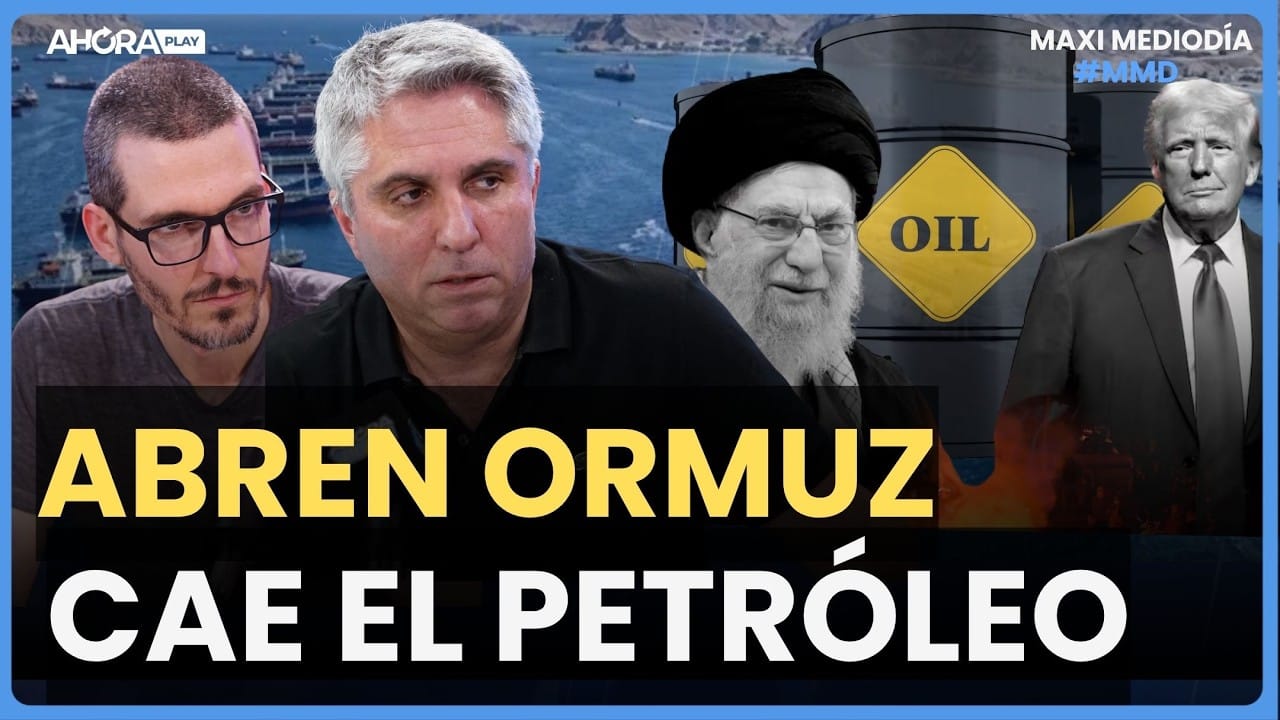
Global financial markets reacted significantly to the reopening of the Strait of Hormuz, with WTI and Brent crude oil prices falling by nearly 10%, placing Brent at approximately $90 per barrel, though still 50% above its value at the start of the year. While soybeans saw a 1.22% rise, corn and wheat registered declines. Precious metals like gold and silver climbed 1.6% and 5% respectively, and copper rose 1.3%, in contrast to a slight 2% dip in aluminum.
The positive impact extended to stock markets, with the S&P 500 hitting a new all-time high with a 1.3% increase, the Dow Jones rising 2.2%, and the Nasdaq gaining nearly 1.3%. Emerging markets also grew 2.2%, and emerging market bonds rose 0.8%. However, Latin American stock markets showed mixed performance, with Brazil and Argentina trending downward. Argentina's country risk stood at 512 points, a 41% drop in the last week, but it remains an obstacle for the country to access international debt markets at reasonable rates.
US and Iran Negotiate Potential $20 Billion Enriched Uranium Deal
The United States is considering a three-page peace plan with Iran that would include the release of $20 billion in frozen Iranian funds, Axios reported. In exchange, Iran would relinquish its stockpile of enriched uranium, a key component for nuclear weapons production. Part of this uranium would be sent to a third country, possibly Russia, while another portion would be downgraded in Iran under international supervision.
This potential agreement seeks to ensure that Iranian uranium is used exclusively for civilian purposes, in line with the stance that Iran has the right to nuclear energy but not to enrich uranium to military grade on its own territory. The proposal revives elements of previous agreements, emphasizing the need for monitoring and cooperation to prevent nuclear proliferation in an already volatile region.
Said Chaya: Iran Views Israel as Existential Threat Linked to Colonial Mechanism
Expert Said Chaya argues that Iran's stance toward Israel is rooted in the perception that the latter acts as a foreign agent perpetuating a colonial mechanism in the region. This view, according to Chaya, has fostered a mutual existential threat between both nations. In response to this dynamic, Israel has undertaken military actions in Gaza and Lebanon, seeking to ensure its own territorial security.
The complex relationship and deep distrust between Iran and Israel mark one of the main sources of instability in the Middle East. The narrative of a reciprocal existential threat justifies and shapes both countries' military and diplomatic strategies, escalating regional tensions and complicating any path toward lasting peace.
▶ Watch this segment — 1:06:02
Abraham Accords Reshape Arab Relations with Israel; Iran Strengthens Ties with Regional Partners
Said Chaya analyzes the stance of Arab countries towards Israel, highlighting that former President Trump in 2020 pushed for the Abraham Accords, normalizing relations between Israel and four Arab nations: Sudan, Morocco, Bahrain, and the United Arab Emirates. Along with previous agreements with Jordan and Egypt, Israel maintains peaceful relations with six out of 22 Arab countries. However, Chaya points out that the perception of internal populations towards Israel is often negative, although the political structures of some of these countries do not directly reflect public opinion.
Regarding Iran, Chaya emphasizes that groups like the Houthis in Yemen, Hamas in Gaza, and Hezbollah in Lebanon should not be seen simply as 'proxies,' but rather as strategic 'partners' that Iran supports to gain advantages and politically align certain regions. Resolving uranium enrichment and reintegrating Iran into the regional neighborhood, following its attacks on targets in several Gulf countries, are presented as complex and long-term challenges in current negotiations.
"They are more like partners, minority partners with a different level of development, but they are partners."
▶ Watch this segment — 1:09:12
Trump, Iranian Official Announce Strait of Hormuz Reopening After Lebanon Ceasefire
Donald Trump announced on Truth Social that the Strait of Hormuz, which he referred to as the "Strait of Iran," is "completely open and ready for free passage." Almost simultaneously, an Iranian parliamentary official confirmed the reopening of the strait for all commercial vessels, linking this decision to a ceasefire in Lebanon. This measure, coordinated by the Organization of Ports and Maritime Affairs of the Islamic Republic of Iran, is presented as a constructive gesture from both sides.
The reopening is part of a broader diplomatic context that included an unprecedented meeting between the ambassadors of Lebanon and Israel in Washington with Senator Marco Rubio. During these talks, the parties expressed their desire to resolve the issue with Hezbollah, culminating in a ceasefire in southern Lebanon. Trump's message, which implicitly acknowledges Iran's sovereignty over the strait, is interpreted as another sign of de-escalation.
"Passage for all commercial vessels through the Strait of Hormuz is declared completely open for the remainder of the Ceasefire period along the coordinated route already announced by the Organization of Ports and Maritime Affairs of the Islamic Republic of Iran."
Argentina Seeks to Issue International Bonds with World Bank and IDB Guarantees
Argentina plans to return to the international voluntary debt market with the backing of guarantees from the World Bank and the Inter-American Development Bank (IDB). This plan aims to allow the country to issue bonds at lower interest rates, as current conditions, with a country risk exceeding 500 points, imply yields above 9% annually, considered too high by the government. The IDB, for example, has committed a record program for Argentina that could exceed $7.2 billion by 2026, including sovereign guarantees and billions for private investment and infrastructure.
The mechanism of these guarantees acts as an endorsement: if Argentina defaults, the multilateral organizations would assume the debt. This would reduce the perceived risk for investors. For Argentine bonds to yield rates close to those of the US Treasury (around 4%), the issuance would need to be fully covered by the guarantee. However, if the issuance amount exceeds the guarantee, the interest rate will reflect the residual risk. The government aims to reduce country risk to around 400 points, a level not seen since the Macri presidency, to ensure a successful return to markets.
Also mentioned in this video
- Agustín Maqueira, gerente comercial de Sailing Inversiones, explica el aumento… (23:54)
- Agustín Maqueira analiza la evolución de la política monetaria en Argentina,… (25:31)
- Agustín Maqueira discute la baja profundidad del crédito en Argentina,… (30:14)
- Agustín Maqueira evalúa la dinámica de las acciones bancarias en Argentina,… (33:00)
- Agustín Maqueira comenta sobre el impacto de las políticas comerciales… (35:50)
- Agustín Maqueira aclara que no tiene información concreta sobre problemas de… (37:44)
- Agustín Maqueira analiza las opciones de inversión en Argentina ante un dólar… (38:28)
- Agustín Maqueira discute el nuevo plazo fijo UVA que paga intereses mensuales y… (41:49)
- El presentador comenta sobre una noticia falsa de La Nación que afirmaba que… (53:32)
- Said Chaya, analista internacional especializado en Medio Oriente, explica la… (58:39)
- Cómo la percepción del martirio y la vida influye en la resistencia de Irán,… (1:00:38)
- Said Chaya reflexiona sobre la dificultad de Occidente para comprender la… (1:13:49)
- El presentador comenta sobre los recientes datos de inflación en Argentina, que… (1:19:20)
- Maxi Montenegro se une al programa y destaca la reapertura del estrecho de… (1:24:40)
- El presentador continúa explicando los cambios en las políticas del Banco… (1:28:22)
- Maxi Montenegro, habiendo solucionado sus problemas técnicos, enfatiza que el… (1:33:50)
- Maxi Montenegro debate si los cambios en las normativas del Banco Central… (1:39:26)
- Maxi Montenegro y el presentador discuten la falta de claridad sobre el… (1:48:00)
- El presentador comparte su experiencia frustrante con Starlink, mencionando la… (1:51:17)
Summarised from AHORA PLAY · 1:54:49. All credit belongs to the original creators. Streamed.News summarises publicly available video content.
Streamed.News
This publication is generated automatically from YouTube.
Convert your full video library into a digital newspaper.
Get this for your newsroom →