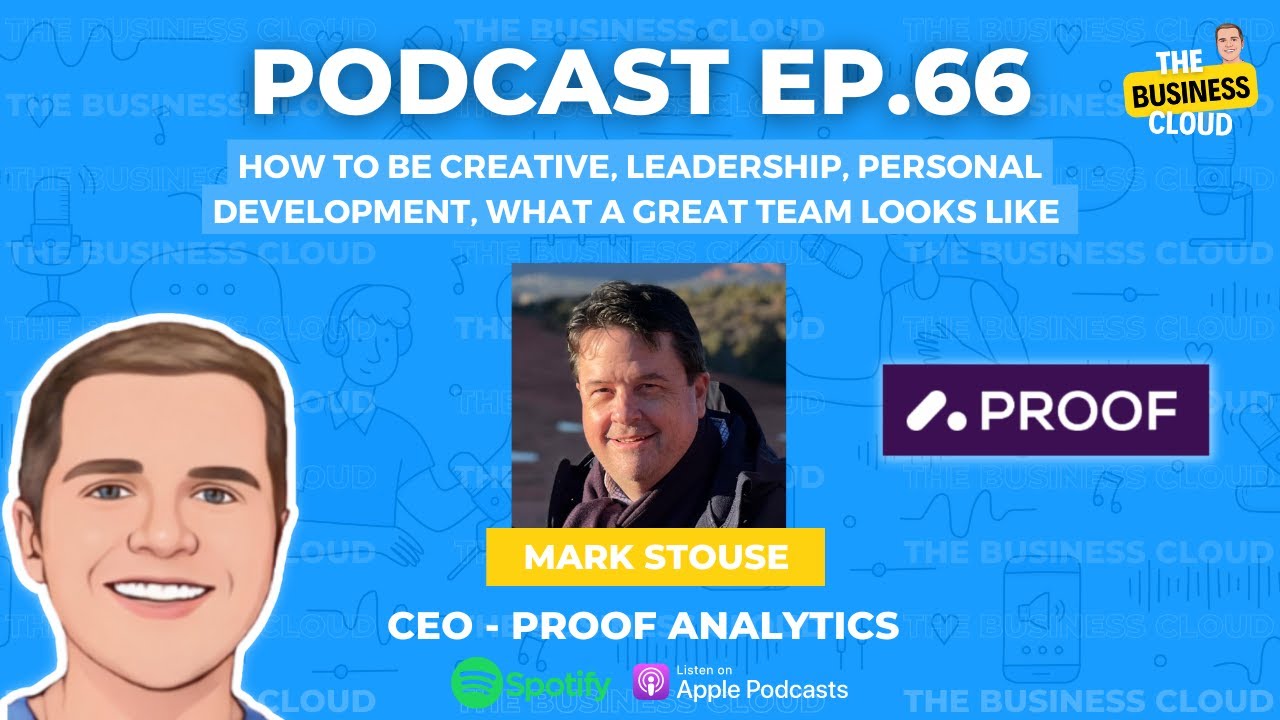
Original source: The Business Cloud
This video from The Business Cloud covered a lot of ground. 6 segments stood out as worth your time. Everything below links directly to the timestamp in the original video.
Most founder confessions arrive after the exit. This one arrives mid-journey, from someone still inside the surgery — which is why it rings differently.
ProofAnalytics Founder Says Entrepreneurship Reveals Character the Way Money and Power Do
Building ProofAnalytics over the past five and a half years has been the most formative — and most costly — period of Stouse's life, and he is candid that foreknowledge of that cost might have stopped him from starting at all. The structural reality of entrepreneurship, he argues, is not that it builds character but that it exposes what was already there: the holes, the ego, the gaps between self-image and actual capability. Stouse describes arriving from a long corporate career convinced he had become a well-rounded, 'T-shaped' leader, only to discover entire dimensions of leadership where he had barely left flat ground.
What makes this more than a founder's war story is the diagnostic framework underneath it. Stouse draws a direct parallel to money and power — forces that don't corrupt so much as reveal pre-existing corruption — and applies the same logic to a startup. The outcome, he says, is binary: you either emerge as a 'narcissistic denialist' or you do the equivalent of open-heart surgery without anesthesia and come out genuinely changed. The popular mythology of SaaS success, he notes bluntly, is drawn from a fraction of one percent of companies; the rest are, accurately described, either in trouble or dead.
"Entrepreneurship will reveal all the holes. You will either come out of that as a narcissistic denialist, or you will have really embraced it and become at least somewhat better. One is way better than the other — but one is also way more painful."
The True Measure of a Great Team Is the Grief When It Ends, Stouse Says
Truly transcendent teams, Stouse argues, are not designed — they are forged. In each of the three teams he has led that reached what he calls 'organism status,' the catalyst was a genuine crucible early in the team's formation: a crisis that was wholly unmanufactured and existential, the kind that forces people to weld together rather than simply cooperate. Individual excellence was the precondition — each person was, on their own, genuinely capable — and that individual quality is what generated the confidence teammates placed in one another. Leadership mattered, but Stouse is pointed about its limits: most of the bonding happened between people and small groups working it out themselves.
The counterintuitive diagnostic he offers is worth sitting with. The real question is not whether a team performed well in the moment but whether its dissolution left people grieving. If the team had truly become an indivisible organism, breaking it apart feels like a live dissection — the same structural tearing, he suggests, that makes divorce so difficult. That grief is not a side effect of success; it is its validation. Teams that disperse without that weight, by implication, never quite crossed the threshold.
"Whenever it comes to an end — and it always does — there is literally a grieving process that you cannot replicate if it wasn't the organism. Because you're redividing what has become indivisible."
Servant Leadership Is Genuinely Hard, and Most Leaders Only Practice It a Fraction of the Time
The most important leadership lesson Stouse has carried across tenures at organizations including Honeywell is deceptively simple to state and structurally difficult to execute: the leader works for the team, not the other way around. The job is to become whatever the team needs, rather than requiring the team to conform to the leader's preferences or style. He acknowledges the gap between the principle and its practice openly — his own teammates at ProofAnalytics, he says, could readily compile a list of every time he has fallen short of it. What keeps him oriented is not achievement but direction: the team needs to see that he is aware of the ego's pull and actively at war with it.
The compounding-decisions analogy he reaches for is analytically precise. Most leaders chase the transformative 20-percent improvement in decision quality; Stouse argues that a half-percent daily improvement, compounded over 365 days, yields roughly a two-thousand-percent gain. The implication is systemic: if every CEO, general manager, and political leader successfully practiced servant leadership even ten to twenty-five percent of the time, the aggregate positive effects across institutions would be, as he puts it, immense — possibly transformational. The friction is not conceptual. It is the ego, which he treats not as a flaw to be eliminated but as an opponent requiring constant, daily containment.
"Here I am — I have worked for 25 or 30 years to reach this position in my life and in my profession, and I'm now working for all of you. That's really what it is."
Intuition Is Personal Machine Learning — and Bad Life Experiences Corrupt the Training Data
The reason people resist celebrating failure, Stouse argues, is not vanity but conditioning: society frames failure as avoidable, which means each instance of it signals a personal defect rather than a data point. The more generative framework he offers draws directly from machine learning — specifically the concept of pattern matching. Human intuition, on this account, is not innate; it is accumulated from lived experience, interpreted and stored as templates for future decisions. The implication follows cleanly: if the input data is distorted — by trauma, by bad environments, by flawed interpretations — the pattern-matching engine will confidently produce wrong answers, and the person operating it will have no internal signal that anything is amiss.
What most people miss is the structural consequence of that model. People who reliably make poor decisions in one domain of life are not weak-willed or unintelligent; their internal training data has simply taught them that black is white in that particular area. The corrective is not motivation but re-training — which requires first acknowledging that the data was corrupted. Stouse's surfboard metaphor carries the same weight: no one controls the wave, success and failure alike are largely about the quality of the rider's moment-to-moment adjustments, and wipeouts are not aberrations but a guaranteed part of the process.
"Your intuition as a human being is your personal private machine learning. If you have bad training data, you actually believe that black is white and white is black in that particular area of life."
Documented Failure Is Transferable Knowledge — the Logic Behind Edison and Operation Paperclip
Creativity in a business context is, at its structural core, a problem-solving process — and problem-solving generates failure as its primary output, not as its exception. Stouse grounds this in two concrete examples. Edison's famous observation that he had discovered 993 ways not to make a lightbulb was not self-deprecation; it was a catalogue of transferable knowledge worth enormous time and resources to any successor willing to receive it. Operation Paperclip, the postwar Allied effort to recruit German rocket scientists, operated on identical logic: those scientists carried embodied knowledge of what not to do, and absorbing that knowledge allowed the program that became NASA to short-circuit years of redundant failure.
The friction this creates in modern organizations is a failure of documentation culture. The knowledge only transfers if it is codified and communicated — and most institutions, conditioned to treat failure as reputationally dangerous, suppress precisely the information that would be most valuable to the next person attempting the same problem. The Medici-da Vinci dynamic Stouse draws on illustrates the necessary counterpart: structure does not inhibit creativity when it is designed to contain the mess rather than eliminate it, giving the creative process the organizational scaffolding it needs to be sustainable.
"If you communicate that, you've just saved the next person all of that time, frustration, and energy. What is that worth? That is worth a ton."
High-Performing Teams Become Organisms — and the Harlem Globetrotters Show What That Looks Like
The three qualities that define the highest-performing teams Stouse has encountered — and led — are awareness, confidence, and trust, a triad he notes carries the acronym ACT. What distinguishes merely excellent teams from transcendent ones is what happens when all three are present simultaneously: the team stops functioning as a collection of individuals and begins operating as a single organism, each member anticipating the others' movements without deliberate coordination. The Harlem Globetrotters serve as his reference point — a group whose court awareness, mutual confidence, and positional trust are so total that their performance appears to exceed what any individual could consciously choreograph.
Stouse has led three teams he believes reached this threshold, and the framing he uses is notable for its precision. He is not describing high morale or strong culture in the conventional sense — those are inputs, not the phenomenon itself. The organism state is the output of something more specific: individual excellence sufficient to generate genuine confidence in colleagues, combined with enough shared experience that trust becomes structural rather than interpersonal. If that combination is rare, it is partly because most organizations optimize for coordination rather than for the conditions that make coordination unnecessary.
"They transcend the idea of team at some point and they kind of become an organism. I would wish for everyone to experience that — because you just can't beat it."
Summarised from The Business Cloud · 44:38. All credit belongs to the original creators. Streamed.News summarises publicly available video content.