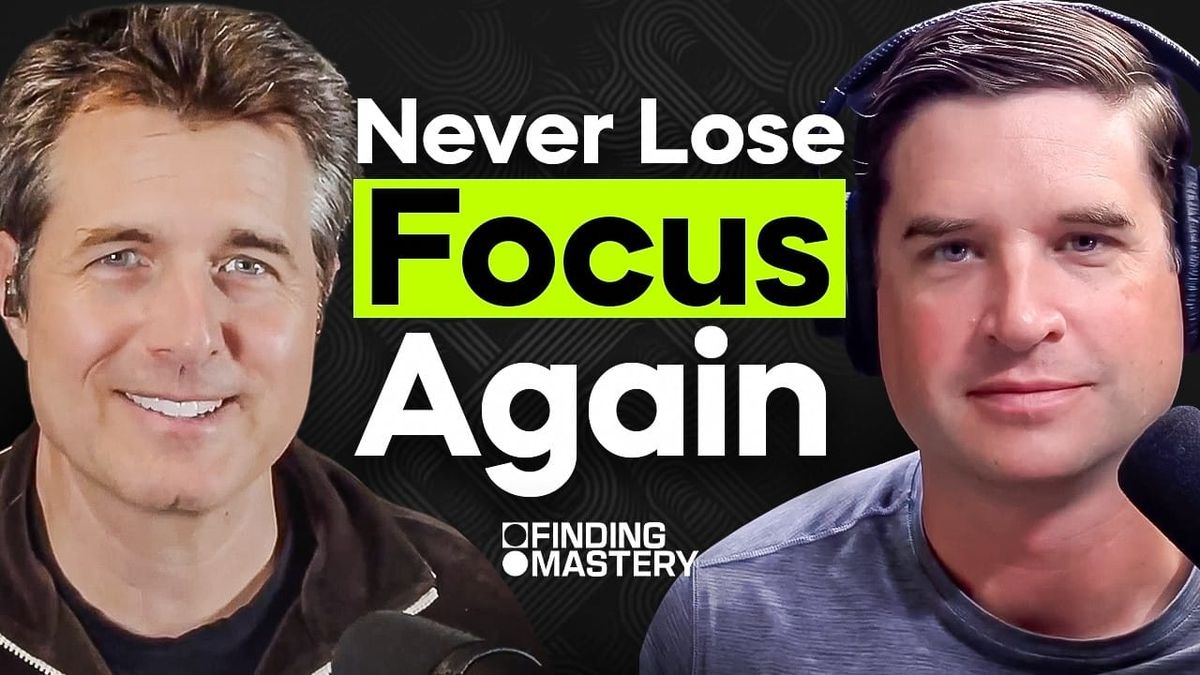
Original source: Finding Mastery
This article is an editorial summary and interpretation of that content. The ideas belong to the original authors; the selection and writing are by Streamed.News.
This video from Finding Mastery covered a lot of ground. 6 segments stood out as worth your time. Everything below links directly to the timestamp in the original video.
The concern about AI in education may be less about cheating than about something subtler: students learning to outsource the discomfort that is the actual engine of intellectual growth.
Cal Newport Warns AI Tools Are Training Students to Avoid Thinking
Students using generative AI to write papers are not saving time — they are taking longer and producing worse work, according to author Cal Newport. Observing university students up close, Newport found they were using chatbots not as shortcuts but as a way to avoid the discomfort of sustained cognitive effort, turning paper-writing into an extended, parasocial back-and-forth that diffused mental strain while undermining the quality of the output. He argues this compounds existing damage from smartphones and algorithmic entertainment, which have already eroded the habits of reading complex material and sitting alone with one's thoughts. On AI's future, Newport is cautiously optimistic — not about a single dominant model doing all work, but about a fragmented ecosystem of narrow, task-specific systems that handle scheduling, inbox management, and administrative overhead, freeing people for the deep thinking those tools cannot replace.
"We're a cognitive society and we're allowing a small number of technology companies to make us worse at being thinkers."
Work Burnout and Phone Addiction Are Distinct Problems Requiring Different Fixes, Newport Argues
The exhaustion that professionals feel from digital overload has two separate root causes that are routinely conflated, according to author Cal Newport. In the workplace, the culprit is structural: too many simultaneous projects combined with a culture of unscheduled, back-and-forth messaging that forces constant channel-checking and fragments concentration. Outside work, the problem shifts from structure to design — platforms like TikTok are engineered to maximize time-on-app, and their algorithmically optimized content gradually rewires short-term reward circuits until the phone feels more compelling than almost anything else in the physical world. Newport's distinction matters because the solutions diverge sharply. Fixing professional fatigue requires changing how organizations assign work and communicate. Fixing personal fatigue requires changing one's relationship with devices themselves — something no workplace policy can accomplish.
"You have to be in control, not letting four or five large companies that run these attention economy empires run your attention and your life."
Centralising Task Lists, Not Adding Headcount, Is Newport's Fix for Knowledge-Work Overload
Leaders trying to improve team output should focus on three levers — protecting deep concentration, controlling workload, and redesigning communication norms — rather than simply adding staff or technology, according to author Cal Newport. The most concrete recommendation Newport offers is replacing the default habit of assigning tasks directly to individuals via email or messaging with a shared central list from which work is pulled at a deliberate pace. The logic, borrowed from manufacturing theory, is that once a task lands on a person's plate, it generates immediate overhead: check-in emails, status meetings, background cognitive load. Multiplied across five simultaneous assignments, that overhead consumes the majority of a worker's productive capacity. Newport argues that keeping individual active workloads small and sequential will, counterintuitively, complete more work over a month or quarter than spreading tasks broadly across a team from day one.
"Our brain is like a computer. There's only so much it can do. The real question is how do I get the most productive output out of this brain today?"
Newport's 'Slow Productivity' Argues Visible Busyness Is Destroying Knowledge Work
The way most organisations measure productivity in knowledge work is not productivity at all, according to author Cal Newport. Because individual output is difficult to quantify, companies default to what Newport calls pseudo-productivity — rewarding visible effort, such as fast email replies and full calendars, as a rough stand-in for genuine value creation. That proxy was tolerable when work was confined to office hours, but mobile devices made it ruinous: workers now face constant pressure to demonstrate activity at any hour, at the granularity of a single Slack message, with no clear off switch. Newport's book proposes three replacement principles — work on fewer things simultaneously, maintain realistic time horizons, and concentrate on doing a small number of things at the highest possible level. The central argument is that excellence compounds non-linearly: a person who becomes truly exceptional at one skill generates far more value than someone who performs adequately across many, because the market rewards scarcity.
"The value for yourself in the marketplace of doing something great shoots up exponentially — it doesn't just straight add."
Management Layers Cause Productivity Drift, Not Because of Bad Managers but Bad Incentives
The gap between how knowledge work could be organised and how it actually runs in most companies is not primarily a people problem — it is a structural one rooted in how large hierarchies distort decision-making incentives. Drawing on Alfred Sloan's theory of managerial capitalism, Newport explains that middle managers, insulated from direct market feedback, naturally drift toward optimising for stability and predictability rather than genuine output. A manager who mandates constant email responsiveness does not immediately see a project delayed or revenue decline as a result; the causal chain is too long and obscured. Over time, this disconnect allows operational habits to drift further from what actually makes employees productive. Newport argues that well-defined process structures — explicit norms around workload and communication — reduce the need for management layers by replacing managerial judgment with shared, agreed-upon systems.
Newport Hardens His Stance on Social Media: Remove the Apps, Don't Moderate Them
Author Cal Newport, long known for skepticism toward social media, says his position has hardened into something closer to outright rejection. He now recommends that people remove from their phones any application whose business model depends on maximising time spent — a category that covers most major social platforms. For those who feel they need occasional access, he suggests using desktop web browsers on a fixed schedule rather than keeping mobile apps installed. Two additional tactics round out his approach: the phone-foyer method, which means leaving the device in a fixed location at home rather than carrying it room to room, and friction tools that require extra physical steps before the phone can be unlocked. Newport's reasoning is blunt — the companies running these platforms are highly motivated and highly skilled at capturing attention, and individual willpower is not a fair match for their engineering.
"They're really good at that game. They really care about money and they're going to win at that game — they're going to beat you at it."
Also mentioned in this video
- Newport and Gervais discuss the central tension in knowledge work between doing… (2:39)
- Busyness does not equal productivity and that overloaded workers are actually… (5:06)
- Of international time zones forcing deep-work hours to be consumed by meetings,… (18:31)
- He deliberately built world-class writing craft to serve that core talent. (33:21)
- Evidence-based smartphone guidelines for children (45:05)
- Gervais and Newport discuss the difficulty of implementing phone-at-home rules… (47:06)
Summarised from Finding Mastery · 57:53. All credit belongs to the original creators. Streamed.News summarises publicly available video content.
Streamed.News
This publication is generated automatically from YouTube.
Convert your full video library into a digital newspaper.
Get this for your newsroom →