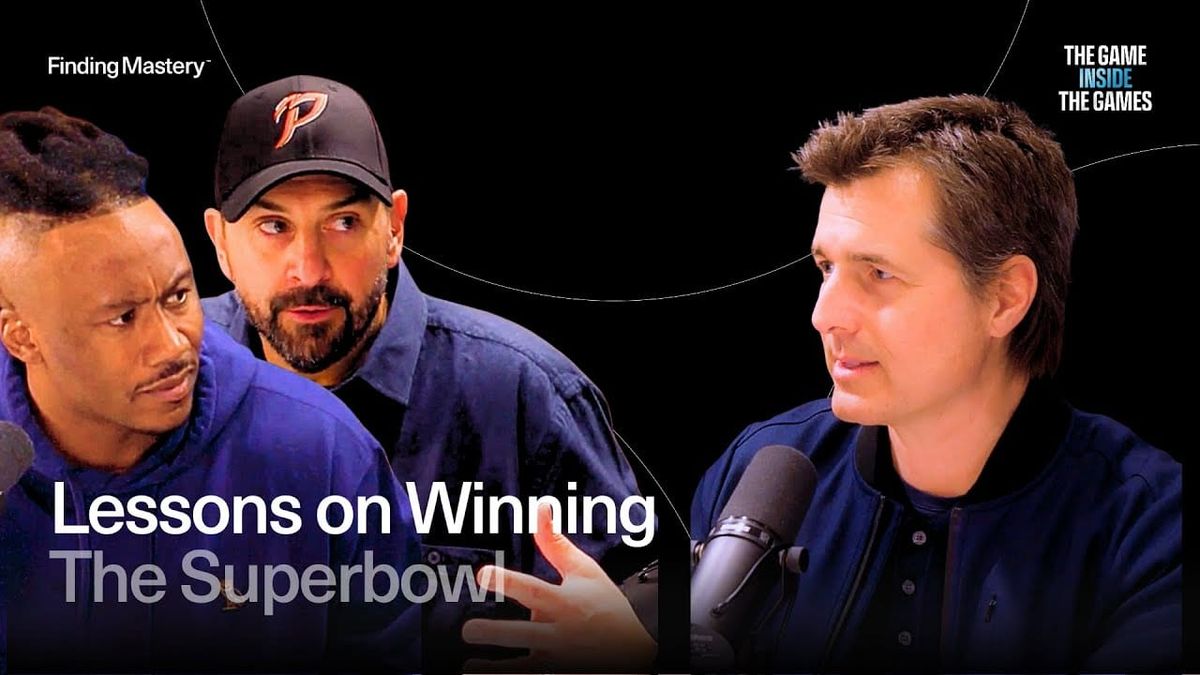
Original source: Finding Mastery
This article is an editorial summary and interpretation of that content. The ideas belong to the original authors; the selection and writing are by Streamed.News.
This video from Finding Mastery covered a lot of ground. 6 segments stood out as worth your time. Everything below links directly to the timestamp in the original video.
Have you ever had a moment that radically redefined your purpose, shifting your focus from external success to something far more personal and fulfilling?
Coach Recalls Pivotal Moment Realizing Purpose Beyond Winning
A veteran coach recounts a transformative moment early in his career, abandoning a path as an aeronautical engineer to focus on coaching. He describes witnessing the pure joy on player Jimmy Schzer's face after executing a move the coach had taught him, which directly led to a touchdown. This instance, he explains, was the "switch" that clarified his purpose: helping young men develop as individuals and players, a mission that had become overshadowed by the relentless pursuit of victory.
This personal epiphany highlights a common tension between external achievement and internal fulfillment, particularly in high-stakes competitive environments. For the coach, the intrinsic satisfaction of fostering growth in others proved far more rewarding than the accolades of winning alone, suggesting a deeper motivation that many can relate to in their own careers and personal lives.
"I had more happiness and appreciation for his joy than I did probably in my entire playing career. And so that was my flip. I wanted to help young men grow and be better men and football players."
Fired Coach Undertakes Six-Month Self-Discovery After Detroit Exit
After being fired from his head coaching role in Detroit, the coach embarked on an intensive six-month self-discovery process, echoing similar experiences of figures like Pete Carroll and Bill Belichick. He conducted extensive interviews with former staff members and family, rigorously collecting feedback on his performance and leadership. This period of reflection revealed an unsustainable work-life balance, characterized by sleeping in his office and minimal time with his family, leading to a candid acknowledgment of the toll it took on his mental health.
This introspective journey underscores the intense personal sacrifice often demanded by high-performance careers, where the pursuit of excellence can obscure fundamental well-being and personal values. His commitment to understanding his mistakes and re-aligning with his core purpose of developing young men—a goal he felt he had lost—offers a powerful example of transforming failure into an opportunity for profound personal and professional recalibration.
"I took a whole quality control approach... I called the people that worked underneath me on my staff, the people that worked in the building, and I just did like almost six months of interviews... I said, 'So, please just' and I wrote it all down."
Coach Highlights Social Media's Emotional Toll on Modern NFL Players
A veteran coach observes a significant shift in the emotional landscape of modern NFL players, attributing increased vulnerability to external influences like social media. He contrasts this with earlier generations of "alpha dog" players like Tedy Bruschi and Junior Seau, who primarily focused on physical and mental readiness. The coach recalls a specific instance with rookie Chandler Jones, noticing the young player visibly affected by online comments, underscoring how deeply external opinions can impact athletes today.
This insight into the contemporary athlete's psyche reveals a critical challenge for coaches and organizations: beyond physical and strategic preparation, understanding and addressing players' emotional well-being is paramount. The anecdote with Chandler Jones—who later faced public mental health struggles—illustrates that what might seem trivial to older generations can be profoundly impactful, highlighting the ongoing need for empathetic leadership and consistent check-ins with players navigating constant public scrutiny.
"Now there's so much more like emotionally I think going on with the kids and the players. They're so much more aware of what's happening. There's so much more outside influence that really affects them."
Coach Regrets Carrying Post-Loss Intensity to New Head Coaching Role in Detroit
The coach reflects on losing Super Bowl 2011, a defeat that particularly bothered him as he was about to transition to his first head coaching role in Detroit. He admits to carrying the intense, almost angry mindset from that loss directly into his new team, a mistake he later recognized after watching Michael Jordan's documentary on the unwavering intensity Jordan brought after a defeat. The coach realized he had failed to leave the emotional baggage of New England behind, imposing an unsuited intensity on a team needing a fresh start.
This candid self-assessment highlights the critical challenge of leadership transitions and the often-unconscious ways past failures can influence new beginnings. His realization that this intense approach was unfair to new players, who needed understanding and a different foundation, underscores the importance of adapting leadership styles to specific contexts and prioritizing the needs of the team over personal grievances or competitive zeal.
"I carried that intensity into a building that wasn't... I didn't realize it until I watched the Jordan documentary... I didn't leave that. It was mismatch. It was it was so wrong."
Coach Reflects on Three-Year Healing Process After Super Bowl Losses
A coach expresses gratitude for experiencing both dramatic Super Bowl victories and devastating losses, describing a three-year "healing process" his team underwent after failing to win. He recounts the profound pain of the 2007 Super Bowl defeat to the New York Giants, which ended an undefeated season, revealing that it took him eight years to even open a box containing memorabilia from that traumatic season. The coach also emphasizes his deep desire to have won that game for Junior Seau, a beloved player whose personal struggles later led to suicide.
This candid reflection highlights the immense emotional toll of high-stakes competition, extending far beyond the final whistle for both players and coaches. The experience underscores how deeply professional sports can impact mental well-being, demonstrating that even amidst gratitude for varied experiences, the echoes of profound disappointment and loss can linger for years, shaping perspectives on resilience, leadership, and the human cost of intense athletic ambition.
"We didn't know how to lose. And so it took, I think, three years for a healing process to take place... It was a trauma."
Coach Recalls Experiencing "Flow State" During Super Bowl 49's Final Seconds
During the frantic final 26 seconds of Super Bowl 49, a coach describes entering a profound "flow state" where time seemed to slow down and a sense of calm focus prevailed amidst the stadium's chaos. Standing beside Bill Belichick, who intently surveyed the opposing sideline while ignoring questions about a timeout, the coach was fully immersed in the strategic unfolding of the game, contemplating the deployment of the defensive package designed to counter the opponent's anticipated play.
This personal account offers a rare glimpse into the psychological phenomenon of flow in a high-pressure environment, where the brain selectively filters out distractions to optimize performance. His ability to maintain composure and clarity, even as the clock wound down, illustrates the survival mechanism behind such states—focusing intensely on the immediate task at hand—a skill that separates top performers who expand their awareness from those who narrow under pressure.
"You get those moments there was like 26 seconds left. That felt like 15 minutes to me. Like life just slowed. Everything slowed down. You're in the zone."
Also mentioned in this video
- The Super Bowl is described as an event with immense noise and extensive media… (0:02)
- The defensive call 'goal line three corner' for Super Bowl 49's critical play,… (2:10)
- Dante Hightower's one-armed tackle on Marshawn Lynch as a crucial play that… (4:03)
- His decision to implement the 'goal line three corner' defense, which hadn't… (5:50)
- The coach details the crucial sequence of plays leading to the final moment,… (9:14)
- Calling the 'goal line three corner' play, ensuring Malcolm Butler was in, and… (15:00)
- The final play of Super Bowl 49, where he was focused on the opposite side of… (22:28)
- The broader applicability of the coach's story for leaders in both sports and… (33:44)
- The host praises the coach's exceptional leadership and philosophy, emphasizing… (43:17)
- The host concludes the interview by thanking the coach and asks Microsoft… (48:16)
Summarised from Finding Mastery · 49:16. All credit belongs to the original creators. Streamed.News summarises publicly available video content.
Streamed.News
This publication is generated automatically from YouTube.
Convert your full video library into a digital newspaper.
Get this for your newsroom →