Original source: Finding Mastery
This article is an editorial summary and interpretation of that content. The ideas belong to the original authors; the selection and writing are by Streamed.News.
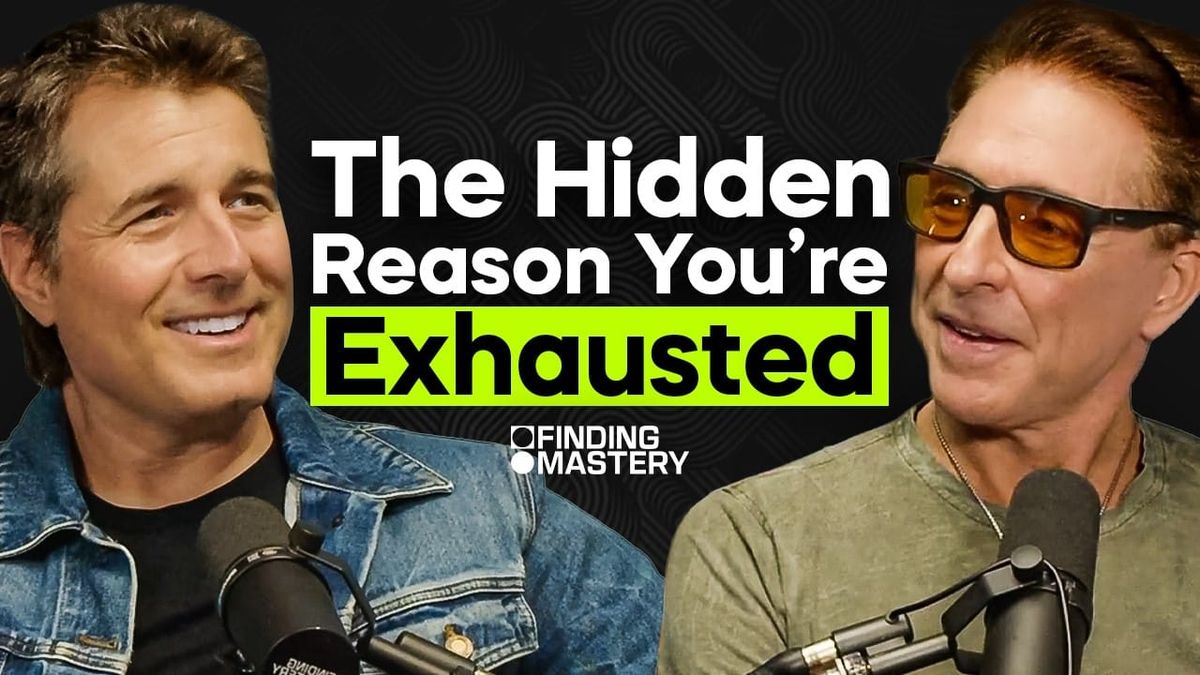
This video from Finding Mastery covered a lot of ground. 6 segments stood out as worth your time. Everything below links directly to the timestamp in the original video.
Ever wonder why seemingly minor slights trigger disproportionate reactions? Dave Asprey shares how uncovering a forgotten childhood incident helped him unmask deep-seated anger, revealing a universal truth about how past experiences shape our present emotional landscape.
Dave Asprey Uncovers Childhood Anger Rooted in First Grade After Public Sabotage
Dave Asprey describes an "emotional hierarchy" akin to Russian nesting dolls, where deeper emotions like fear are often masked by surface feelings such as anger or sadness. He illustrates this with a personal experience involving a public attempt to sabotage his reputation, which initially evoked intense anger and disregulation. Through self-inquiry, guided by a team member, he discovered the root of this reactive anger was a forgotten first-grade incident where he was wrongly blamed after tattling on another child. This deeply personal journey, which Asprey notes is also taught in Buddhist monasteries where he has spent time, highlights how lingering childhood traumas can influence adult reactions to perceived injustice. His method of tracing current emotional responses back to their earliest origins suggests a path to moving beyond reactive states by recognizing and addressing the ego's underlying fear.
"When you peel them away, I wasn't angry even though I felt angry. It was actually sadness. And then you peel away the sadness. Oh, look, there's fear... When you get through all this, it's ultimately your ego trying to keep you safe."
Dave Asprey Credits Biohacking for Resilience During "Hundreds of Millions" Dollar Loss and Betrayal
Biohacker Dave Asprey reveals that his extensive practices in optimizing his brain and biological states were crucial in navigating a period of profound personal and business hardship. He faced significant financial loss, including what he estimates as hundreds of millions of dollars in net worth, along with intense feelings of injustice and betrayal from investors and board members. Despite the severity of these challenges, he states that his understanding of mitochondrial energy and consciousness management prevented him from breaking down. Asprey reflects that experiencing both injustice and betrayal are among the most difficult traumas for adults to process, often leading to prolonged bitterness. His ability to move past this dark period, even calling friends to inform them of lost investments, underscores a unique application of biohacking principles. It suggests that physiological and mental self-management can build a profound resilience, enabling individuals to confront severe setbacks with a different perspective than traditional coping mechanisms might offer.
"I've been through a lot, and it's enough that it probably would have broken most people, and I think had I not had the benefit of knowing how to make enough energy in my brain with my mitochondria, how to manage my health and then how to manage my mental or even consciousness states... I have awareness of where I am now."
Dave Asprey Challenges Cholesterol Focus, Recommends Inflammation Markers for Heart Health
Dave Asprey contends that the widespread focus on cholesterol as the primary indicator of heart disease risk is outdated, stemming from measurement ease in the 1930s rather than modern understanding. He points out that supercentenarians often exhibit higher-than-average cholesterol levels, and notably, half of all heart attack victims do not have high cholesterol. Instead, Asprey advocates for measuring specific inflammation markers, such as homocysteine and C-reactive protein, as far more accurate predictors of heart attack risk. Asprey expresses concern regarding most statin drugs, arguing they inhibit mitochondrial function and deplete co-enzyme Q10, suggesting they are rarely necessary for the majority of people. He further recommends LPLA2, an enzyme released when artery linings are damaged, as a crucial test to determine if existing cholesterol levels are actually causing arterial harm. This approach shifts the health paradigm from simply lowering cholesterol to actively reducing inflammation and monitoring direct signs of arterial damage.
"The people who live the longest, the super centenarians, they have higher than average cholesterol. That's weird. And half of people with heart attacks don't have high cholesterol. That's weird. So... markers of inflammation are far more indicative of risk."
Dave Asprey Recounts Loneliness of Founder CEO Amidst Betrayal and Near Bankruptcy
Dave Asprey recounts a profoundly dark period where he transitioned from financial security to facing potential bankruptcy within a year or two, exacerbated by betrayal from investors and even friends who had lost money. He describes the extreme loneliness inherent in being a founder CEO, noting the impossibility of fully confiding in team members due to the power dynamic, or in a spouse who might not grasp the intricate business complexities, causing undue stress on personal relationships. This isolating experience underscored for Asprey the critical importance of a trusted community of fellow entrepreneurs. He found invaluable support among those who had navigated similar highs and lows, allowing him to discuss complex business challenges, betrayals, and potential failures that felt incomprehensible to others. His story highlights a seldom-discussed aspect of leadership, emphasizing that unique professional burdens require a specific type of peer support to prevent leaders from succumbing to isolation.
"It's lonely anyway because the people on your team, they're trusted. They're your friends, except you can fire them... So having a community of entrepreneurs I could talk with, trusted friends... was really really helpful just otherwise it's lonely because no one understands your experience as a founder."
Dave Asprey Blends Ancient Spirituality and QEEG Tech for Accelerated Emotional Healing
Dave Asprey details his extensive self-discovery journey, which integrates diverse spiritual and therapeutic practices, including shamanic training, time in Buddhist monasteries, and work with lineage leaders in the Andes. He highlights how technology like Quantitative Electroencephalography (QEEG) can significantly accelerate the process of identifying and resolving deep-seated emotional triggers, especially when combined with practices like holotropic breathing that induce altered states of consciousness. This multi-faceted approach aims to move individuals beyond emotional reactivity towards a more internally congruent state. Asprey recounts how this work helped him process public criticism, which initially left him "thrown off for about six months," by reframing it as a beneficial experience. He argues that addressing the belief that "life isn't fair" is crucial for emotional maturity, allowing individuals to release old grievances. By leveraging QEEG, he explains, one can learn to downregulate anxious brain activity and understand the underlying neurological patterns of emotional states, offering an efficient pathway to inner peace that transcends traditional methods alone.
"I've done it with a variety of therapists. I've undergone shamanic training. I've spent time at Buddhist monasteries. I've gone down to the Andes. I've worked with like leaders of lineages... and I've worked with tech. So for me, this is in the realm of transpersonal psychology."
Former Vegan Dave Asprey Claims Plant-Based Diets Cause Protein Deficiency, Cites "Death Per Calorie" in Tofu
Dave Asprey, who previously followed a vegan diet for six years, now contends that most vegans are protein-deficient because plant-based proteins are approximately 30% less efficient than their animal-based counterparts. He recommends consuming one gram of animal protein per pound of ideal body weight daily to enhance mental clarity, energy, and reduce food cravings. Asprey also provocatively argues that agricultural practices involved in plant-based food production mean tofu carries a significantly higher "death per calorie" count than grass-fed beef due to widespread animal casualties from harvesting machinery. Asprey illustrates his "death per calorie" argument with observations from farming, noting the extensive wildlife killed during grain harvesting, and an anecdote from a Tibetan lama who justified eating yak by stating, "one death feeds everyone." He also criticizes chicken as a less optimal protein source than beef or lamb due to its unfavorable fatty acid ratio and lower mineral content, as well as the widespread use of flax in chicken feed, which he asserts contains too much estrogen. This perspective challenges conventional dietary wisdom, particularly the ethical and health assumptions often associated with veganism.
"All vegans are protein deficient no matter what they do. Even if you're supplementing... plant-based proteins are about 30% as efficient as animal-based proteins... The death per calorie from tofu is way higher than grass-fed beef because I kill one animal per year to eat that cow."
Also mentioned in this video
- The presence of toxins in plants, the concept of listening to one's biology,… (0:00)
- Dr. Michael Gervais introduces Dave Asprey, an entrepreneur, author, and the… (0:40)
- Dr. Michael Gervais and Dave Asprey discuss their differing philosophies on… (2:44)
- Conventional advice and seek what truly works, inspiring the biohacking… (4:32)
- Using technology to connect a computer to his brain allowed him to achieve… (6:05)
- His experience at Copan Monastery, realizing that ancient spiritual practices,… (21:18)
- Dave Asprey details his QEEG-based approach at 40 Years of Zen, where clients… (23:06)
- Dr. Michael Gervais outlines three key areas he wants to explore with Dave… (26:38)
- Dave Asprey asserts that emotions reside in the body, not just the brain,… (27:17)
- The controversial idea that mitochondria possess consciousness, citing Martin… (28:46)
- Improving mitochondrial efficiency enhances longevity and emotional regulation,… (33:00)
- The importance of minerals and how many plants, through evolution, contain… (37:37)
- Whole grains, nuts, oatmeal, brown bread, and brown rice for containing toxins,… (39:53)
- Dave Asprey suggests nattokinase to resolve soft plaque and chelation to remove… (49:58)
- Personalized biohacking practices, stating that individual responses to health… (52:43)
- Dave Asprey recommends key practices for longevity, including optimizing… (54:06)
- Protein intake during intermittent fasting, noting that recent studies show no… (56:02)
- Infrared saunas for detoxification and benefits, red light therapy, and brief,… (58:00)
Summarised from Finding Mastery · 1:02:37. All credit belongs to the original creators. Streamed.News summarises publicly available video content.
Streamed.News
This publication is generated automatically from YouTube.
Convert your full video library into a digital newspaper.
Get this for your newsroom →