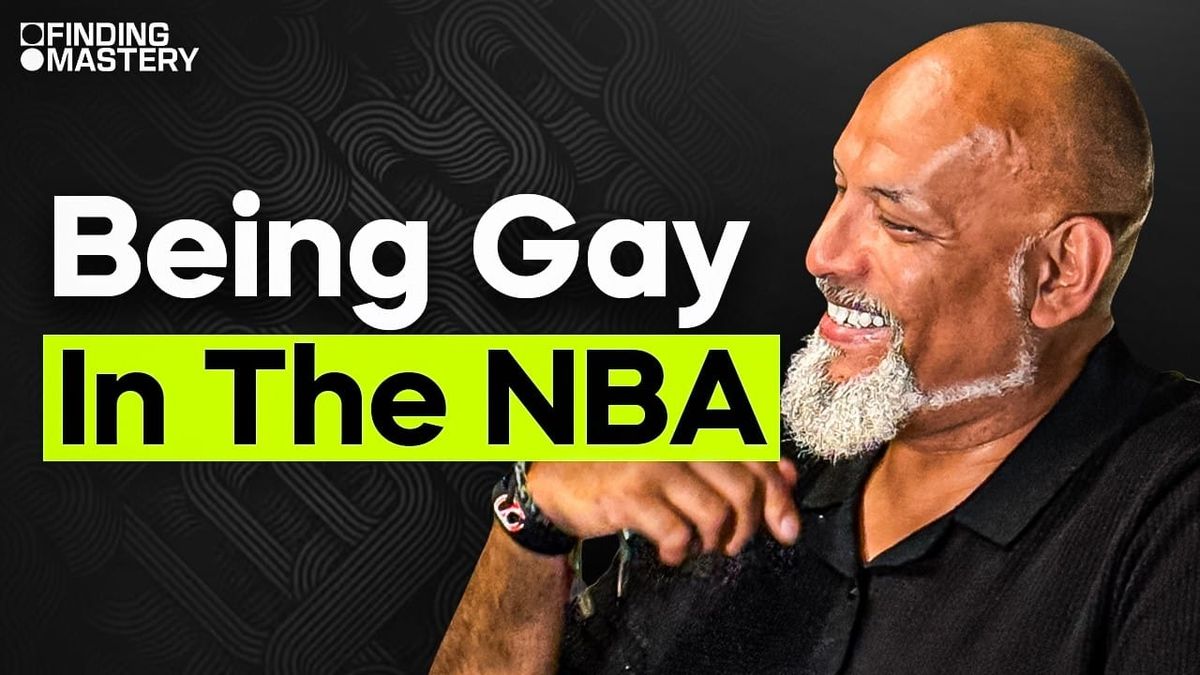
Original source: Finding Mastery
This article is an editorial summary and interpretation of that content. The ideas belong to the original authors; the selection and writing are by Streamed.News.
This video from Finding Mastery covered a lot of ground. 5 segments stood out as worth your time. Everything below links directly to the timestamp in the original video.
What motivates someone to take a deeply personal step into the public eye? John Amaechi recounts the surprising, small moment that led him to embrace a powerful new role as a visible advocate.
Hidden Boy at Pride Festival Spurs John Amaechi's Public Coming Out
John Amaechi decided to publicly come out in America after a poignant experience at Manchester Pride in 2005, shortly after his retirement from professional basketball. While observing the parade from Cathedral Gardens, he noticed a young boy, estimated to be around 13 to 15 years old, crouched behind a tombstone, furtively watching the festivities. The boy visibly brightened when Sir Ian McKellen, the parade marshal, waved in their general direction, an image that deeply affected Amaechi.
This moment made Amaechi realize the profound impact his public visibility could have on others, particularly those who might not relate to established figures like McKellen, due to factors such as Amaechi's own Black identity. His decision stemmed from a desire to offer a different kind of role model, acknowledging that his presence could resonate with marginalized individuals, thereby providing a crucial sense of hope or validation.
"A wave from a stranger from a distance. Are you kidding me? That that is like psychology. I was like, damn it. Now I now I've got to now I've got to come out in America."
John Amaechi Details Public Reaction to Coming Out, Including Death Threats and Hurtful Apathy
John Amaechi received a wide spectrum of reactions after publicly coming out, which generated significant fear within his family, with his sisters expressing deep concern for his safety, particularly given the prevalence of guns in America. He categorized the responses into three distinct groups: approximately 20% offered warm support and gratitude; 5% were vehemently hateful, including numerous death threats sent to his family's home in England; and a substantial 75% remained outwardly neutral.
Amaechi found the neutrality of the 75% especially hurtful, viewing it not as genuine impartiality but as complicity, which he believed amplified the noise and impact of the hateful 5%. This large group often dismissed the issue, claiming it was "too early" or "not the right time" for such discussions, demonstrating an apathy that underscored the profound isolation felt by those targeted by prejudice.
"There was about a 20% group of people who were warm and supportive... a 5% group that were vociferously hateful... and in the middle was this 75% who you might think were neutral, but in cases of human dignity, neutrality is complicity."
John Amaechi Cautions Against Universal 'Come Out' Advice, Citing Privilege and Danger
John Amaechi posits that true principles are "earned" through facing consequences, emphasizing the fundamental importance of not denying one's authentic self while acknowledging the real dangers involved. He highlights that the fear of rejection, both private and public, is a deeply ingrained biological mechanism, akin to being "kicked out of the tribe," which makes vulnerability inherently risky for individuals.
Amaechi cautions against the widespread activist advice that "everyone should just come out," arguing it overlooks significant disparities in privilege and safety. He explains that his own decision to come out was made from a relatively secure position, supported by genuine care from teammates and multi-million dollar NBA contracts. For many, he stresses, revealing aspects of their identity could lead to real harm, destitution, or even death, making such universal advice irresponsible without the means to support those facing severe repercussions.
"Principles aren't principles until they're dinged a little bit... if you are the kind of person who's in an environment where you think it is so toxic and dangerous that coming out... would cause you real harm then I'm not here looking for martyrs."
John Amaechi Blames Public 'Selfishness' for Enabling 'Bad Actors' and Societal Horrors
John Amaechi articulates that his significant rage is primarily directed not just at "bad actors," but increasingly at what he perceives as the public's widespread selfishness. He contends that many individuals are willing to overlook or enable horrific actions if they are promised one specific comfort or the avoidance of discomfort, such as lower taxes or reduced immigration.
Amaechi argues against the notion that people are simply "intoxicated" by charismatic leaders. Instead, he suggests a deeper societal issue: a fundamental human desire to embrace comfort, avoid discomfort, and sidestep blame for their circumstances. This underlying selfishness, he believes, forms a remarkable coalition that empowers megalomaniacs and allows them to inflict terrible things, as people turn a blind eye if their single "lightning rod" issue is addressed.
"There are a large group of people that because of one or two key principles will allow horrors to occur... if you just promise them less brown people in this country... They will sacrifice the NHS. They will sacrifice their personal wealth."
John Amaechi Explains Refusal to Debate Unyielding Opponents, Citing Audience Confirmation Bias
John Amaechi explains his strategic decision to refuse debating individuals he believes are unwilling to change their minds, noting that many audiences are not seeking new information but rather confirmation of their existing beliefs. He distinguishes between audiences genuinely open to learning and those who listen primarily to reinforce their "lightning rod" views, whether through podcast hosts or politicians, particularly in current political climates across America and Europe.
For Amaechi, attempting to dismantle such deeply held "lightning rods" in a debate is counterproductive, as it is perceived not as intellectual discourse but as a personal attack, leading to no constructive outcome. He specifically recounted that during a recent podcast incident, his greatest fear was not danger, but merely having a "nice chat" about his book after witnessing indefensible views, which he felt would make him an "awful person" by compromising his principles for commercial gain.
"I don't debate people who won't change their mind. It's not a debate then... If we just have a nice chat about my book, I'm an awful person. How could I allow just having a nice chat about my book... because I didn't challenge..."
▶ Watch this segment — 1:13:51
Also mentioned in this video
- His experience as the first openly gay NBA player, the hate he received, and… (0:00)
- His current work helping individuals and organizations thrive, focusing on… (2:41)
- His passion for helping people with his words stems from his childhood… (4:32)
- John Amaechi shares that memories of his mother and her unconditional love… (6:05)
- His mother's love as the 'gravity' around which he rotates, noting that her… (7:08)
- His mother's ability to be fully present and engaged despite her busy schedule… (8:14)
- Dr. Jervy observes that John Amaechi uses vivid imagery and emotion in his… (9:16)
- The conflicting perceptions he experiences, with his mother seeing him as her… (10:18)
- Dr. Jervy questions why John Amaechi omitted his NBA career from his book… (11:27)
- The 'micro assaults' he experiences daily due to his large size, where people… (13:52)
- His journey from a small town in England where basketball was obscure to the… (17:52)
- His mixed feelings of accomplishment, terror, and sadness upon entering the… (21:12)
- He knew he was gay from age 11 and was 'out' to those who cared about him, but… (22:55)
- Dr. Jervy and John Amaechi discuss the fears athletes face in coming out,… (26:01)
- John Amaechi advises people struggling to reveal their true selves to first… (31:04)
- To gather evidence about whom to trust by observing people's behavior, looking… (32:25)
- John Amaechi elaborates on his concept of 'duty of care,' distinguishing it… (34:35)
- The importance of diverse representation, believing his image as a black, gay… (39:53)
- Dr. Jervy clarifies that he is more interested in the courage to be oneself… (41:36)
- John Amaechi shares his excitement for being 'utterly wrong' and continuously… (45:10)
- He managed the vitriol after coming out by curating a strong support group of… (49:48)
- John Amaechi reflects on how his life, marked by boldness and vulnerability,… (51:06)
- John Amaechi reveals that being bullied made him shy and hesitant to interact… (52:05)
- John Amaechi expresses his current rage not about his early life, which was… (52:51)
- The challenge of understanding people with different perspectives, noting that… (56:54)
- Knowing oneself is foundational for a relational approach to life, comparing it… (59:13)
- The importance of presence as a tool in relational interactions, advocating for… (1:01:07)
- His 'fence conversation' for new team members, emphasizing a leader's… (1:04:06)
- Dr. Jervy acknowledges the safety that comes from knowing someone's first… (1:07:17)
- A recent incident where he walked out of a podcast appearance after realizing… (1:09:18)
- John Amaechi attributes his ability to see more potential in people to his NBA… (1:16:47)
- 'deeper examination' as a kingpin skill, emphasizing the importance of… (1:17:36)
- His OBE (Officer of the Order of the British Empire) was awarded for volunteer… (1:19:51)
Summarised from Finding Mastery · 1:22:51. All credit belongs to the original creators. Streamed.News summarises publicly available video content.
Streamed.News
This publication is generated automatically from YouTube.
Convert your full video library into a digital newspaper.
Get this for your newsroom →