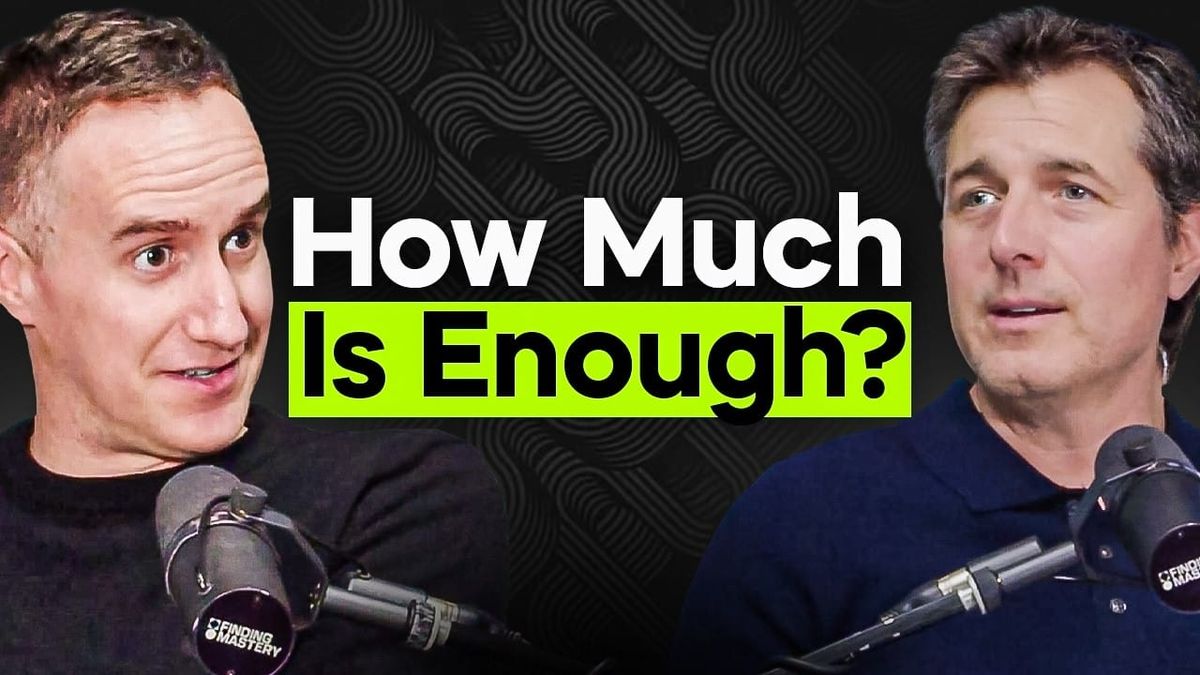
Original source: Finding Mastery
This article is an editorial summary and interpretation of that content. The ideas belong to the original authors; the selection and writing are by Streamed.News.
This video from Finding Mastery covered a lot of ground. 6 segments stood out as worth your time. Everything below links directly to the timestamp in the original video.
Have you ever considered how your deepest insecurities might actually be your greatest motivators? Morgan Housel shares a compelling personal story about how profound early life challenges forged an unusual and powerful dual personality.
Morgan Housel Details Early Life Traumas That Forged His Dual Drive
Financial author Morgan Housel reveals two significant early life traumas that shaped his adult personality and drive. His education effectively ceased at eighth grade due to competitive ski racing, a career that ended at 18 with a broken back. This left him with a profound sense of educational inadequacy compared to his college-bound peers. Compounding this, he grappled with a severe stutter, only achieving fluent speech around the age of 30.
These experiences fostered a "jackal and hide" personality, characterized by both deep humility and fierce determination. Housel explains that the genuine belief he was an "idiot" and barely able to speak fueled an equally intense desire to prove himself. He argues that this ability to toggle between acute self-awareness of his limitations and a relentless drive to overcome them proved to be a highly productive force throughout his life.
"If you only have one of those sides it's dangerous. If you can toggle between them, it's actually pretty productive because I had the humility of knowing that I was an idiot and and that I could barely speak. And the next day I could be like, 'Yeah, but it hurts me so bad that I'm going to sprint as fast as I can and work as hard as I can to get out of this zone.'"
Morgan Housel Reveals Unconventional Saving Strategy Prioritizing Independence Over Returns
Financial author Morgan Housel outlines his highly personal and unconventional saving philosophy, prioritizing independence and preparedness for unknown risks above maximizing investment returns. Housel explains that he saves not for specific purchases, but for "events that I cannot even fathom," operating on the principle that "risk is what you don't see." This approach aims to safeguard against unforeseen personal or global disruptions.
Housel equates saving money with "buying independence," a concept he values more than any material possession, providing peace of mind and the ability to wake up knowing he can "do whatever I want today." Despite conventional financial advice, he maintains a substantial 20-25% cash allocation, deeming it essential for sleeping well at night and ensuring his family's stability, even if his career or the economy were to collapse.
"What I want more than anything out of money is independence. It's the only goal that I want out of money... when I save money, I don't necessarily think of it as I'm saving money. I think of it as I'm buying independence. I'm purchasing independence."
Morgan Housel: Self-Awareness is Top Financial Skill, Advocates for "Humble Bubble" Mindset
Financial author Morgan Housel argues that self-awareness stands as the greatest financial skill, essential for genuine contentment. He advocates for cultivating a "humble bubble" mindset, where personal financial goals and aspirations remain insulated within one's family, rather than being driven by external comparisons to others' possessions or lifestyles. Housel warns that defining success based on outperforming peers, such as having a bigger house, inevitably leads to dissatisfaction.
To foster this self-awareness, Housel proposes a thought experiment: envision living on a deserted island with unlimited money, where no one else can ever see your home, car, or clothes. He suggests that for many, this scenario would significantly diminish the desire for lavish material possessions, revealing how much of modern consumption is fueled by social performance rather than true need or enjoyment. This insight, he notes, is particularly crucial in an age dominated by curated social media personas.
"I I try to live in a in a in a humble bubble is how I described it financially of I want my goals and my aspirations and my strategies to really not leave the roof of my house... If I lived on a deserted island with my family and nobody could see how we lived, nobody could see anything that we bought... How would I choose to live?"
Morgan Housel Advises Parents: Lead by Example on Money, Avoid Withholding Support to Teach Hard Work
Financial expert Morgan Housel offers parents counterintuitive advice on teaching children about money, emphasizing that observation, not lectures, is the primary learning mechanism. Children develop their financial models by watching their parents' spending habits and listening to casual comments about money or the wealth of others, often solidifying these beliefs by their mid-teens, regardless of direct instruction. Therefore, Housel stresses that the most effective approach is to lead by example.
Housel also cautions against a common, yet often damaging, parental tactic: withholding financial support from children to instill the value of hard work. While well-intentioned, this action is frequently misinterpreted by children as a sign of unworthiness, leading to deep-seated self-esteem issues and potentially fractured parent-child relationships, particularly in affluent families. He advises parents to teach through encouragement and example, rather than inadvertently causing humiliation.
"What the child actually hears by and large is I'm not worthy of your support... And what the kid hears is, 'I'm I'm just not worth it. Mom and dad could help me, but they don't because I'm not I I don't deserve it.'"
Morgan Housel Finds Wealth Reduces "Bad Days" More Than It Adds "Happy Days"
Reflecting on his personal journey with wealth, financial author Morgan Housel observes a common human tendency: the desire for "twice what I have right now" to achieve happiness, regardless of one's current financial standing. He admits experiencing this phenomenon himself, noting how the perceived "magic number" consistently shifts just beyond reach. However, Housel provides a nuanced perspective on the actual impact of his own recent financial success, particularly after his books gained popularity.
While Housel acknowledges that his increased wealth has not necessarily led to more overtly "happy" days, it has profoundly reduced his bad days. He describes a previous period marked by anxiety, career doubts, and sleepless nights worrying about his family's future. Now, these moments of terror and uncertainty are significantly fewer, representing a crucial "lifestyle upgrade." This distinction suggests that the true value of financial stability lies less in adding joy and more in alleviating stress and fear.
"I'm not happier now than I was 5 years ago before my books came out. I'd say I have fewer bad days. I don't have more good days, but I probably have fewer bad days."
▶ Watch this segment — 1:03:03
Morgan Housel: Soaring Home Prices Are an "Accounting Trick" for Owners, Devastating for Young Buyers
Financial author Morgan Housel challenges the common perception that rising home prices benefit existing homeowners, calling it an "accounting trick" that offers no real gain. He illustrates this by explaining that if a home bought for $300,000 doubles to $600,000, the homeowner must still purchase another property that has similarly inflated in value, negating any perceived profit from the sale.
Housel argues that the true impact of this housing market dynamic is a "tremendous" loss for younger generations. Their entry into homeownership now costs double, severely hindering their ability to build wealth. He concludes that society has inadvertently "screwed the young generation" by allowing this inflationary cycle, while older generations experienced an illusory gain that did not improve their net financial position.
"You didn't gain anything. But you know who did lose on that tremendously is the young couple, the young generation who now their entry into the housing market, it does cost twice as much."
Also mentioned in this video
- Getting rich requires optimism and risk-taking, while staying rich demands… (0:00)
- His career in financial writing as accidental, beginning with a job at The… (2:47)
- For the first 15 years of his career, he focused on the accumulation of money… (7:02)
- Of repeating such phenomena. (7:36)
- Morgan Housel reflects on the role of luck in outlier success, citing Bob… (8:25)
- His approach to financial writing avoids lecturing, shaming, or offering… (10:50)
- The idea that luck and risk are two sides of the same coin, defined as things… (13:10)
- Morgan's definition of risk, suggesting it involves venturing into areas beyond… (13:59)
- Morgan Housel elaborates on his definition of risk as what you don't see,… (15:23)
- The host praises Morgan's system-thinking approach and asks for two or three… (18:03)
- The distinct skills of getting rich and staying rich, highlighting that the… (18:24)
- The host clarifies that a foundational psychological disposition for getting… (20:09)
- Its essential role for high performers, while Morgan concludes that pure… (21:20)
- The host shifts the conversation to the current financial climate, noting… (23:16)
- The perception of unprecedented uncertainty, stating that the world is always… (24:22)
- Like AI uncertainty, inflation, and political instability are recurring themes,… (26:14)
- The host clarifies Morgan's asset allocation, noting his 20% cash is considered… (31:12)
- Morgan Housel reiterates his simple investment allocation, which includes a… (31:38)
- The host confirms that Morgan's cash allocation provides a buffer against… (32:15)
- The current expense of homeownership, expressing concern for younger… (32:51)
- The host asks if changing the psychology of ownership, making renting more… (35:38)
- Local zoning issues make it nearly impossible to build enough homes where… (36:10)
- Morgan Housel advises renters to consider their current life phase when… (37:56)
- Morgan Housel believes that convincing people to buy homes with low-interest… (39:32)
- The host asks if it's better to rent in an ideal neighborhood or buy in a less… (39:55)
- Morgan Housel suggests aiming to save 10% of income after basic living expenses… (41:20)
- Money's easy measurability, unlike qualities like being a good parent, makes it… (43:05)
- Morgan Housel cautions against using material possessions like expensive cars… (44:11)
- The host asks Morgan about his preference between real estate and the stock… (45:08)
- Morgan Housel advises people to spend more time understanding their own unique… (46:43)
- The host agrees that life is a competition and people perform on social media,… (51:00)
- He buffers against envy by living a private life with a small core group of… (53:07)
- The host transitions to discussing Morgan's mastery of self, praising his… (57:36)
- The host asks Morgan about the most difficult emotions he works with, and… (1:01:39)
- Money as one component among many in fostering a good life for future… (1:04:35)
- The "end of history illusion," explaining that people readily acknowledge past… (1:05:46)
- He wants people to read "The Art of Spending Money" not for direct advice, but… (1:07:36)
- Morgan Housel advises spouses to respect each other's flaws as reflections of… (1:08:13)
- The host references Biggie Smalls' "More money, more problems," and Morgan… (1:08:33)
Summarised from Finding Mastery · 1:09:48. All credit belongs to the original creators. Streamed.News summarises publicly available video content.
Streamed.News
This publication is generated automatically from YouTube.
Convert your full video library into a digital newspaper.
Get this for your newsroom →