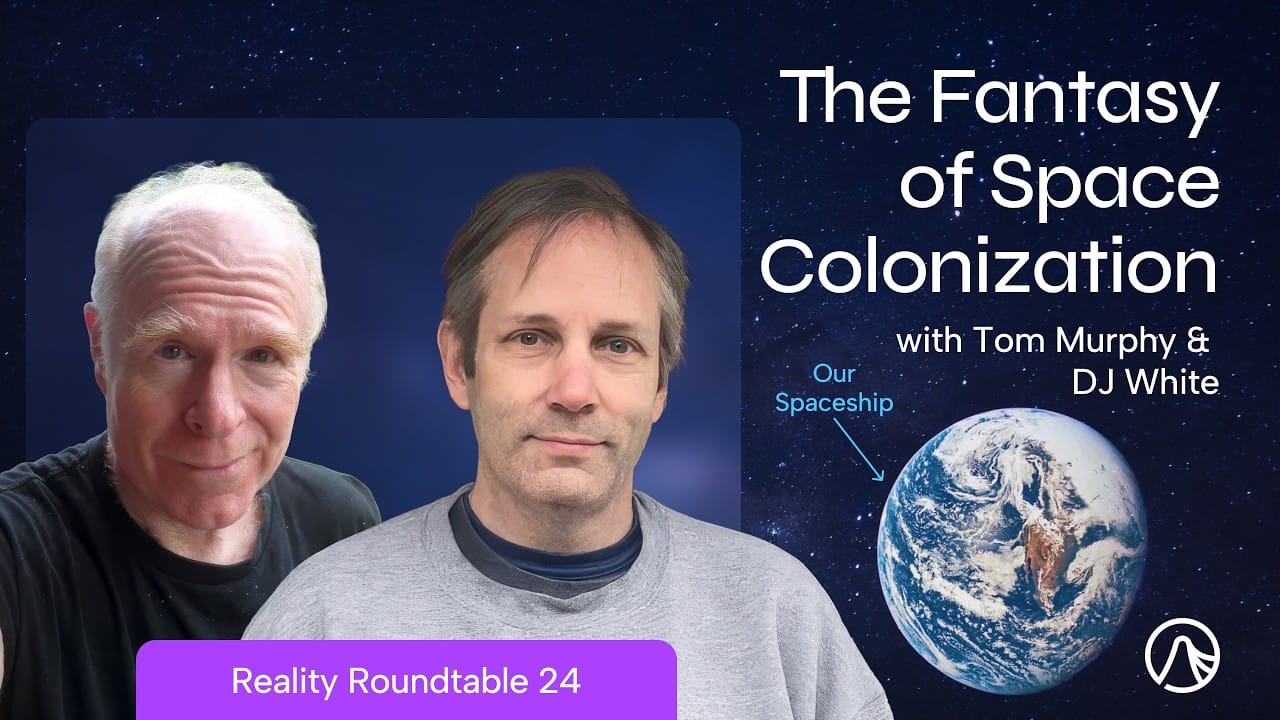
Original source: Nate Hagens
This article is an editorial summary and interpretation of that content. The ideas belong to the original authors; the selection and writing are by Streamed.News.
This video from Nate Hagens covered a lot of ground. 6 segments stood out as worth your time. Everything below links directly to the timestamp in the original video.
Space colonisation is often discussed as a question of ambition and engineering. This segment makes the case that it is neither — the basic ecological science required to keep humans alive off-Earth has not been attempted, let alone solved.
Physicist Enumerates the Barriers to Mars and Moon Colonisation: Toxic Soil, Bone Loss, and No Life Support for Even a Cockroach
The fundamental obstacles to human settlement in space are not engineering puzzles awaiting clever solutions — they are stacked, compounding physical realities that no one is seriously attempting to solve. That is the central argument made by physicist Tom Murphy, who laid out a systematic case against the viability of Moon and Mars colonisation that goes well beyond the familiar complaint that rockets are expensive.
The International Space Station, Murphy noted, costs roughly $1 billion per astronaut per year to operate — a figure that underscores just how completely off-Earth habitation depends on constant resupply from the planet below. Mars compounds every problem: its atmosphere is 95 percent carbon dioxide at roughly one percent of Earth's atmospheric density, making it functionally a near-vacuum. Its soil is laced with perchlorates, toxic compounds that would contaminate any attempt to grow food. Low gravity causes bone loss and eye degeneration even in astronauts aboard the ISS, who must exercise strenuously on treadmills just to slow the deterioration — and still require months to recover mobility after returning to Earth.
Perhaps the most striking data point in Murphy's argument is ecological rather than physical: no one has yet built a closed life-support system capable of keeping even a cockroach alive indefinitely. That threshold — far simpler than sustaining humans — has not been crossed, and according to Murphy, it is not even being seriously pursued. The research simply is not happening. As his co-guest noted, anyone who reaches Mars will be arriving on what amounts to a one-way trip, living in a cave, eating perchlorate-contaminated food, and hoping their supply launches from Earth do not fail.
"Show me that for a cockroach and maybe I'll start to think you can do it for a human — but come on, they're not even working on the problem."
Deep Space Radiation Exposure of 300–600 Millisieverts Per Year Makes Long-Term Habitation Lethal, Physicist Says
Living in deep space would expose humans to radiation levels roughly 300 times higher than on Earth's surface — enough, according to physicist Tom Murphy, to virtually guarantee premature death from cancer for anyone who stays long enough. The numbers Murphy presented are specific and stark: on Earth, shielded by atmosphere and magnetosphere, the average person receives about two millisieverts of radiation per year. On the Moon that rises to roughly 300 millisieverts; in deep space or aboard a hypothetical O'Neill-type orbital colony, the figure reaches 600 millisieverts annually.
The significance of those numbers becomes clear when set against the medical threshold Murphy cited: one sievert of cumulative exposure raises cancer risk by roughly five percent. At 300 to 600 millisieverts per year, a person accumulates seven sieverts — the point at which cancer risk roughly doubles — within about 25 years. Murphy noted that shielding is theoretically possible, but requires the equivalent of ten metres of water surrounding the habitat, which is why cave-dwelling is the only realistic option on the lunar or Martian surface. Even then, secondary radiation produced when high-energy cosmic rays strike spacecraft walls creates an additional hazard that shielding cannot fully eliminate.
Beyond the physical dangers, the psychological dimension of a Mars mission adds its own category of risk. A guest with expertise in human behaviour pointed out that once a crew is past the halfway point to Mars, there is no turning back — no rescue capsule, no emergency return. Crew members who experience mental breakdown or suicidal crisis mid-journey would have to be medicated and physically restrained, with no access to surgical care or psychiatric support. The combination of no-return commitment, extreme isolation, and physical confinement makes the psychological risks as serious as the radiological ones.
"Long-term space habitation is basically guaranteed to end in cancer. But I'm only kind of joking there, because you'd likely face desiccation, starvation, decompression, or bone failure first."
Asteroid Mining Economics Collapse Under Basic Physics: Retrieved Dirt Costs $132,000 Per Ounce
The promise of asteroid mining — that humanity can escape resource scarcity by tapping the mineral wealth of the solar system — founders on a number that proponents rarely advertise: the only time a space mission retrieved material from an asteroid and returned it to Earth, the dirt worked out to approximately $132,000 per ounce. Not platinum. Not gold. Dirt. That figure, cited by physicist Tom Murphy, captures the core problem with the entire concept before any question of engineering feasibility even arises.
The underlying physics is the rocket equation, which describes the brutal relationship between a spacecraft's mass and the fuel required to move it. In practice, a rocket launching from Earth is roughly 90 percent fuel by mass, leaving only around 10 percent for everything else — the vehicle, the crew, the equipment, and any cargo being returned. To retrieve meaningful quantities of asteroid material, a mission would need to carry enough propellant to match the asteroid's trajectory, collect the material, and return it — a process that would require, in Murphy's words, several asteroids' worth of fuel just to retrieve the contents of one.
The market economics compound the physical problem. Even if a mission successfully returned large quantities of a valuable metal like nickel, flooding the terrestrial market with that material would immediately depress its price to the point of worthlessness — a dynamic illustrated in the film referenced during the conversation. Murphy assessed the entire enterprise as failing not just technically but commercially, noting that space mining ventures have not succeeded financially despite years of effort. The concept, he argued, does not occupy the "real axis" of possibility — it is a compelling story that collapses under quantitative scrutiny.
"The cost works out to about $132,000 per ounce — and this wasn't metal, this was dirt."
Space Colonisation Believers Invoke Human Ingenuity — but No One Is Building the Life Support to Back It Up
The most common rebuttal to physical critiques of space colonisation is an appeal to human ingenuity: the barriers seem insurmountable today, but given enough time and demand, human cleverness will find a way. Tom Murphy and his co-guest argued that this response reflects a specific and flawed assumption embedded in mainstream economic thinking — the neoclassical idea that sufficiently high prices will always call forth a solution.
Murphy traced that assumption to the experience of the fossil fuel era, when two centuries of abundant energy made it appear as though human demand could indeed conjure almost anything. That appearance, he argued, was a product of unique historical circumstances rather than a permanent feature of reality. The same logic that says markets will solve the life-support problem on Mars would, taken seriously, imply that markets could also deliver immortality or robot bodies — claims that expose the circularity of the argument.
The more pointed challenge Murphy and his co-guest issued was empirical rather than philosophical: if human ingenuity were genuinely being applied to the problem of surviving in space, someone would at least be working on closed ecological life-support systems. No one is. The threshold they set as a minimum proof of concept — a fully closed system capable of sustaining a cockroach indefinitely — has not been achieved, and the research to achieve it is not underway. The space industry, they argued, is focused on launch stunts and orbital demonstrations rather than the slower, unglamorous ecological science that actual colonisation would require. That gap between the ambition being promoted and the work being done, they concluded, is the clearest indicator that the ingenuity argument is being invoked as a substitute for progress rather than a description of it.
"They're not even working on the problem — they're ecologically ignorant."
Space Colonisation Beliefs Persist Through Sci-Fi Saturation, Fossil Fuel Extrapolation, and 'Energetic Remoteness'
If the physical and economic case against space colonisation is as strong as its critics argue, why do so many highly intelligent people remain convinced it is inevitable? Tom Murphy and his co-guest offered a multi-layered cultural and psychological explanation, rooted in the specific conditions under which modern technological optimism developed.
Murphy pointed to the fossil fuel era as the foundational context. The past two centuries of extraordinary material progress were powered by an unprecedented energy subsidy — the stored solar energy of hundreds of millions of years, burned in a few generations. People raised in that environment naturally extrapolated its trajectory forward, assuming that the pace of transformation they had witnessed was a permanent feature of human civilisation rather than a product of singular historical circumstances. Space travel arrived at the peak of that confidence, becoming culturally fused with the sense that anything was achievable.
His co-guest introduced the concept of 'energetic remoteness' to describe a specific gap in public intuition: the inability to grasp that vast quantities of resources — oceans of methane on Saturn's moon Titan, for instance — can be simultaneously real and completely inaccessible, not because of engineering limitations but because the energy required to exploit them would exceed any plausible return. This concept, he argued, is poorly understood and rarely taught, leaving people unable to distinguish between resources that exist and resources that are usable. The cultural infrastructure of science fiction, he added, fills that gap with images of abundance that treat physics as a negotiable obstacle rather than a hard constraint.
"Maybe it's a psychological antidote to the carbon pulse — instead of facing what's coming, we replace it with this story."
Space Ambitions Will Be Rendered Moot by Economic Simplification Before They Could Be Realised, Speakers Argue
The debate over whether humanity can colonise space may be overtaken by a more immediate question: whether the industrial civilisation required to attempt it will remain intact long enough to try. Tom Murphy argued that the coming contraction of global economic complexity — what he and host Nate Hagens called the Great Simplification — will make space ambitions irrelevant long before the technical barriers could be addressed.
Murphy illustrated the fragility of the supply chains that underpin advanced technology with a personal example: building a precision instrument as a side project, he found that supply disruptions stemming from the COVID pandemic made a third of the hundred-plus components he needed difficult or impossible to source. That was a minor disruption by historical standards. A sustained decline in population or economic output, he suggested, would cascade through interconnected industrial systems in ways that would make maintaining present-day technological complexity extremely difficult, let alone expanding it toward space.
As for what is actually driving space colonisation advocacy, Murphy identified three overlapping motivations: genuine awareness of existential risks to life on Earth, the profit incentives of startups and investors, and what he called a myth-of-progress mindset that treats the expansion of human reach as intrinsically valuable regardless of feasibility. He noted without naming names that the leading billionaire proponent of multi-planetary colonisation has financial interests that make the framing convenient. The deeper problem, he argued, is that there is no viable glide path — no sequence of steps that would allow humanity to maintain and then extend its technological capabilities through the kind of demographic and economic decline that current trends suggest is approaching.
"I don't know how you maintain the complexity we'd need — a supply chain hiccup from COVID made a third of the parts I needed genuinely hard to find."
▶ Watch this segment — 1:15:14
Also mentioned in this video
- Earth as a perfectly tuned spaceship and argues that every part of Earth is… (0:00)
- His two decades of NASA-funded astrophysics research, including lunar laser… (3:02)
- His journey from childhood sci-fi enthusiasm and space fascination to… (7:29)
- So many people believe in space mining fantasies, citing magical thinking,… (17:51)
- Tom Murphy details the severe practical barriers to Moon and Mars colonization,… (25:03)
- Space colonization advocates focus on transportation ('the commute') while… (34:42)
- Earth as already a spaceship traveling through space, emphasize that every… (41:28)
- The guests discuss generation ships as pure fantasy, noting no technology… (58:21)
- Tom Murphy cites his 2012 survey of physics professors and students showing… (1:02:07)
- The real profound frontier is Earth itself (1:08:09)
- Space enthusiasts toward Earth-based action (1:24:34)
Summarised from Nate Hagens · 1:35:15. All credit belongs to the original creators. Streamed.News summarises publicly available video content.
Streamed.News
This publication is generated automatically from YouTube.
Convert your full video library into a digital newspaper.
Get this for your newsroom →