Original source: Boeing
This article is an editorial summary and interpretation of that content. The ideas belong to the original authors; the selection and writing are by Streamed.News.
This video from Boeing covered a lot of ground. 6 segments stood out as worth your time. Everything below links directly to the timestamp in the original video.
A spacecraft designed to carry astronauts just landed itself — because NASA decided the risk of putting people inside was too great. The capsule performed perfectly; the mission that preceded it did not go as planned.
Boeing Starliner Lands Uncrewed in New Mexico Desert at 11:01 p.m.
Boeing's Starliner capsule touched down at White Sands Space Harbor on the US Army's missile range in New Mexico at precisely 11:01:35 p.m. Central Time, completing a successful autonomous return from the International Space Station. With no crew aboard, flight controllers in mission control remotely commanded the parachutes to be cut away after landing — a procedural difference from a standard crewed return, where astronauts would normally handle that step themselves.
The landing capped one of the more unusual missions in recent American spaceflight history. Starliner's two astronauts, Butch Wilmore and Sunita Williams, remained on the space station and will return separately aboard a SpaceX vehicle, leaving the Boeing capsule to prove it could navigate the final leg home on its own. Controllers described the descent as flawless, with all six airbags confirmed good and cheers audible in the background at mission control.
"Really just a flawless and beautiful descent of Starliner today."
▶ Watch this segment — 1:16:53
NASA Returns Boeing Starliner Without Its Crew After Safety Review Raises Concerns
Boeing's Starliner capsule undocked from the International Space Station and began an autonomous journey back to Earth without the two astronauts it carried into orbit, after NASA concluded that unresolved technical problems posed unacceptable risks for a crewed return. The decision followed a flight test readiness review in which engineering teams, despite months of analysis and testing, could not achieve sufficient expert agreement that the spacecraft met human spaceflight safety standards. Astronauts Butch Wilmore and Sunita Williams, who launched in June, stayed aboard the station.
The situation is rare in the history of American spaceflight: a crew capsule returning empty while its passengers wait for a ride home on a competitor's vehicle. Wilmore and Williams formally joined the station's long-duration crew and are expected to remain there until February 2025, returning aboard a SpaceX Dragon as part of the Crew-9 mission. NASA framed the uncrewed return not merely as a safety measure but as an opportunity to gather additional test data on Starliner's performance during re-entry.
"Uncertainty and lack of expert concurrence did not meet the agency's safety and performance requirements for human spaceflight."
Starliner's Final Descent: Six Good Airbags, Three Good Parachutes, Textbook Re-entry
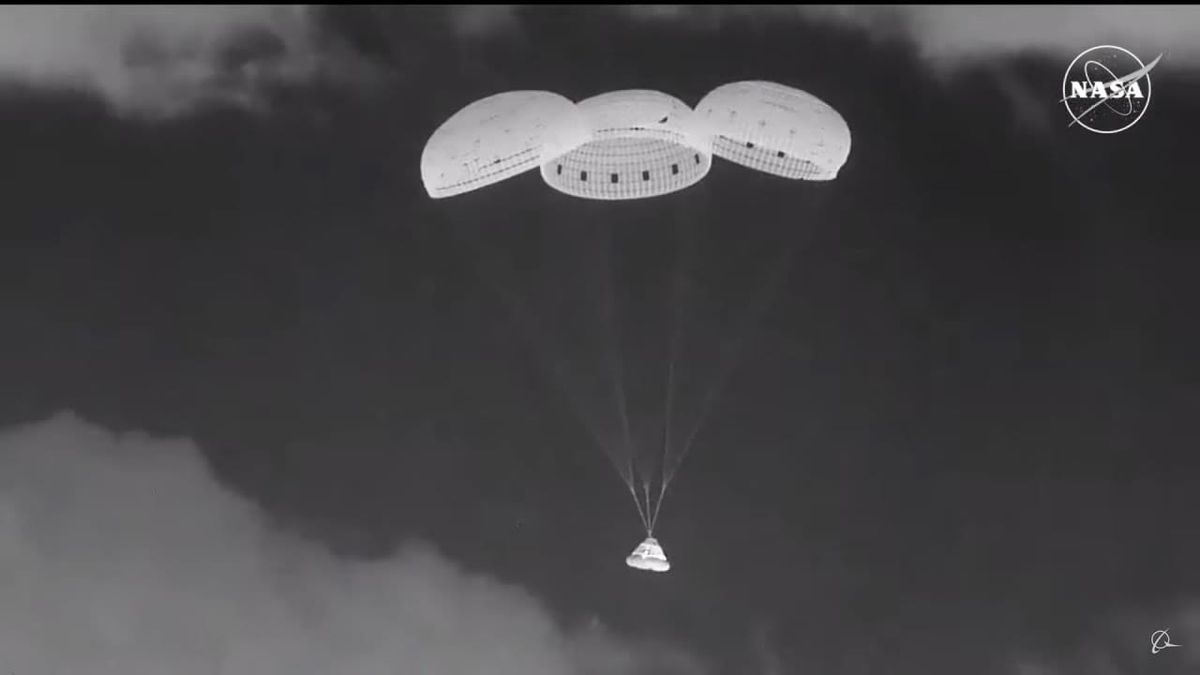
In the final minutes before touchdown, Starliner executed each descent milestone in rapid succession and on schedule. The forward heat shield was jettisoned to clear the way for two drogue parachutes, which slowed the capsule to a speed safe for the three main parachutes to deploy. Recovery teams on the ground reported hearing the audible booms of the mains deploying. The base heat shield then separated, allowing six nitrogen-filled airbags to inflate — all six confirmed functional by flight controllers — cushioning the capsule for its landing on the New Mexico desert floor.
The sequence unfolded over roughly four minutes and was captured live by aircraft-mounted cameras, including a high-altitude WB-57 research plane and a lower-flying Cessna. The clean run through each stage carried particular significance given the propulsion difficulties that had shadowed the mission since June. Controllers confirmed every system performed as expected, offering Boeing and NASA engineers a dataset from a re-entry that went precisely as designed.
"Three good parachutes looking great."
▶ Watch this segment — 1:11:27
Starliner's Deorbit Burn Completes Successfully, Setting Course for New Mexico Landing
Four of Starliner's orbital maneuvering and attitude control thrusters fired for 59 seconds, generating roughly 6,000 pounds of thrust to slow the capsule from orbital velocity and pull it out of its flight path around Earth. Mission control confirmed the burn completed cleanly, with the spacecraft maintaining correct attitude throughout, assisted by smaller reaction control thrusters. The burn committed Starliner to a touchdown at White Sands, New Mexico, approximately 44 minutes later.
The successful deorbit burn was a critical moment given the thruster problems that had defined the mission. NASA and Boeing ran approximately one million computer simulations ahead of the return, modeling different thruster combinations to ensure a safe path home under various failure scenarios. The confirmation of a clean burn reduced the remaining variables to re-entry heating and parachute deployment — the final stages of a closely watched mission.
"All good — thrusters firing well."
Helium Leaks and Thruster Failures: How Starliner's June Mission Unravelled
When Starliner arrived at the International Space Station on June 6th, engineers almost immediately detected helium leaks and encountered problems with the reaction control thrusters that help steer the vehicle during approach. In the weeks that followed, teams conducted extensive ground and flight testing, commissioned independent reviews from propulsion experts, and developed multiple contingency return plans — yet could not resolve the uncertainty to NASA's satisfaction. The result was a decision to leave Wilmore and Williams aboard the station and bring Starliner home empty.
The two astronauts will eventually return aboard a SpaceX Dragon capsule as part of the Crew-9 mission alongside NASA astronaut Nick Hague and Russian cosmonaut Alexander Gorbunov, with a projected departure in February 2025. The episode adds a complicated chapter to Starliner's development history and raises questions about the programme's path toward regular crewed service, with Boeing's capsule now needing to demonstrate reliability before NASA certifies it to fly astronauts routinely.
Another Starliner Thruster Fails After Undocking, But Engineers Say Landing Unaffected
After Starliner separated from the space station, flight controllers ran a series of post-undocking thruster tests and found that one of the twelve small reaction control system jets on the crew module failed to fire on command. The thrusters in question steer the capsule during the final phase of re-entry, after the service module separates. However, because the twelve jets are arranged in two independent strings of six, losing one reduces redundancy without eliminating the capability — and controllers confirmed no impact on the deorbit burn or landing approach.
The finding adds to a pattern of propulsion anomalies that have followed Starliner throughout the mission, though engineers stressed that the spacecraft retains sufficient backup systems to complete a normal landing. Despite the new failure, flight director Rick Henfling received a formal 'go' from all flight controllers, clearing Starliner for its planned deorbit burn. The episode illustrates both the fragility of the programme's hardware and the layers of redundancy engineers built in to compensate.
"No impact to the deorbit burn or re-entry — it's not required for flight rules."
Also mentioned in this video
- A recorded audio exchange from earlier in the day is played in which astronauts… (9:39)
- On-site weather conditions, convoy equipment, and tracking cameras ready for… (14:48)
- No onboard video will be available during descent, and show dark live camera… (17:46)
- Hosts detail the landing and recovery team preparations at White Sands,… (22:42)
- Hosts confirm everything is on track for the 10:17 p.m. CT deorbit burn now… (27:17)
- The service module separation process, describing how jettisoning the module… (33:45)
- Hosts confirm the service module has separated and is falling away to burn up… (39:54)
- With about 14 minutes to entry interface, hosts check back in with the landing… (46:05)
- Hosts count down to entry interface, describing Starliner's trajectory over the… (53:48)
- The ablative heat shield process, and preview the upcoming milestones of… (1:01:06)
- Hosts report Starliner has exited the blackout period with all systems nominal,… (1:07:11)
- Their view of Starliner's descent and the recovery convoy moving toward the… (1:20:09)
Summarised from Boeing · 1:26:30. All credit belongs to the original creators. Streamed.News summarises publicly available video content.
Streamed.News
This publication is generated automatically from YouTube.
Convert your full video library into a digital newspaper.
Get this for your newsroom →