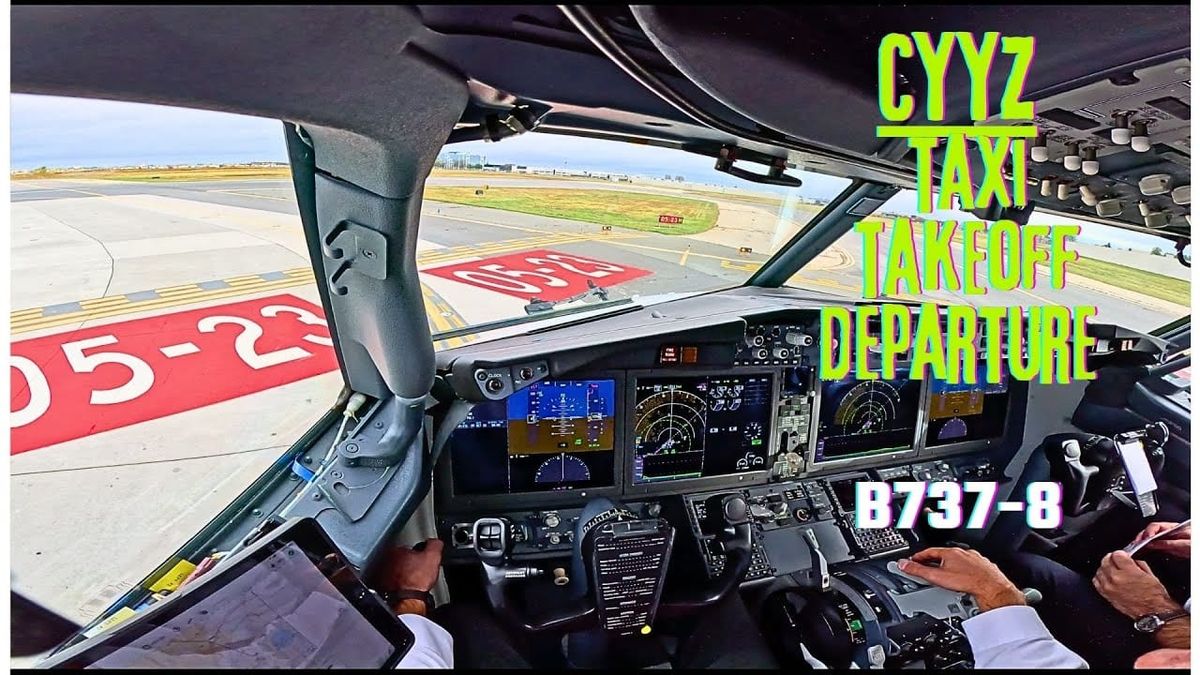
Original source: Pilot View
This article is an editorial summary and interpretation of that content. The ideas belong to the original authors; the selection and writing are by Streamed.News.
This video from Pilot View covered a lot of ground. 3 segments stood out as worth your time. Everything below links directly to the timestamp in the original video.
Every commercial departure involves a chain of safety checks you never hear about as a passenger. Wake turbulence from a preceding jet can be serious enough that controllers routinely delay the next aircraft's takeoff to let it dissipate.
Airport Tower Juggles Turbulence Warnings and Multi-Runway Traffic in Routine Departure Sequence
Air traffic controllers at a busy airport managed simultaneous departure and arrival traffic across two runways, issuing turbulence warnings to pilots following a Boeing 737 departure. Controllers cautioned at least two aircraft about wake turbulence — the invisible, potentially destabilizing air disturbance left behind by a departing jet — before clearing them for takeoff on Runway 23, while separately directing a Boeing 787 arrival onto Runway 24 Left.
The exchange illustrates the layered, real-time decision-making that controllers perform continuously, balancing the sequencing of departures with the need to protect following aircraft from hazardous wake effects. Wake turbulence management is one of the most persistent safety considerations in commercial aviation, particularly when heavier aircraft like the 737 or 787 precede smaller or lighter traffic.
Cockpit Recording Captures the Methodical Pre-Taxi Safety Ritual Before Every Commercial Flight
Before a commercial aircraft moves a single metre from the gate, its crew works through a structured checklist covering hydraulic systems, engine start switches, anti-icing, air conditioning, flap position, stabilizer trim, and flight control verification. In this recording, the crew sets flaps to five degrees, confirms a stabilizer trim of 6.9 units, and verifies flight controls before declaring the pre-taxi checklist complete — a process that takes under two minutes but underpins every safe departure.
The ritual reflects a discipline built over decades of aviation safety research: standardised checklists exist precisely because human memory, even under normal conditions, is unreliable for multi-step technical procedures. The brevity of the exchange belies the consequence of any item missed.
Final Checks, Clearance, and Climb: The Last 90 Seconds Before a Jet Leaves the Ground
In the moments before receiving takeoff clearance on Runway 23, the flight crew confirms flap settings, cabin security, and fuel load — more than 12,600 units on board — before acknowledging the clearance and accelerating down the runway. Once airborne, the crew checks in with departure control at 1,500 feet, is identified on radar, and receives a climb instruction to flight level 230, approximately 23,000 feet. The flap retraction sequence follows in stages as the aircraft accelerates through 250 knots.
The sequence captures a critical transition point in any flight: the hand-off from tower to departure control, where responsibility for the aircraft shifts from ground-based sequencing to en-route separation. Each radio call and checklist item in this phase is time-sensitive, with the crew managing aircraft configuration changes simultaneously with communication and navigation tasks.
Summarised from Pilot View · 15:46. All credit belongs to the original creators. Streamed.News summarises publicly available video content.
Streamed.News
This publication is generated automatically from YouTube.
Convert your full video library into a digital newspaper.
Get this for your newsroom →