Original source: Pilot _obet
This article is an editorial summary and interpretation of that content. The ideas belong to the original authors; the selection and writing are by Streamed.News.
This video from Pilot _obet covered a lot of ground. 3 segments stood out as worth your time. Everything below links directly to the timestamp in the original video.
The next time a cargo plane diverts unexpectedly, it may be because the crew is deliberately suffocating a fire by climbing to the edge of breathable altitude — a procedure most passengers have never heard of.
Boeing 747-8 Freighters Have No Main-Deck Fire Extinguishers — Pilots Starve Flames of Oxygen Instead
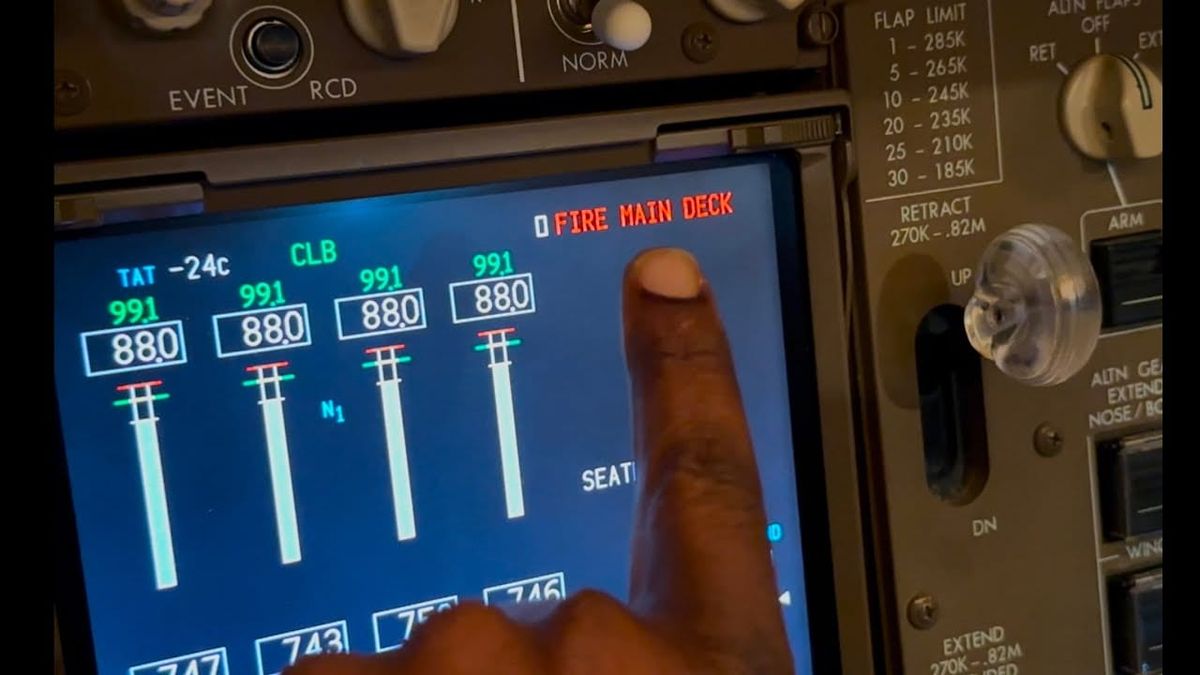
When a cargo fire breaks out on the main deck of a Boeing 747-8 freighter, pilots cannot simply discharge chemical extinguishant — because none exists for that space. Instead, a dedicated depressurization switch deliberately allows the cabin altitude to climb to 25,000 feet, a height at which the atmosphere contains so little oxygen that any fire struggles to sustain itself. The crew, already on supplemental oxygen, is unaffected by the thinning air while the fire is slowly choked out below them. The maneuver runs automatically once triggered, and happens in parallel with the aircraft already being turned toward the nearest suitable diversion airport.
The design reveals a significant philosophical divide in aviation fire suppression: lower cargo holds, where passenger baggage travels, do carry chemical extinguisher systems, but the cavernous main deck — the economic heart of a freighter operation — relies entirely on atmospheric denial. It is a reminder that even the most routine-seeming safety systems involve calculated trade-offs, and that freight aviation operates under constraints and procedures largely invisible to the travelling public.
"We don't have fire extinguishers for the main deck — so the strategy used is to starve the main deck of oxygen by raising the cabin."
747-8 Freighter Fire Procedure Deliberately Shuts Down Two of Three Air Systems — But Not the Third
Arming the main deck cargo fire switch on a Boeing 747-8 freighter automatically kills two of the aircraft's three air-conditioning packs, but leaves the third — pack one — deliberately running. The reason is counterintuitive: maintaining airflow through the cockpit prevents smoke from accumulating where the pilots sit and need to see. Crews are explicitly instructed that if pack one happens to be off due to a separate fault, they should switch it back on even if it triggers a new warning message, because any airflow is better than none. The same checklist step also activates oxygen supplies for non-crew personnel, such as animal handlers or other supernumerary staff riding on the upper deck.
The sequence illustrates how cargo aircraft emergency procedures must account for a wider and less predictable cast of occupants than passenger jets. A freighter might carry grooms, veterinarians, or couriers alongside its cargo, and the systems protecting them are identical in function — if not in labelling — to the passenger oxygen masks familiar from safety briefings.
"Pack number one is the important one that actually gives the airflow through the cockpit — that's the last pack to come off."
Inside a 747-8 Freighter Cargo Fire Drill: How Pilots Respond in the First Seconds
The opening moments of a simulated main-deck cargo fire on a Boeing 747-8 freighter illustrate just how quickly a flight crew must shift from routine operations to emergency response. A master warning fires, a fire alert appears on the central display, and the first item on the electronic checklist is immediate: get oxygen masks on before smoke can incapacitate the crew. The checklist frames the entire emergency around two objectives — suppress the fire and land as soon as possible — with every subsequent action subordinate to those two goals.
Along the way, the drill surfaces a detail relevant beyond freighters: on passenger aircraft, one of the first responses to reported cabin smoke is switching off recirculation fans, because their electric motors are a common ignition source. The procedure on the freighter echoes that logic, with the checklist automatically halting those fans when the fire warning triggers. For most travellers, these fans are invisible infrastructure — but they represent one of the more frequent culprits behind in-flight smoke reports.
"Quite often the recirculation fans are the ones that would fail and cause smoke to get into the cabin."
Also mentioned in this video
- The scenario of a main deck cargo fire on a 747-8 freighter at 35,000 ft and… (0:03)
- The presenter physically demonstrates how to don and purge the oxygen mask,… (4:11)
- The presenter continues through the electronic checklist covering diversion… (14:13)
- The presenter summarises the full main deck fire procedure, then gives a… (17:28)
Summarised from Pilot _obet · 20:35. All credit belongs to the original creators. Streamed.News summarises publicly available video content.
Streamed.News
This publication is generated automatically from YouTube.
Convert your full video library into a digital newspaper.
Get this for your newsroom →