Original source: BAA Training
This article is an editorial summary and interpretation of that content. The ideas belong to the original authors; the selection and writing are by Streamed.News.
This video from BAA Training covered a lot of ground. 3 segments stood out as worth your time. Everything below links directly to the timestamp in the original video.
The next time you hear a cabin crew safety briefing, consider that the pilots above you are trained to handle a pressure loss through pure muscle memory, with every second counting.
Inside the Cockpit: How Airbus A320 Crews Train for Sudden Decompression at 35,000 Feet
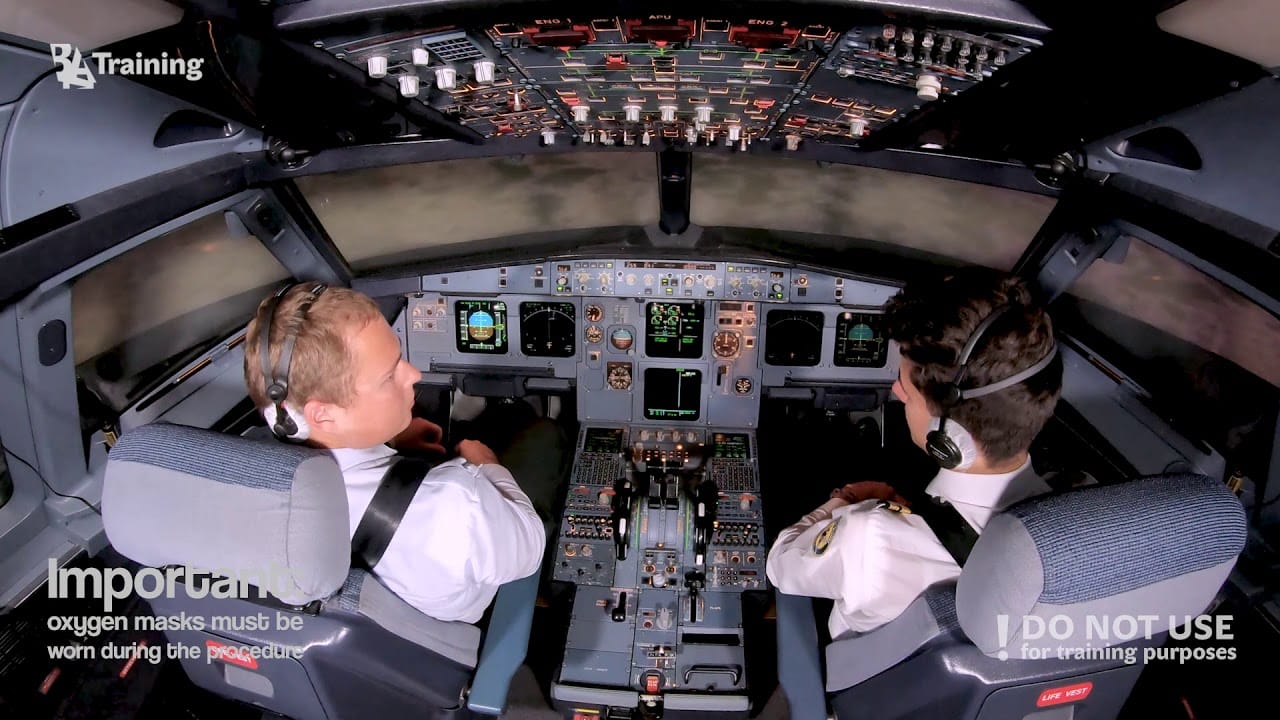
When cabin pressure fails at cruising altitude, A320 pilots have no time to consult a checklist. This training demonstration reveals the sequence of memorised actions both crew members must execute immediately: the handling pilot turns on seatbelt signs, switches the engine mode selector to ignition, dials in emergency transponder code 7700, and broadcasts a Mayday to air traffic control, while the flying pilot simultaneously initiates a rapid descent to 10,000 feet, deploys passenger oxygen masks, and banks the aircraft roughly 30 degrees off its airway to clear other traffic. In a structural failure scenario, airspeed is deliberately held constant to avoid worsening the damage.
The drill illustrates why aviation safety depends so heavily on memorised procedure rather than in-the-moment decision-making. At altitude, useful consciousness without supplemental oxygen can last under a minute, leaving crews almost no margin to think through steps they haven't already internalised.
"In case of depressurization we should turn away from our airway approximately by 30 degrees — and since we have a structural failure, we want to maintain our present airspeed to avoid further damage."
Simulated Mayday Call Shows the Real-Time Choreography of an Aviation Emergency
A training exercise captures the moment a crew broadcasts a Mayday call following simulated structural failure and cabin decompression, requesting clearance to descend to flight level 100 — roughly 10,000 feet. Air traffic control confirms the descent and asks the crew to verify the minimum safe altitude below that level. Simultaneously, the pilots deploy passenger oxygen masks and begin working through the aircraft's automated warning system, which flags a cabin altitude above 14,000 feet — the threshold at which the air becomes dangerously thin for unprotected passengers.
The exchange shows how tightly scripted these interactions are under pressure. Every radio call follows a fixed format, and the aircraft's onboard alert system guides crews through follow-on checks even as they manage the descent. The coordination between cockpit and ground control is designed to leave as little room for ambiguity as possible during the most critical phase of any emergency.
Pilots Detail Structural Failure to Air Traffic Control Mid-Descent in Training Scenario
As the simulated emergency descent continues, the crew formally reports both the decompression and an anticipated structural problem to air traffic control, receiving confirmation to proceed to flight level 100. Pilots manage the aircraft's speed carefully through 250 knots — a threshold below which handling characteristics change — before levelling off, at which point the immediate threat is considered contained and the crew can address remaining checklists.
The sequence underscores a layered approach to crisis management in commercial aviation: stabilise the aircraft first, communicate the situation to the ground second, and only then turn to secondary procedures. The requirement to verbally describe the nature of a structural failure mid-descent reflects how controllers use that information to clear airspace and prepare emergency services on the ground.
Also mentioned in this video
Summarised from BAA Training · 7:28. All credit belongs to the original creators. Streamed.News summarises publicly available video content.
Streamed.News
This publication is generated automatically from YouTube.
Convert your full video library into a digital newspaper.
Get this for your newsroom →