Original source: Flightradar24
This article is an editorial summary and interpretation of that content. The ideas belong to the original authors; the selection and writing are by Streamed.News.
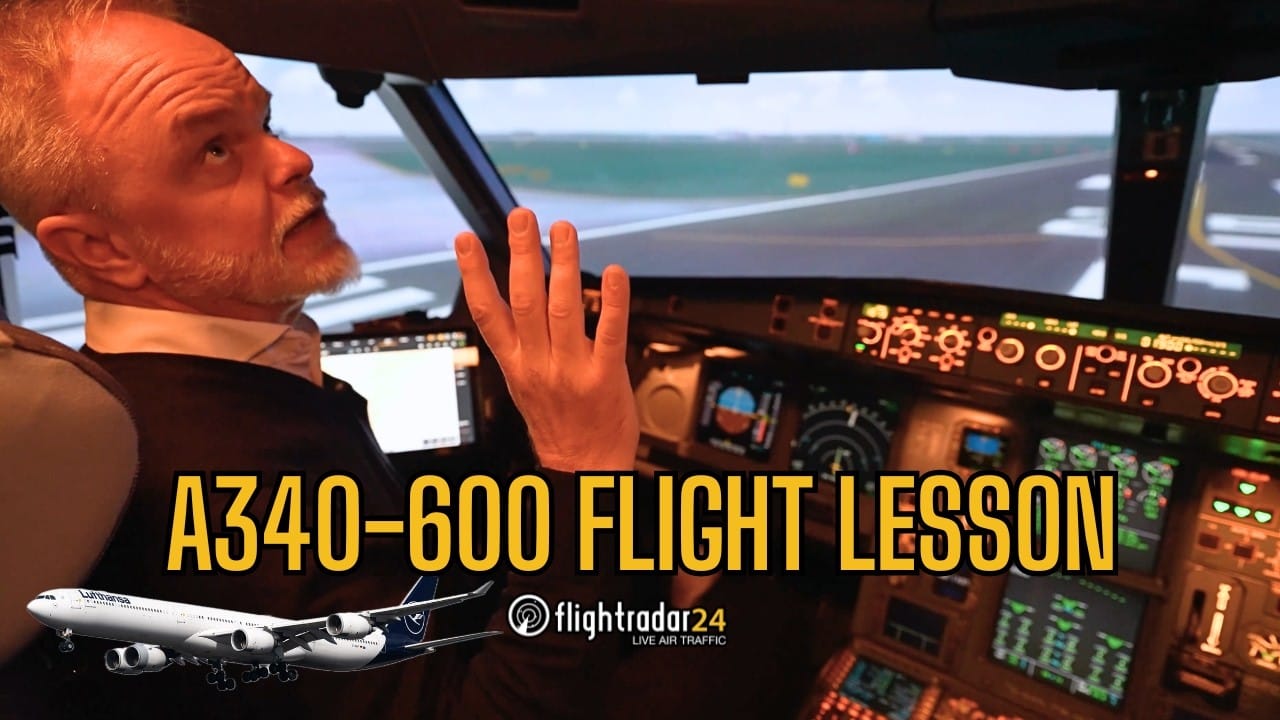
This video from Flightradar24 covered a lot of ground. 6 segments stood out as worth your time. Everything below links directly to the timestamp in the original video.
This segment shows the critical, step-by-step actions pilots take during a sudden engine fire on takeoff, highlighting the immediate decisions required for passenger safety.
Pilot Demonstrates Engine Fire Emergency on Takeoff in Airbus Simulator
During a simulated rejected takeoff, pilots must swiftly address an engine fire by first silencing alerts and notifying Air Traffic Control (ATC) of the emergency. The immediate procedural steps involve alerting the cabin crew, shutting off the affected engine's master switch, activating the fire push button, and then discharging fire extinguishing agents one and two until their respective lights indicate completion. This sequence is critical for containing the fire on the ground.
"So now the fire disappeared. So this is important that pilots notice that the message or the ECOM disappears."
Airbus Design Feature Requires Specific Landing Technique, A340-600 Needs Precise Rotation
Airbus aircraft are designed to automatically lower the nose by approximately two degrees at 50 feet above the runway, forcing the pilot to actively lift the nose for a soft landing. This design requires minimal control inputs compared to other aircraft, such as Boeings, where larger inputs are typically needed. Pilots must anticipate this automatic pitch change and apply subtle back pressure to maintain the desired attitude.
"Like the design of every Airbus is at around 50 ft. It lowers the nose to be 8 seconds later at minus 2. By doing this the pilot without knowing this is forced to lift the nose up."
Pilot Details Standard Aircraft Takeoff Procedure in Simulator
Executing a takeoff sequence begins with starting a stopwatch and checking annunciators to confirm all systems are operational. Pilots then set takeoff power to the target EPR ratio, with the pilot monitoring confirming "thrust is set." Brakes are held until a speed of 1.1 is reached, then released. Key speed calls follow, including "100 knots" and "V1" from the computer, prompting the pilot to call "rotate."
"So we normally would have done like the briefing then we would start the stopwatch like on every flight we start the stopwatch and then I said okay take off and then I'm reading the annunciators here to see that everything is running like it should."
Pilot Instructions Detail Takeoff Pitch and Manual Flight Transition
During takeoff, after the "rotate" call, pilots must swiftly pull and hold the stick to achieve a precise 12.5-degree pitch, maintaining this angle until the aircraft confirms a "positive climb." Once a positive climb is established, the command "gear up" is given, and the landing gear is retracted. This sequence ensures a controlled and safe ascent immediately after liftoff.
"And the goal is to have the this pitch indicator. The cross will disappear once we are airborne at 12.5°."
Pilot Guides Landing Approach, Emphasizing Crosswind Correction
To begin a landing approach, pilots should set flaps to position two as the aircraft passes the beam point, managing speed and altitude carefully. Tailwinds necessitate a reduction in the standard 45-second outbound flight time by approximately five seconds, while maintaining a consistent sink rate of about 0.8. The goal is to aim for the midpoint between the runway and the aircraft's position, not directly at the runway.
"And always aim for the midpoint between the runway and our position. Not to aim on the runway as you're we're trying to have a a straight final."
Pilot Explains Critical Manual Night Landing Strategy
Performing a manual landing in night conditions requires pilots to use minimal control inputs and maintain a relatively high initial power setting. A crucial technique is to resist the natural urge to "dive" towards the runway lights, which can be deceptive in the dark. Instead, pilots must focus on maintaining a consistent and controlled sink rate throughout the final approach.
"And if you just see now the the runway or the lights, it's very important not to dive."
Also mentioned in this video
- The Lufansa training center in Frankfurt houses 22 full-flight simulators,… (0:21)
- Lufansa Aviation Training distinguishes itself through its long experience with… (1:04)
- Klouse provides a detailed tour of the simulator's cockpit, explaining the… (1:58)
- He continues the cockpit tour by explaining the center pedestal with thrust… (4:13)
- Klouse demonstrates the engine status, current location at Frankfurt runway 25,… (5:50)
- The unique flight control system of the Airbus, which uses multiple flight… (7:04)
- When the simulator switches to A340-600 mode, the thrust levers and fuel panel… (8:07)
- The landing approach including flap settings, gear down, speed management, and… (10:40)
- The guest practices landing the Airbus, receiving guidance on subtle control… (14:22)
- Rejected takeoff procedures, explaining that the captain typically decides to… (17:32)
- The need to maintain an attitude of 10 degrees nose up. (20:17)
- Klouse praises the guest's landing, reiterating the Airbus's design philosophy… (24:09)
- Klouse guides the guest on another landing attempt with the flight director,… (24:34)
- The difference between Boeing and Airbus thrust lever systems, noting that… (25:21)
- Klouse mentions having flown an Airbus 220 and an A320, noting that the A320 at… (31:08)
Summarised from Flightradar24 · 32:45. All credit belongs to the original creators. Streamed.News summarises publicly available video content.
Streamed.News
This publication is generated automatically from YouTube.
Convert your full video library into a digital newspaper.
Get this for your newsroom →