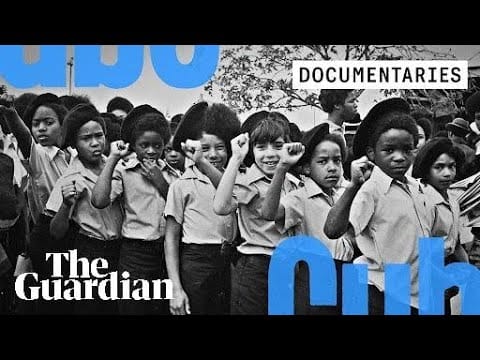
Original source: The Guardian
This article is an editorial summary and interpretation of that content. The ideas belong to the original authors; the selection and writing are by Streamed.News.
This video from The Guardian covered a lot of ground. 6 segments stood out as worth your time. Everything below links directly to the timestamp in the original video.
Understanding the alleged systematic efforts to suppress the history of organizations like the Black Panther Party is crucial for recognizing how narratives are shaped and controlled, influencing public perception of justice and activism today.
Speaker Alleges Concerted Effort to Suppress Black Panther Party History
A speaker claims a deliberate and concerted effort was made to suppress the history and legacy of the Black Panther Party, asserting that this initiative aimed to prevent public understanding of the organization's true nature. This suppression reportedly involved extreme violence against members, including the assassination of a 19-year-old woman with shotguns and the killing of two men within a single week, with specific mention of a figure named Hanrahan.
The speaker suggests that this alleged program, which targeted various Black liberation movements, reflects a broader strategy to hijack and co-opt historical narratives, making it challenging to discuss these events transparently. This historical revisionism, according to the speaker, is a constant battle crucial for understanding past and present power dynamics.
"It's intentional that our history and legacies are hijacked and co-opted."
Fred Hampton's 1969 Killing Recounted 55 Years Later
A speaker recounted the December 4, 1969, police raid on the Black Panther Party's residence at 2337 Westman Road, where Chairman Fred Hampton was killed. Described as a "15-minute gun battle," a sergeant involved, Groth, reportedly called it "15 minutes of hell and a miracle." The speaker highlighted the personal impact, noting their eight-and-a-half-months pregnant mother felt gun shells penetrate her mattress during the incident.
This historical event, marking its 55th anniversary soon, is presented as a stark reminder of the violence faced by civil rights activists and the relentless struggle required to achieve peace for both Black and White communities. The account emphasizes the ongoing need for revolutionary efforts to bring about societal change.
"My mother, she was eight and a half [months pregnant], felt the shells coming through that mattress."
Speaker Links National Inability to Grieve with Attacks on Black History
A speaker advises that grieving is the crucial first step for individuals facing fear and worry, emphasizing that allowing loss to change us is essential for personal growth. They contend that a nation that refuses to collectively grieve cannot truly evolve, drawing a parallel to personal experiences with profound loss.
This refusal to grieve, the speaker argues, is exploited by what they describe as a right-wing "cultural strategy" specifically designed to attack and undermine Black history. The objective, they assert, is to prevent collective memory and the subsequent building of collective power, thereby hindering the community's ability to address major societal challenges like climate disasters, gun violence, and war.
"There is a reason why the right wing has built an entire cultural strategy on attacking Black history, because they don't want us to remember because remembering builds collective power."
Black Panther Party Advocated Self-Determination and Community Programs, Speaker Says
The Black Panther Party was a revolutionary organization that championed self-determination for Black people and implemented vital community programs, a speaker explained. These initiatives included free breakfast and free busing services, demonstrating a commitment to supporting its community members.
This description comes ahead of the 55th anniversary of Chairman Fred Hampton's death, emphasizing the party's historical significance and the enduring legacy of its leaders. The speaker's remarks underscore the party's dual focus on political revolution and tangible community support.
"The Black Panther Party fought for self-determination and the right to determine... [they had] the free breakfast programme, free busing programmes."
Elaine Brown Led Black Panther Party, Championing Egalitarian Society
A speaker introduced their mother, Elaine Brown, as the former chairman of the Black Panther Party, noting she was the only woman in U.S. history to lead what they described as a paramilitary organization. The speaker emphasized the internal culture of the Black Panther Party, stating that despite its political nature, it functioned as a close-knit family, fostering a sense of belonging and mutual understanding among its members.
Brown's leadership aimed for an egalitarian society, where personal characteristics such as disability or gender identity would not impede equal access to "life, liberty, and the pursuit of happiness." This vision highlights the party's commitment to broad social justice beyond racial equality, offering a nuanced view of its ideological foundations and its internal community bonds.
"My mother is a woman named Elaine Brown and she was the chairman, making her the only woman in US history to lead a paramilitary organisation. Really, I think the Black Panther Party wanted an egalitarian society."
Speaker Recalls Childhood Shift from Black Panther Party Community to Isolated Malibu
A speaker recounted their abrupt move at age seven from the immersive community of the Black Panther Party in Oakland to a more isolated environment in Malibu. This transition marked a significant cultural shift, as they went from a supportive bubble to a school where they were the sole Black student in a class of eight, experiencing overt racism firsthand when a boy called them a racial slur, prompting a physical response.
The move highlighted a stark contrast in upbringing and historical narratives; the speaker was no longer in schools aligned with the Black Panther Party's teachings but in an environment that presented conflicting historical accounts. This experience led to feelings of isolation and a struggle to reconcile their formative education with the new social realities and historical interpretations encountered outside their previous community.
"I went from this very [protective environment]... to Malibu... I was the only Black. So I went from this very [protected environment] to typical Hollywood weird... This boy Reese called me n****r and I punched him in the mouth."
Also mentioned in this video
- The citizenship status of Black people in America, recounting a personal… (0:14)
- The speaker shares that they were raised not to trust America, viewing the… (1:00)
- The speaker asserts that America's democracy is a hypocritical facade, allowing… (7:16)
- The challenges of growing up in the party dormitories, separated from their… (10:01)
- Coming out as queer at age 12, their mother's emotional reaction, and their… (15:43)
- The speaker reflects on initially wanting to ignore their family history but… (21:26)
Summarised from The Guardian · 25:55. All credit belongs to the original creators. Streamed.News summarises publicly available video content.
Streamed.News
This publication is generated automatically from YouTube.
Convert your full video library into a digital newspaper.
Get this for your newsroom →