🌐 Lee esto en Spanish →
Original source: AHORA PLAY
This article is an editorial summary and interpretation of that content. The ideas belong to the original authors; the selection and writing are by Streamed.News.
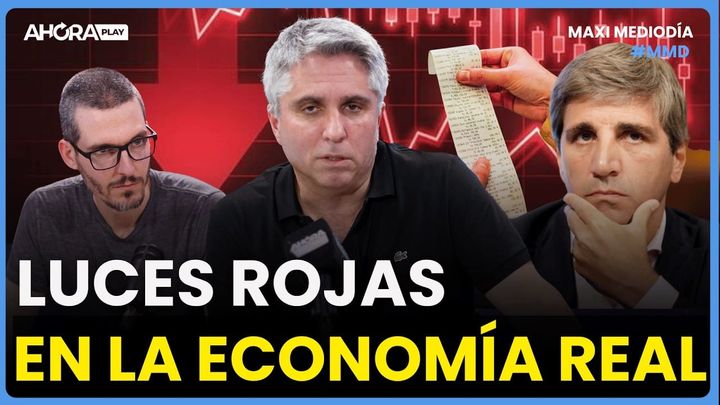
This video from AHORA PLAY covered a lot of ground. 6 segments stood out as worth your time. Everything below links directly to the timestamp in the original video.
Have you ever wondered how government economic policy directly impacts your wallet and the country's future? This Central Bank analysis reveals the challenges and opportunities in the Argentine economy, from your salary's purchasing power to the exports that drive markets.
Central Bank Presents Optimistic Outlook for Argentine External Sector Despite Wage Decline
The Vice President of the Central Bank, Vladimir Werning, presented an optimistic report on Argentina's external sector during the International Monetary Fund Assembly in Washington. The report highlights an accumulation of nearly $6 billion in reserves and projects reaching $8 billion. It emphasizes the high effective price of soybeans for producers, driven by exchange rate unification and the reduction of export taxes, as well as the normalization of dividend payments to multinationals, with $690 million transferred in the first quarter. Furthermore, a historical low in dollar purchases for hoarding has been observed.
However, the report acknowledges a stark disparity: while fuel prices, utility rates, and other goods have increased significantly, formal wages have only grown by 13.8% since August last year, far below the general inflation of 20.5% and sectoral adjustments. This situation suggests to investors lower future inflationary pressure from wage demands, though it also reflects the deterioration of workers' purchasing power. The Central Bank argues that this "inflationary slowdown" will continue after the correction of relative prices.
"It reveals that wages have fallen far behind prices. Look, since August it puts 20 against 13.8. Formal wages, according to INDEC. That is, it acknowledges that wages have suffered a loss."
▶ Watch this segment — 1:55:10
Argentina Records Historic $2.5 Billion Trade Surplus in March, Driven by Exports
Argentina registered a trade surplus of $2.5 billion in March, according to INDEC data, bringing the total to $5.5 billion in the first quarter. This achievement is attributed to a 30% increase in the value of exports, with 25% growth in volume, driven mainly by agricultural products such as corn, wheat, and oils, as well as mining (especially gold and lithium) and the automotive sector. Imports, in contrast, fell by 3.7% in volume in March and 7.3% in the first quarter, despite an increase in their prices.
This outlook projects record exports for the year, estimated at $98 billion to $99 billion, approaching the historical mark of $100 billion. Growth is expected to be driven by significant increases in the agricultural, mining, and oil sectors. Although the trade surplus is positive for foreign currency accumulation, its impact on employment and domestic economic activity remains a point of debate, as the decline in imports also reflects a contraction in domestic demand.
"Uh, it yielded a trade surplus of 2.5 billion dollars in March alone, right? With exports growing 30%, 25% in volume and the rest in prices, and imports growing 1.7% but actually falling in volume, falling almost 4% in volume in quantities."
Argentine Society Shows Signs of Breaking Point Amid Job Losses, Political Experts Warn
Juan Carlos Torren, a political analyst, indicates that Argentine society, which initially gave a "blank check" to the Milei government and "celebrated" the initial adjustments, is reaching a breaking point. Although inflation shows signs of decelerating, citizens are now presenting additional demands, primarily related to growing concern over job losses. This situation suggests that initial support for the government's "experiment" is waning, and expectations of economic "normality" are threatened by the lack of employment opportunities.
Torren emphasizes the lack of political experience within the current government, where many officials do not come from the public sector, leading to improvisation. In a context where politics is discredited, he argues that experience is crucial for managing the country's complexity. The emergence of new social demands, beyond controlling inflation, poses a significant risk to government stability if it fails to respond effectively to concerns about employment and the general economic situation.
"That blank check, if you will, with which a good part of society supported this experiment, today is being presented for payment. There are a number of people lining up and saying, 'Hey, but listen to me.' And so, how? Inflation has come down. Yes, but they're adding other demands."
▶ Watch this segment — 1:19:09
Argentina Lacks Long-Term Political Horizon to Resolve Fundamental Economic Problems, Juan Carlos Torren Affirms
Argentina fails to resolve its fundamental economic problems, such as recurrent inflation and devaluation, unlike other countries in the region that faced similar challenges in the past, according to Juan Carlos Torren. The political analyst maintains that the difficulty lies not in the country's lack of technical or economic capacity, but in the absence of a "longer political horizon." He explains that leadership in the Casa Rosada often feels pressured by short-term concerns, preventing the implementation of sustainable economic policies and generating a cycle of instability.
Torren argues that the "helmsman of the ship" does not need to be an economist, but rather possess the "political acumen" to identify and support a good economic strategy that transcends improvisation and mere enthusiasm. He criticizes the notion of political agreements on economic principles if these are not backed by a winning political force that defines a clear direction. Without a consolidated center of power that maintains direction and social support, efforts to stabilize the economy ultimately lose momentum and credibility, perpetuating instability.
"In terms of technical capacity, I believe Argentina has it in abundance, like other countries. Whether those technical capacities are capable of generating a better economy is another matter. Between technical capacity and a better economy, something more than that is required. And that something more that is required, I was saying, is a longer-term horizon."
▶ Watch this segment — 1:43:24
CEPA Warns of Trade Surplus Amid Job Destruction Due to Sectoral Divergence
A report by the Center for Argentine Political Economy (CEPA) reveals a concerning divergence in the Argentine economy: dollar-generating sectors, such as agriculture, finance, and mining, are expanding but create few jobs. In contrast, sectors that historically demand dollars and are major job creators, such as construction, manufacturing, and commerce, are in recession and destroying jobs. Specifically, agriculture grew by 44%, finance and mining by 18% each, while construction fell by 14%, industry by 9%, and commerce by 4-5%. The growing sectors represent only 9% of employment, while those in decline account for 45%.
This dynamic explains why, despite a significant trade surplus in the first quarter—driven by a drop in imports due to industrial contraction—the country faces rising unemployment. The CEPA report highlights that while the export sector contributes to dollar accumulation, the lack of growth in industry and construction generates "job destruction" and "unemployment" that contradicts the apparent macroeconomic success in trade balance.
"The sectors that are expanding are the dollar-generating sectors but create no jobs. And the sectors that are contracting are the dollar-spending sectors, but they generate a lot of employment and are currently destroying jobs."
Milei's Polarizing Discourse Could Lead to Social Demands if Economy Fails to Respond, Analysts Warn
Juan Carlos Torren, a political analyst, argues that President Milei came to power with an "exalted" and "angry" discourse that resonated with 30% of the electorate, who identified him with the political "caste." However, Torren warns that the rest of society, which gave "borrowed votes," does not subscribe to this "angry" tone and is showing reluctance. The analyst criticizes the "affective polarization" inspired by a philosophy of "we don't hate enough," considering it counterproductive for the political life and governance of a country as complex as Argentina.
Although the government entrenched itself in the support of its most intense minorities, Torren points out that there is a "world left outside" that base, which will express its demands if the economy does not offer concrete answers. He suggests that, even if the economic situation improves, the challenge of how to manage a complex country without a more "ecumenical" and encompassing rhetoric will persist. The polarization strategy, while effective in the campaign, could generate significant political conflicts if not complemented by management that integrates a broader social base.
"Milei's slogan, that exalted tone, a clean slate, the caste, the chainsaw, it seems to me that it was the expression of 30% of the electorate. That 30%, that feeling of 30%, was extrapolated, extended to the rest. But it seems to me that the rest accompanied it with more reluctance."
▶ Watch this segment — 1:25:49
Also mentioned in this video
- El anfitrión da la bienvenida a un nuevo stream y presenta el tema de la… (7:02)
- Se discute la agresividad en la política digital argentina, mencionando una… (11:09)
- Se retoma la discusión económica, analizando si Argentina enfrenta la… (16:16)
- Martín Genero comenta la tensión en los mercados globales debido al fin del… (18:16)
- Se complementa la información del mercado con declaraciones de Kevin Warsh,… (22:48)
- Martín Genero alerta sobre la situación en Medio Oriente, donde Estados Unidos… (26:01)
- Se profundiza en el impacto de la caída de las importaciones, asociándola a la… (32:14)
- Se discute si la situación económica actual es parte de una reconversión… (35:32)
- Se cuestiona la narrativa de reconversión productiva al señalar la caída del… (41:10)
- Se presenta el análisis de Arriazu, quien advierte sobre la enfermedad… (46:50)
- Un invitado explica que, desde la perspectiva del gobierno, la caída del… (52:39)
- Se retoma la discusión sobre si la caída del ingreso disponible es un costo… (55:57)
- Se profundiza en la discusión sobre la baja productividad y los salarios bajos… (1:00:10)
- Se discute la falta de inversión privada en infraestructura y construcción, a… (1:04:05)
- Se muestra un gráfico del nivel de actividad (EMAE) en un pico histórico, pero… (1:06:23)
- Juan Carlos Torren, profesor emérito de la Universidad de Itela, comenta su… (1:09:05)
- Juan Carlos Torren explica que los planes de estabilización corren el riesgo de… (1:12:56)
- Juan Carlos Torren sostiene que el gobierno de Milei no logra descifrar cómo… (1:33:51)
- Amilcar Collante comenta que los datos de marzo convalidan el pronóstico de un… (1:51:12)
Summarised from AHORA PLAY · 2:08:10. All credit belongs to the original creators. Streamed.News summarises publicly available video content.
Streamed.News
This publication is generated automatically from YouTube.
Convert your full video library into a digital newspaper.
Get this for your newsroom →