🌐 Also available in: 🇪🇸 Español
Original source: Universidad de Palermo
This video from Universidad de Palermo covered a lot of ground. Streamed.News selected 8 key moments and summarises them here. Everything below links directly to the timestamp in the original video.
Understanding the true nature of art, beyond personal appreciation, allows us to decipher how artistic expressions act as mirrors of civilization and as pathways to understanding our own humanity. This perspective invites a reassessment of art's cultural function in contemporary society.
Art as cultural revelation and totem of values, beyond subjective taste
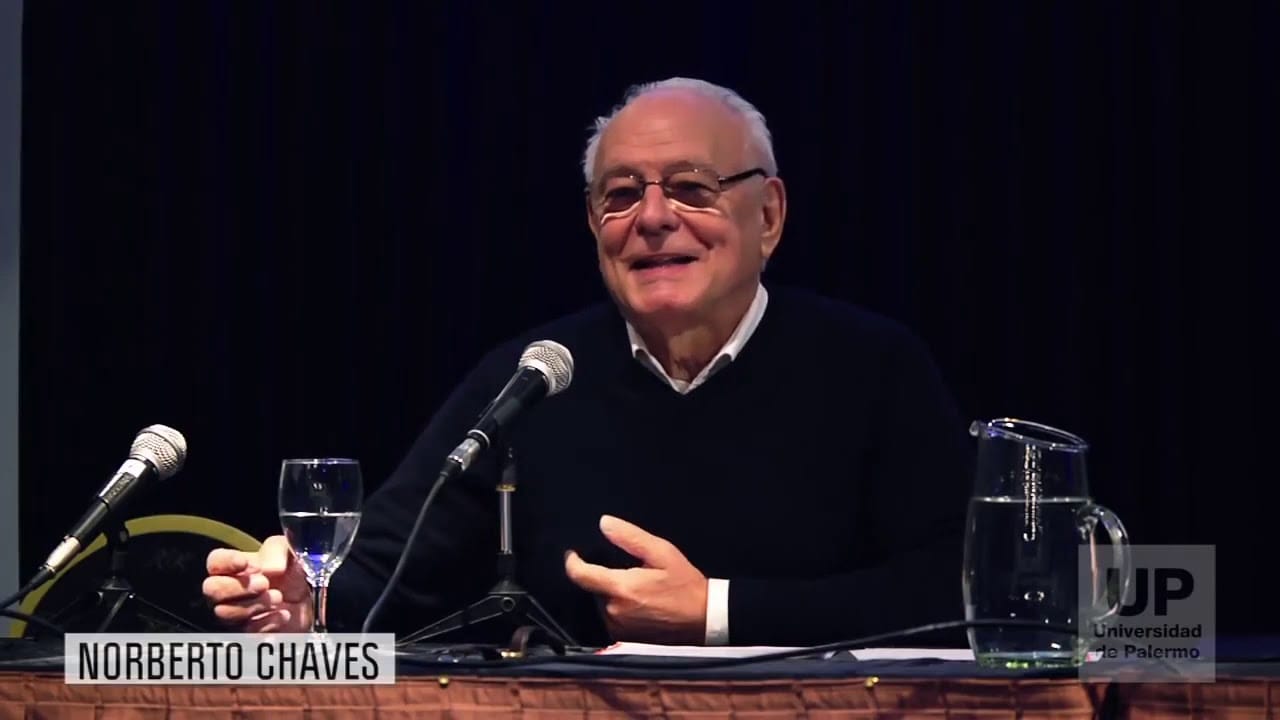
Norberto Chaves argues that art functions as a direct revelation of culture, continuously manifesting its aesthetic, ethical, and symbolic values — much like a totem that distills the essence of a civilization. This unmediated appearance of culture, free from utilitarian purpose, allows the viewer a profound sense of identification and belonging. According to Chaves, the power of art transcends any notion of subjectivity or individual taste, asserting itself as an inescapable presence of being.
Works such as the Eagles' 'Hotel California' or Gershwin's 'Summertime' illustrate how art achieves temporal transcendence and universal resonance, forging an empathic connection that endures across eras and interpretations. This capacity of art to evoke a deep recognition of the human being within their community — and within their own essence — positions it as a cultural phenomenon of tremendous magnitude that defies superficial classification.
"It is a revelation — culture appears to us through a painting like an angel. It is a revelation, like a totem, in which all the values of a culture are synthesized."
Norberto Chaves defines design as a phase of productive planning encompassing all products
Norberto Chaves argues for the need to overcome the recurring confusion between design and art through a precise and universal definition of the former. In its integral conception, design stands as an intrinsic phase of the production process, whose primary function is to plan and prefigure all characteristics of a product — material or immaterial — prior to its realization. This anticipatory stage, encompassing everything from the definition of materials to modes of manufacturing, distribution, and consumption, fundamentally distinguishes design from craft practice, where form takes shape simultaneously with production.
The exponential proliferation of design specializations — from graphic design to digital experience design — attests to its ubiquitous role in contemporary production. The pursuit of perfection and the optimal response to a pre-existing need, external to design itself, define its purpose. This definition underscores that design possesses no single methodology or aesthetic, but rather adapts whichever each project demands, constituting a field of action that spans the entirety of human production.
"Design is a phase of the production process in which all the characteristics of a product are defined — its modes of production, distribution, and consumption. Full stop."
Art reveals culture 'undressed' and enables human transcendence
Norberto Chaves proposes that art, stripped of any utilitarian function, operates as a medium through which culture manifests in its purest and most unveiled form. This absence of practical purpose allows for the full enjoyment of the symbolic universe inherent to a culture, fostering a profound experience of self-recognition — both as individuals and as members of a cultural community. The cave paintings of bison, capable of moving viewers across millennia, exemplify art's capacity to transcend temporal and cultural barriers by evoking the essence of the human, the 'anthropic.'
Art, as a kaleidoscopic mirror offering countless cultural reflections — from folk art to Renaissance masterworks — enables the search for identity and connection with a specific cultural 'tribe.' Citing Castoriadis, Chaves underscores that art 'serves no purpose' in a functional sense, yet serves 'far greater ones' by lending meaning to the world and to human existence itself. This understanding highlights art's power as a tool for self-knowledge and intergenerational connection.
"In art we see culture undressed, without the screen of utility. The function of art is to let you revel in your own symbolic universe."
Design as an 'empty' discipline that adopts external norms and becomes essential
Norberto Chaves describes design as an inherently 'empty' discipline, in the sense that it lacks a set of its own universal norms or principles — which sets it apart from more rigid disciplines. Instead, design operates by responding to external conditions and adopting the specific rules and principles of each product and particular need, granting it unlimited elasticity and capacity for expansion. This adaptability transforms it into a strategic profession that is inescapably necessary across all productive and social fields.
Design's ability to free itself from dogmas such as constructivism or functionalism, and instead embrace the demands of diverse contexts — from technical instruments to clothing with strong symbolic meaning — has been key to its development and omnipresence. Citing Charles Eames, Chaves emphasizes that design is not satisfied by pre-established principles, but rather responds to a universal need, whether for affordable housing or a luxury yacht, reaffirming its role as a servant of human needs.
"Design is an empty discipline — meaning it has no norms of its own. It adopts whatever norms correspond to each product, and that is its enormous virtue and privilege. That is precisely why it is a strategic profession in social development."
Aesthetics is a universal dimension, not exclusive to art, argues Norberto Chaves
Norberto Chaves addresses a persistent misconception: the erroneous identification of aesthetics with the exclusive domain of art. He argues that aesthetics is, in fact, a universal dimension of human behavior, manifesting in everyday actions such as getting dressed before going out, and a structural function of communication. From a semiotic perspective, the aesthetic function of a message consists in presenting itself attractively in order to facilitate its reception, transcending the mere transmission of information.
Chaves further notes that the notion of aesthetics as inherent to art is refuted by certain contemporary artistic movements — such as conceptual art or some forms of surrealism — which deliberately discard or minimize the aesthetic dimension. He concludes that restricting aesthetics to the artistic domain reveals a fundamental misunderstanding of its nature as a universal need and intrinsic component of human interaction and communication.
"To restrict aesthetics to the world of art is to understand nothing. Aesthetics is a structural necessity of communication."
Art is distinguished by its symbolic function without material utility, unlike utilitarian objects
To clarify the essential difference between design and art, Norberto Chaves proposes a conceptualization of art as the sole symbolic function of a product that lacks direct material utility. Unlike utilitarian objects — such as a chair, whose primary purpose is practical use, namely sitting — art exists exclusively for the expression and contemplation of its symbolic content. While all human products possess a symbolic dimension that alludes to the culture that created them or to their uses, in utilitarian objects this dimension is secondary to their practical function.
Chaves underscores that human beings cannot tolerate insignificance, assigning meaning even to natural phenomena, which gives every object — whether useful or not — a symbolic dimension. However, the qualitative leap toward art lies in the exclusivity of this symbolic function, stripped of any utilitarian imperative. This emphatic definition — that art 'serves no purpose' in functional terms, yet serves 'far more,' as Castoriadis puts it — is fundamental to clearly distinguishing between design, which fulfills needs, and art, which explores meaning.
"In art, the symbolic function — which includes the aesthetic — is the only function. That is to say, there is no utility. To put it bluntly: art serves no purpose."
Design objects can migrate into the art world, but their productive nature remains unchanged
Norberto Chaves acknowledges that, while design and art are conceptually distinct universes, there are exceptional cases in which objects born in the realm of design migrate and establish themselves in the field of art. These examples, though anecdotal and rare, are frequently cited by those who argue for blurring the line between the two disciplines. However, Chaves emphasizes that such migrations do not alter the fundamental nature of design as a phase of the productive process with an intrinsic utility. A Toulouse-Lautrec poster, conceived with a communicational and persuasive function, is transformed into a contemplative work of art once its original purpose disappears — as evidenced by the meticulous archiving and care it receives.
Another example is the clothing designed by Coco Chanel for Vaslav Nijinsky in Diaghilev's Ballets Russes. Although created for a utilitarian purpose — to dress a dancer — these garments transcended their original function to incorporate symbolic and aesthetic dimensions into the spirit of the work, ultimately acquiring the status of artistic pieces. Nevertheless, Chanel as a brand remains a benchmark in fashion design, demonstrating that these instances of 'migration' are isolated cases and do not undermine the essence of design as a discipline that operates in service of a function.
"The fact that they are two absolutely heterogeneous disciplines does not mean there is no possibility of migration between their products — primarily from design into art."
Norberto Chaves dismantles the confusion between creativity and art
Norberto Chaves identifies two fundamental mechanisms behind the bias that equates design with art. The first lies in an unshakeable belief that is impervious to factual refutation — a conviction that holds firm 'no matter what,' regardless of evidence to the contrary. The second mechanism consists of the mistaken identification of creativity as the exclusive domain of art. Talent and imagination are assumed to be attributes unique to the artist, leading to a skewed understanding of human nature and the creative process.
Chaves argues that creativity is a universal human capacity, intrinsic to survival and development across all areas of life, from prehistoric times to the present day. This ability to conceive what did not previously exist manifests itself in fields as diverse as technology, engineering, and gastronomy — not only in art. Therefore, equating creativity with being an artist is a conceptual error that ignores the breadth and structural necessity of creativity in human production.
"Creativity is universal. It applies across all fields. There is enormous creativity in technology, in art, in design, in engineering, in gastronomy."
Summarised from Universidad de Palermo · 56:34. All credit belongs to the original creators. Streamed.News summarises publicly available video content.