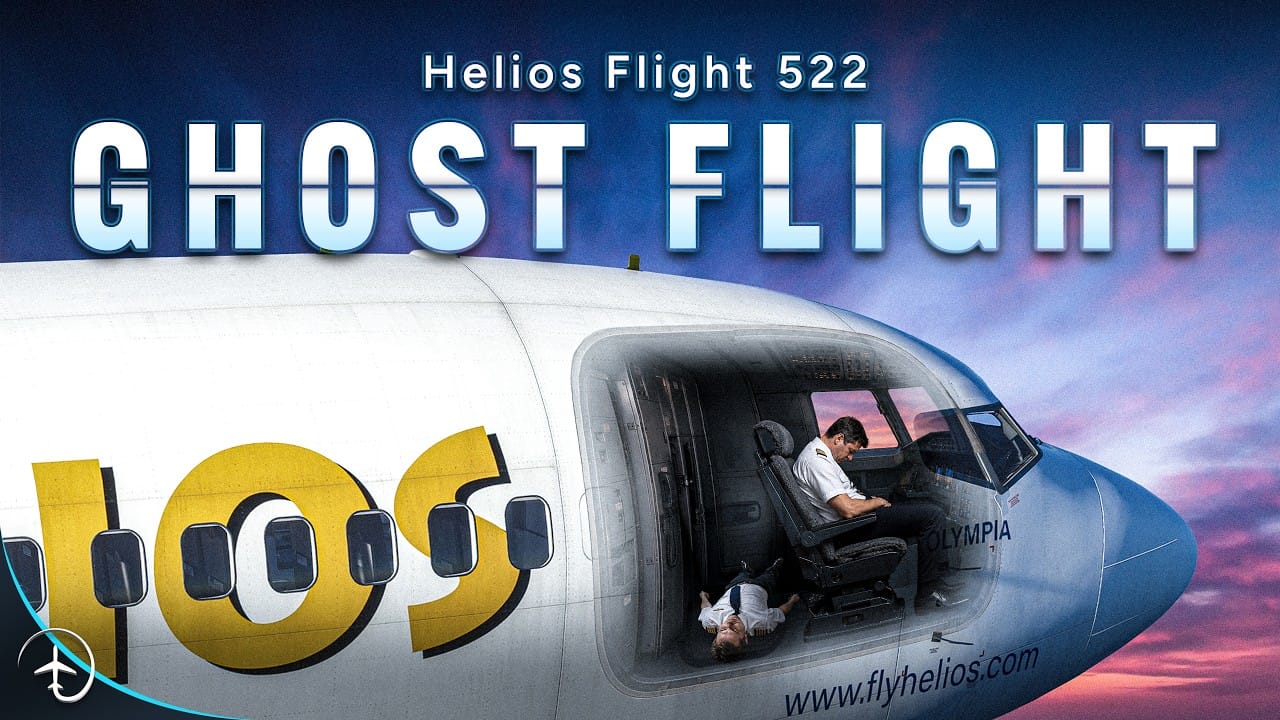
Original source: Mentour Pilot
This video from Mentour Pilot covered a lot of ground. Streamed.News selected 8 key moments and summarises them here. Everything below links directly to the timestamp in the original video.
The crash of Helios 522 serves as a stark reminder that aviation accidents are rarely caused by a single mistake, but by a chain of latent safety issues, human factors, and technical oversights.
Investigators Attribute Helios 522 Crash to Cascade of Human and Systemic Failures
The crash of Helios Flight 522 was the direct result of the aircraft's pressurization system being left in manual mode following a ground test, investigators concluded. This initial error was compounded by the flight crew's failure to recognise the signs of depressurisation, a misinterpretation driven by distraction and the severe cognitive degradation caused by hypoxia.
Ultimately, the accident was not the outcome of a single mistake but of an airline whose safety culture had failed. Investigators pointed to a chain of latent conditions at Helios Airways, including absent management, weak regulatory oversight, and a pattern of unresolved technical deficiencies that set the stage for the catastrophe.
▶ Watch this segment — 1:05:54
Boeing 737 Warning Horn Flaw Implicated in Multiple Near-Catastrophes Before Helios Crash
The misinterpretation of the cabin altitude alarm by the Helios 522 crew was not an isolated incident. Several other Boeing 737 crews worldwide had made the exact same mistake, confusing the sound with a takeoff configuration warning. Incidents in Ireland and the US brought aircraft dangerously close to disaster as pilots, baffled by the alarm, began to suffer the effects of hypoxia before realising the true nature of the problem.
Despite these documented near-misses alerting Boeing to the design ambiguity by 2004, the company's planned remedy was an update to the flight crew training manual scheduled for October 2005. This response was too late to prevent the Helios 522 accident, highlighting a critical lag between identifying a known risk and implementing an effective safety solution.
"The captain later filed a report stating that if the first officer hadn't had that sudden moment of clarity, they might have continued troubleshooting the wrong problem until they lost consciousness."
Engine Flameouts Forced Heroic Flight Attendant to Manually Fly Failing 737
Less than a minute after flight attendant Andreas Prodromou entered the cockpit, the left engine of Helios 522 flamed out due to fuel exhaustion. The failure disconnected the autopilot, forcing Prodromou, a private pilot, to take manual control of the heavy jet which was now yawing from asymmetric thrust. The aircraft began an uncontrolled descent, and as it passed through 7,000 feet, the right engine also ran out of fuel.
With both engines gone, the Boeing 737 became an unpowered glider. Despite Prodromou's attempts to control the aircraft, as witnessed by F-16 pilots, the situation was unrecoverable. His final actions were to pull back on the controls before the aircraft struck Grammaticko Hill, killing all on board.
"The F-16 pilot had no idea of how much control the person inside had, so he signaled for him to follow, pointing down towards the airport... But the reply was a negative headshake. Andreas just pointed downward, as if to say that the end was inevitable."
▶ Watch this segment — 1:01:03
Flight Attendant Andreas Prodromou Was Sole Conscious Person in Helios 522 Cockpit
After the aircraft had flown silently on autopilot for nearly two hours, a figure appeared in the cockpit, a moment witnessed by the escorting F-16 fighter pilots. The individual was 24-year-old flight attendant Andreas Prodromou, who had remained conscious by using a portable oxygen bottle. Prodromou, who was also a trained private pilot and scuba diver, sat in the captain's seat and took the controls.
His remarkable actions provided a heartbreaking final chapter to the flight. Investigators believe he may have first tried to help his girlfriend, another flight attendant, or other crew members before finally gaining access to the flight deck. His presence demonstrated immense courage in the face of an impossible situation.
"Out of all of the people on board, he was probably the one with the best chance. You see Andreas was also a trained private pilot, which meant that all of the instruments and levers inside might have been at least somewhat familiar to him."
Boeing 737's Ambiguous Warning Horn Created 'Powerful Association' Leading to Pilot Error
A critical design flaw in the Boeing 737 contributed to the crew's confusion on Flight 522. The aircraft used the exact same audible horn for two different alerts: a pre-flight takeoff configuration warning and an in-flight cabin altitude warning. Because pilots test the takeoff configuration warning before every flight, they develop a powerful cognitive association between that specific sound and a ground-based issue.
This design, which relied solely on the phase of flight to provide context, failed to account for this deeply ingrained human factor. When the horn sounded in the air, the Helios crew's immediate assumption was that it was a false takeoff warning, leading them to troubleshoot the wrong problem as the cabin lost pressure.
"Over time, this had created a powerful association in their minds. That horn now meant takeoff configuration warning, not pressurization warning."
Hypoxia Incapacitated Helios 522 Pilots as Key Warnings Went Unseen
As the cabin altitude of Flight 522 climbed past 14,000 feet, passenger oxygen masks deployed automatically. This should have been the final, unmistakable cue to the pilots about the depressurisation. However, a crucial secondary warning light associated with the mask deployment was likely missed because the pilots had not reset the Master Caution system after an earlier, unrelated equipment cooling alert.
With their attention fixated on the wrong problem and the final warning systemically blocked from their view, the pilots were soon overcome by hypoxia as the aircraft ascended through 20,000 feet. Both lost useful consciousness, leaving the Boeing 737 to continue its pre-programmed flight to Athens entirely on autopilot.
"When the passenger oxygen auto-deploy system activated, with its own amber warning light, this was never highlighted to the crew and likely therefore missed, finally sealing everyone's fate."
Hellenic Air Force F-16s Intercept 'Ghost Flight' Helios 522, Find Incapacitated Crew
When Helios Flight 522 failed to descend for its Athens approach and instead entered a holding pattern at 34,000 feet, the Hellenic Air Force scrambled two F-16 fighter jets to investigate. The pilots intercepted the unresponsive airliner and witnessed a chilling scene through the cockpit window: the first officer was slumped motionless in his seat, and the captain's seat appeared to be empty.
The visual inspection immediately confirmed controllers' worst fears, ruling out a hijacking and pointing to crew incapacitation. The F-16 pilots also reported seeing passenger oxygen masks deployed throughout the cabin, providing clear evidence of a catastrophic depressurisation event that had left the aircraft flying on its own.
"He reported that the captain's seat was empty and it appeared as the first officer was slumped over in his chair motionless with his head almost resting against the glareshield."
Helios 522 Crash Prompted Key Safety Changes to Boeing 737 and Flight Procedures
In the wake of the Helios 522 tragedy, aviation authorities implemented several critical safety changes. Boeing updated its maintenance manuals to mandate explicit verification that the pressurisation mode selector is returned to the "Auto" position after a ground test. Regulators also revised flight checklists to place a stronger emphasis on the immediate use of oxygen masks at the first sign of a pressurisation issue.
To eliminate the design ambiguity that confused the pilots, the FAA issued a directive requiring separate, distinct warning lights for the takeoff configuration and cabin altitude alerts. This hardware change ensures that crews can no longer misinterpret the two critical warnings.
▶ Watch this segment — 1:08:15
Also mentioned in this video
- On August 14th, 2005, a Boeing 737 named Helios 522 was flying over Greece,… (0:01)
- Helios Airways, founded in the late 1990s as Cyprus's first privately-owned… (0:50)
- Helios Airways faced scrutiny from the UK Civil Aviation Authority due to… (1:56)
- Auditors discovered practices like shortening scheduled flight times to avoid… (3:24)
- Helios Airways operated in a regulatory 'no man's land' due to the understaffed… (4:21)
- By 2005, Helios's Boeing 737-300, registered as 5B-DBY, had a reputation for… (5:37)
- Physical issues such as loud bangs near the rear of the aircraft and ice… (7:01)
- In December 2004, the aircraft experienced a serious pressurization event,… (8:05)
- On August 13th, 2005, the F5B-DBY experienced banging noises and ice buildup… (11:11)
- The captain's log entry, "aft service door requires full inspection," mandated… (12:10)
- The engineering team visually inspected the aft service door, checking seals,… (13:22)
- Pressurization leaks that only appear at altitude are difficult to find with a… (14:00)
- At cruising altitude, human bodies cannot function due to low air pressure and… (15:08)
- On a Boeing 737, compressed "bleed air" from the engines is cooled and routed… (15:53)
- Normally, cabin altitude is controlled automatically by setting cruise and… (17:15)
- Engineers decided to run a pressurization test to find leaks around the aft… (18:07)
- Despite testing the aircraft up to its overpressure safety valve limit, the… (19:56)
- Of switching it back to auto, meaning the cabin outflow valve remained under… (21:19)
- The crew for Helios Flight 522, an experienced but procedurally inconsistent… (22:10)
- During pre-flight setup, the pressurization mode selector was overlooked… (23:58)
- The pressurization mode selector's manual position went unnoticed because… (27:17)
- Helios Flight 522 taxied out and departed under clear skies, climbing smoothly,… (29:21)
- As the 737 climbed, the unpressurized cabin, with its outflow valve partially… (30:35)
- The cockpit voice recorder did not capture the post-takeoff checklist phase,… (32:06)
- At 06:11 and 21 seconds, the captain confirmed climbing to Flight Level 340,… (33:03)
- As the aircraft climbed through 12,000 feet, the cabin altitude reached 10,000… (34:01)
- Instead of initiating an emergency descent, the captain called Helios… (42:21)
- With no descent initiated, the oxygen from the deployed passenger masks,… (47:24)
- Instructions or descend, continuing to maintain 34,000 feet and follow the… (49:57)
Summarised from Mentour Pilot · 1:10:31. All credit belongs to the original creators. Streamed.News summarises publicly available video content.