Original source: Pilot Debrief
This video from Pilot Debrief covered a lot of ground. Streamed.News selected 5 key moments and summarises them here. Everything below links directly to the timestamp in the original video.
The pilot's final moments reveal a cascade of poor judgments, culminating in a low-altitude manoeuvre that made a fatal outcome almost inevitable.
Pilot’s Fatal Crash Followed Reckless Descent Below Altitude Minimums
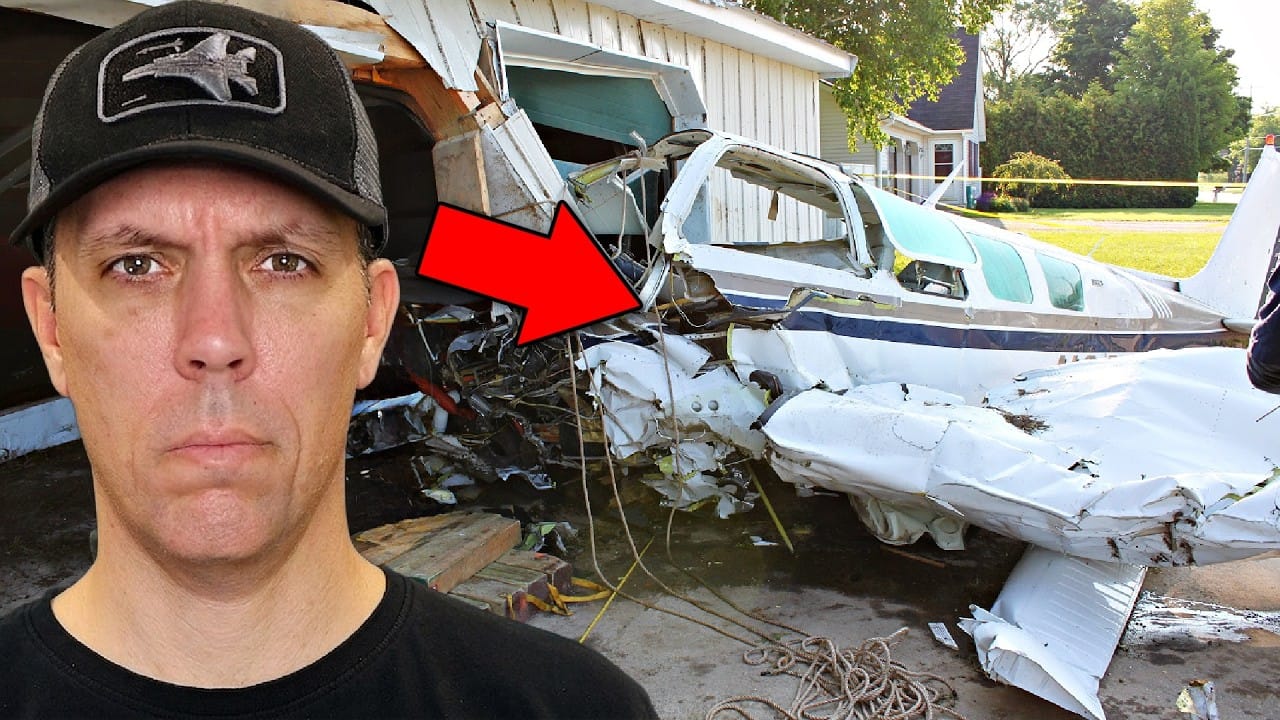
After a failed instrument approach at Boyne Mountain Airport, the pilot made the fatal decision to divert to a nearby airfield with even worse weather, reporting a 200-foot overcast ceiling. Despite the approach procedure mandating a minimum descent altitude of 438 feet, eyewitnesses saw the aircraft emerge from the clouds at just 200 feet above the ground. The pilot then attempted a hazardous low-level circling manoeuvre to align with the runway, ultimately stalling the aircraft during a final turn and crashing into a residential garage.
The decision to deliberately descend below the published minimum altitude in instrument conditions represents a profound failure in aeronautical judgment. This manoeuvre eliminated any margin for error and placed the aircraft in a high-energy, low-altitude state from which recovery was nearly impossible. The subsequent crash, which killed the pilot and his wife while his son survived for a second time, was not the result of an unforeseen event but the direct consequence of a series of reckless choices.
"Steve made a reckless decision to fly below the minimum descent altitude, which is extremely dangerous."
NTSB Finds Flap Mismanagement Led to Pilot's Fatal Stall
The National Transportation Safety Board investigation determined the direct cause of the second crash was the pilot's failure to deploy the aircraft's flaps during his final, low-altitude turn. This critical omission resulted in a higher stall speed, and as the pilot manoeuvred tightly to align with the runway, he exceeded the wing's critical angle of attack. The aircraft subsequently entered an aerodynamic stall and spin from an altitude too low for recovery.
What needs to be understood is that this technical error was the final link in a chain of poor aeronautical decision-making. The pilot had already placed himself and his family in an extremely hazardous situation by descending below minimums and attempting to circle to land in near-zero visibility. This high-stress environment created the conditions for a fatal procedural mistake, underscoring how poor planning and reckless flying directly lead to catastrophic handling errors.
"During his final turn to the runway, he exceeded the critical angle of attack, causing the aircraft to stall and spin into the ground below."
Pilot in Second Fatal Crash Relied on weather.com, Missed Key Forecast
Eight years after a crash that his family survived, the same pilot took off on June 24, 2011, in a similar Beechcraft Bonanza with his son, new wife, and two dogs. Despite having logged an additional 465 flight hours, the NTSB investigation revealed a critical lapse in his pre-flight preparation: his only weather check was a visit to weather.com on his iPad. He did not consult official aviation weather sources for the required METAR and TAF reports.
The significance of this oversight is that he missed a forecast predicting deteriorating conditions at his destination in northern Michigan. While the weather was acceptable at his time of departure, it was forecast to worsen to a broken ceiling at 400 feet. Relying on a general-purpose consumer weather site instead of aviation-specific data meant the pilot launched into a flight with no true understanding of the hazardous conditions he would face upon arrival, setting the stage for a second tragedy.
"Weather.com is not a source that pilots use to check the weather. You need to get the METARs and the TAFs for all the airports relevant to your flight plan."
Pilot in Bonanza Crash Miscalculated Fuel Supply for Night Flight in Poor Weather
Prior to his first family flight that ended in a crash, the pilot filed an instrument flight plan acknowledging poor weather at his destination, which included a 300-foot ceiling with rain and mist. His planning, however, contained a critical error regarding his fuel supply. His flight plan stated he had 60 gallons of fuel on board for a 35-gallon trip, an apparently safe margin.
However, a post-accident analysis by the NTSB revealed a significant discrepancy. Based on flight logs and refuelling records, the aircraft likely had only 38 gallons or less at takeoff. This miscalculation is a fundamental error in flight planning that severely limited the pilot's options. Embarking on a single-pilot, nighttime flight into bad weather with insufficient fuel reserves created a high-stakes scenario with almost no tolerance for delays, diversions, or unforeseen circumstances.
"He would have used about 216 gallons of fuel over that same period, leaving him with only about 38 gallons in the tank."
Engine Failure During Go-Around Followed Pilot's Autopilot Struggle
While on approach to Fort Wayne in poor weather, the pilot struggled to properly configure the autopilot to capture the ILS signal, forcing him to disengage it and hand-fly the final segment. Becoming unstable and feeling behind the aircraft, he made the procedurally correct decision to execute a go-around at 400 feet. As he applied power to climb, however, the engine began to sputter and quit completely, leading to an emergency declaration just moments before the crash.
The engine failure at this critical phase was the direct consequence of the fuel miscalculation made before takeoff. The aircraft was likely experiencing fuel starvation. The pilot's difficulties with the automation compounded the problem by increasing his workload and stress at a time when his fuel state was critical. This sequence demonstrates how a seemingly isolated planning error can cascade into a catastrophic in-flight emergency, rendering even correct procedural decisions futile.
"As Steve started climbing away from the ground, the engine started to sputter. He tried adjusting the mixture, the throttle, and the boost pump, but nothing was working. ... The engine quit."
Also mentioned in this video
- A story about a pilot who caused two fatal plane crashes eight years apart,… (0:00)
- The first crash occurred on September 1st, 2003, involving Steve, his wife, and… (0:27)
- After the engine quit, all lights went out, forcing Steve to use flashlights;… (8:24)
Summarised from Pilot Debrief · 16:14. All credit belongs to the original creators. Streamed.News summarises publicly available video content.