Original source: Fullfunnel io
This article is an editorial summary and interpretation of that content. The ideas belong to the original authors; the selection and writing are by Streamed.News.
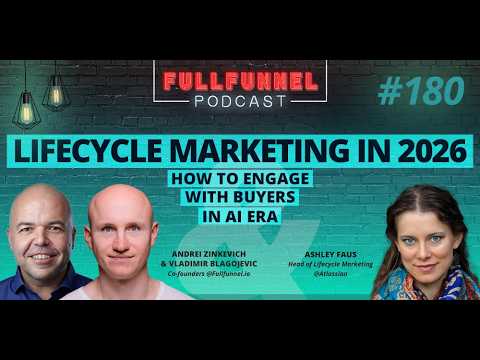
This video from Fullfunnel io covered a lot of ground. 6 segments stood out as worth your time. Everything below links directly to the timestamp in the original video.
If your sales team calls the leads junk, the problem may start with how your CRM defines a lead — here is a concrete first-90-days plan for fixing that before anything else.
New Marketing Leaders Should Audit CRM Definitions Before Chasing Growth Targets
Before optimizing any marketing program, incoming leaders must first establish shared definitions for terms like MQL, lead, and customer — then verify that the CRM actually tracks those agreed definitions. Ashley Faus describes a nonprofit whose marketing team counted every collected email address as a lead, a mismatch that produced board-level conflict with sales. Arbitrary lead-scoring logic — assigning 40 points to one webinar and 60 to another with no clear rationale — compounds the problem, making year-over-year growth targets meaningless if the definition underneath them keeps shifting.
The first 90 days for any marketing leader, Faus argues, are better spent on an audit and rebaselining exercise than on generating quick wins. She also flags a subtler risk: a single large customer who requires disproportionate support hours and compute costs may not be profitable regardless of their contract size, making revenue-mix analysis as important as top-line growth.
"If you're going to change the definition, you've got to change it in the system too. You can't just change it in the board meeting or on the slides."
Five-Intent Framework Offers Sharper Metrics for Lifecycle Marketing Programs
Most marketing teams measure programs almost exclusively through buy-intent actions — book a demo, contact sales, activate a trial — but Ashley Faus argues that lifecycle marketing demands a different lens. She proposes mapping both leading and lagging indicators to five distinct customer intents: buy, use, trust or affinity, learn, and help or remediation. For retention and expansion, use-intent and learn-intent metrics are more predictive than upgrade prompts. Specifically, community engagement — how often a user participates in forums or AMAs — functions as a leading indicator of product stickiness, even though it rarely appears in a standard dashboard.
Faus also introduces SEQ (a measure of ease of use) as a complement to Net Promoter Score. Where NPS asks about positive gains, SEQ taps loss aversion by asking how disappointed a user would be to lose access — a psychologically stronger signal of genuine product dependency and reduced churn risk.
"We want our customers to feel sad if they lose the product, because that's a much more powerful feeling than just feeling happy or fine that they have it."
Sales Complaints About Lead Quality Are the Starting Point for Better Marketing Alignment
When sales teams dismiss marketing-generated leads as worthless, that friction is actually a diagnostic opportunity. Ashley Faus uses the example of scraping LinkedIn commenters to build an outbound list — a tactic that signals zero purchase intent — to illustrate how misaligned lead definitions destroy trust. The fix starts with a joint conversation about what a genuinely good lead looks like, using close-rate data as evidence: contacts who clicked 'book a demo' or activated a trial convert at measurably higher rates than cold prospects. Faus also notes that a buyer researching pricing without budget or authority — a real scenario she describes firsthand — is not a lead no matter how engaged they appear.
The broader principle is to study what top-performing salespeople do differently: how they filter their pipeline, which touchpoints they credit. That filtering logic, she argues, can be reverse-engineered and scaled into marketing programs far more reliably than adjusting lead-scoring point values.
"If sales is telling you they can't close these leads, the likelihood that your entire sales organization just fundamentally can't sell seems unlikely."
Atlassian's Product-Led Growth History Shapes How It Tracks Lifecycle Marketing
Because Atlassian operated for much of its history without a sales team, it built lifecycle marketing around in-product behavior rather than sales pipeline stages. Ashley Faus identifies specific 'sticky actions' — creating a first Jira project, inviting a collaborator, tagging someone in a Confluence page — as the metrics that signal genuine product adoption. That PLG heritage means lifecycle marketing at Atlassian sits close to product marketing rather than demand generation, though Faus notes three legitimate organizational homes: demand gen, customer success, or product marketing, each reflecting a different theory of where customer value originates.
The structural choice matters because it shapes which metrics the team is held to. In sales-led organizations, lifecycle tends to inherit buy-intent metrics from demand gen; in PLG organizations, it aligns more closely with usage and activation data owned by product marketing or customer success.
"To me, this question from a sales-led perspective — where an AE gets a list of accounts and their spend potential and is told to go chase them — they're basically flying blind."
The '$10 Game' Offers a Lower-Risk Method for Testing Marketing Assumptions
Changing how an established organization measures marketing success is politically difficult, but Ashley Faus recommends two concrete entry points. The first is piloting new metrics on an emerging product line rather than the core business, where the stakes are lower and proof-of-concept is achievable. The second draws on a product-management exercise she calls the '$10 game': instead of spreading budget evenly across many programs, pick one and either triple its budget or shut it off entirely. Cutting a program that feels indispensable reveals quickly whether it was actually driving results — if it was, the decline shows up fast enough to reverse course.
The approach converts an abstract strategic argument into observable data, giving teams evidence to justify broader change without risking the whole business on a single shift in measurement philosophy.
"If that's the one thing that's working, it's going to show up fast enough that you can turn it back on. And if it's not working, great — you've just killed it."
AI's Best Role in Lifecycle Marketing Is Contextual Help, Not Upgrade Triggers
AI is most useful in lifecycle marketing not as an automated upsell mechanism but as a personalization engine — provided the underlying customer data is clean and rich. Ashley Faus describes how Atlassian's integrated product suite (Jira, Confluence, and Loom) enables AI to convert meeting notes into assigned Jira tickets and Confluence project plans, replacing work that previously required manual transcription and task assignment. The key principle: AI should recommend the next action that solves a user's actual problem, such as suggesting Loom to a marketer already using Confluence, rather than firing an upgrade prompt the moment a usage threshold is crossed.
The precondition for any of this is a comprehensive, clean data layer capturing in-product behavior — which lifecycle marketing teams are better positioned to build than acquisition teams, since they already work with known customers whose usage patterns are observable.
"The mindset is really about using context to help the user get more value, not just waiting to pounce until you can show them the right upgrade or cross-sell message."
Also mentioned in this video
- The evolution of lifecycle marketing, noting how the original idea of… (1:04)
- Lifecycle marketing was originally meant to focus on the long-term lifetime… (2:46)
- The host agrees on the importance of clean data and context for AI,… (13:44)
- The host asks if there are workarounds to avoid tough conversations about… (47:11)
Summarised from Fullfunnel io · 54:52. All credit belongs to the original creators. Streamed.News summarises publicly available video content.
Streamed.News
This publication is generated automatically from YouTube.
Convert your full video library into a digital newspaper.
Get this for your newsroom →