Original source: Fullfunnel io
This article is an editorial summary and interpretation of that content. The ideas belong to the original authors; the selection and writing are by Streamed.News.
This video from Fullfunnel io covered a lot of ground. 6 segments stood out as worth your time. Everything below links directly to the timestamp in the original video.
If your ABM program feels busy but unproductive, mapping every target account to a stage with a 90-day engagement window will quickly show you exactly where the work is being lost.
Three-Component Account Progression Framework Offers ABM Teams a Baseline for Measuring Pipeline Impact
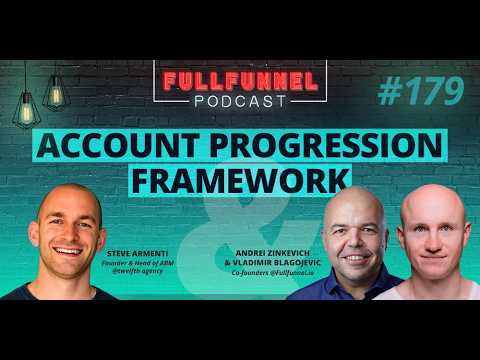
The framework breaks ABM measurement into three layers: a static account progression table, a real-time event layer that tracks engagement as it happens, and an impact-and-velocity reporting component. Accounts are indexed into stages — starting at 'unaware,' defined as zero engagement in the past 90 days, through to 'aware,' 'engaged,' 'qualified,' and 'sales ready' — by pulling and mapping data from LinkedIn, Google, Meta ads, web analytics, and CRM exports such as HubSpot or Marketo.
The practical shock of running the initial index is instructive: most teams discover that 80–90% of their target accounts sit in the 'unaware' bucket, a humbling baseline that forces a rethink of tactics. Because awareness is treated as time-constrained rather than permanent, the 90-day window prevents teams from coasting on stale engagement data.
"We run this report and it's humbling for clients because it's like 80–90% are unaware — whereas they thought they had made more effort with these accounts. But when you time-constrain it, awareness is fleeting."
Retroactive Data Analysis Turns Account Progression History into an ABM Forecasting Engine
By mapping historical marketing and sales data backward into the progression framework, teams can calculate precise baseline velocities — for example, that it takes 55 days on average to move an account from unaware to aware, or 38 days from aware to engaged — and identify which channels drove each transition most cost-effectively. That baseline then powers forecasting at three levels of sophistication: simple historical extrapolation, a compounding growth model that assumes improving lead quality and sales capability over successive quarters, and a fully predictive statistical or machine-learning layer for teams with data science resources.
The approach reframes forecasting as a structural output of the measurement system rather than a separate exercise, making long sales cycles more manageable by anchoring projections to observed behavior patterns.
"Forecasting in a simple way is just looking at the past and predicting that the same thing will happen in the future — it takes this many days, costs this much budget, these channels, these campaigns."
SDR Rejection Reasons in Salesforce Revealed Thousands of Flawed MQLs at Google Cloud
SQL quality scoring, as practiced on the Google Cloud demand generation team, combined standard marketing criteria — ICP fit, job title, behavioral engagement score — with a largely overlooked signal: the disqualification reason subfield that SDRs were required to complete in Salesforce when rejecting a marketing qualified lead. Manually reviewing thousands of MQLs against those rejection reasons surfaced a concrete mismatch: marketing's scoring treated a VP of Infrastructure as a qualifying technology title, while sales consistently rejected the same persona because the product — Chromebooks in this case — required a pure IT buyer.
The lesson is that MQL scoring built entirely inside the marketing function will drift from commercial reality without a structured feedback loop from the people actually speaking to those leads. The rejection-reason field is that loop, and most teams treat it as administrative overhead.
"Sales would come back and say we can't sell that person, we can never sell that person — they won't buy Chromebooks. That feedback loop was really key."
Account-Level ABM Funnel Requires Different Metrics at Every Stage, from Impressions to Hand-Raisers
Tracking ABM performance at the account level demands a tiered metrics architecture rather than a single lead score. Ad impressions, clicks, and website visits — with homepage visits weighted differently from pricing or demo page visits — define the 'aware' and early 'engaged' stages. An account moves to 'known' when a contact inside it becomes identifiable through a webinar registration, content download, or event booth scan. Qualification is determined not by any single action but by the volume and combination of those behaviors across the account as a whole, and 'sales ready' requires an explicit hand-raise: a demo request, trial sign-up, or contact form submission.
The critical distinction is that individual lead scoring cannot simply be applied to an account — ABM execution naturally generates high activity volumes at the account level, so qualification thresholds must be calibrated accordingly.
"Ad impressions don't mean you're qualified. But if there are enough of them and it's combined with ad clicks, website visits, content downloads, webinar registrations — then they are starting to show some qualification."
Eight Months of People Alignment at Google Cloud Preceded Any ABM Process, Speaker Argues
Achieving sales-marketing alignment at an enterprise level took eight months and rested on three conditions: the marketing leader holding genuine autonomy over the full demand generation function including budget, channels, and web assets; a mirrored counterpart on the sales side who owned everything from SQL to opportunity creation; and a single shared metric — SQL volume — for which both leaders faced joint accountability in bi-weekly pipeline reviews attended by the VP of Sales, GM of Product, and head of marketing. OKRs were written using the SMART framework to make commitments specific and time-bound.
The sequence matters: teams that build process first without people alignment end up with well-documented workflows that quietly break at the handoff between functions. Getting the structural incentives right — so that marketing and sales are both hurt by the same number moving in the wrong direction — is what makes the process stick.
"I was held accountable to SQLs. So was she. And when we got together in that bi-weekly pipeline review, it was very clear what we were reporting on and what we were accountable to."
A $25-a-Month Claude Subscription Can Replace a Custom ABM Reporting Dashboard, Practitioner Says
The recommended tech stack for implementing the account progression framework runs four layers: Clay — or alternatives such as Common Room or ZoomInfo — for building and enriching the target account list; Google, Meta, LinkedIn, and specialist tools like Primer for executing and capturing account-level marketing activity; a CRM such as Salesforce or Pipedrive combined with an email service provider like HubSpot, Marketo, or ActiveCampaign for sales activity data; and a reporting layer built through AI. Because no off-the-shelf tool yet produces this specific report, the recommended shortcut is a Claude subscription at $25 per month, configured with the right context and stage definitions to generate a dynamic HTML dashboard on a repeatable schedule.
The absence of a purpose-built product for this use case is itself a signal — the framework is specific enough to be valuable but standard enough that a dedicated SaaS tool would have a clear market.
"You can do this with a $25-a-month Claude subscription — you can have a dynamic dashboard produced in HTML bi-weekly, every month, whatever you want, and make it repeatable."
Also mentioned in this video
- The guest's past achievement at Google, where he increased SQL quality score… (0:08)
- The need for marketing leaders to trust sales feedback and for teams to dive… (4:21)
- The guest confirms that AI can significantly help with initial qualification… (7:07)
- Solutions for sales alignment, emphasizing manual lead qualification, and then… (10:02)
- The importance of quality inputs and strategic thinking in AI prompting, as… (32:36)
- Agility to test innovative frameworks like account progression and dynamic… (47:12)
Summarised from Fullfunnel io · 54:21. All credit belongs to the original creators. Streamed.News summarises publicly available video content.
Streamed.News
This publication is generated automatically from YouTube.
Convert your full video library into a digital newspaper.
Get this for your newsroom →