🌐 Also available in: 🇪🇸 Español
Original source: DECODE con DaniNovarama
This video from DECODE con DaniNovarama covered a lot of ground. Streamed.News selected 8 key moments and summarises them here. Everything below links directly to the timestamp in the original video.
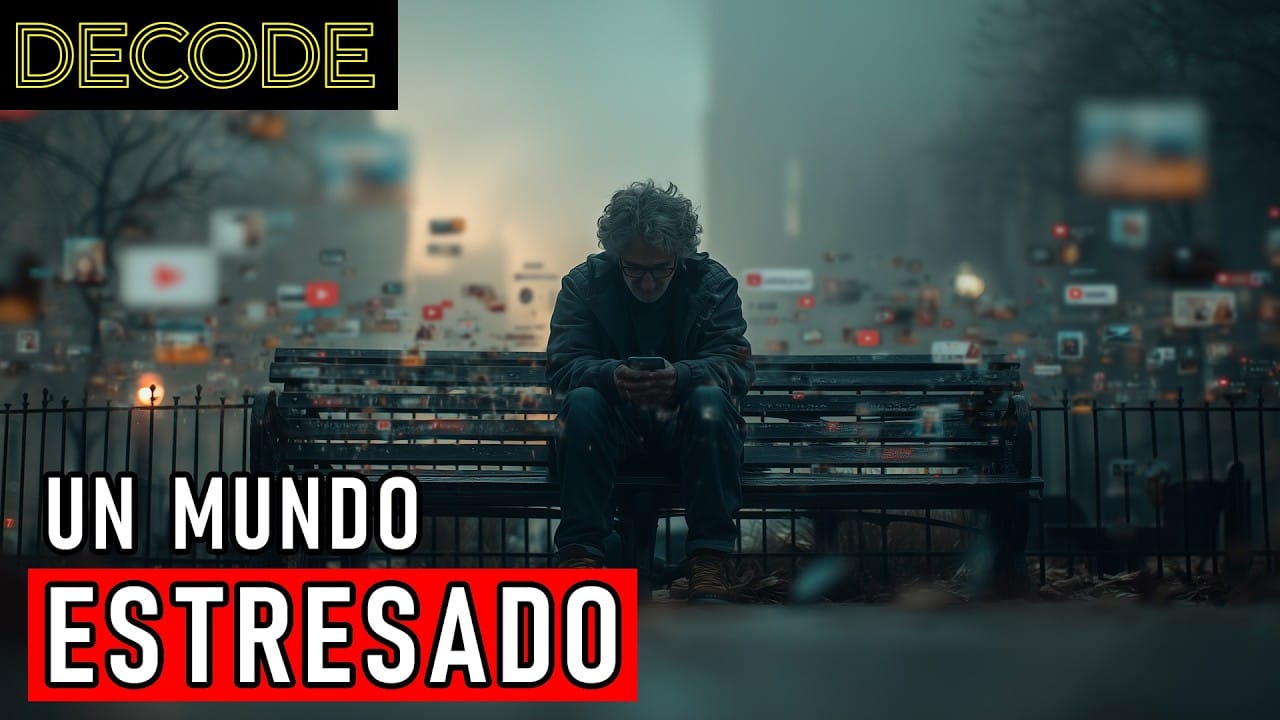
The unease people feel despite real-world progress is no accident. Understanding how the attention economy distorts our perception is essential for separating genuine alarm from exhausting noise — and for grasping the gap between actual progress and media-driven anxiety.
Attention economy drives chronic stress despite historic gains in human welfare
We live in the safest, most prosperous era in human history, with record gains in literacy and life expectancy. Yet today's information environment traps us in a "collective psychosis." The attention economy rewards bad news and collapse narratives, locking populations in chronic stress — a finding underscored by "Factfulness" author Hans Rosling.
The business model is built on fear. Algorithms exploit the brain's hardwired tendency to fixate on the negative, while "merchants of fear" monetize collective anxiety through ad revenue and speaking fees. The result: a self-reinforcing cycle where negativity spreads and the perception of a world in freefall drowns out objective reality.
"We live in one of the safest eras in history, yet the information environment is obsessed with showing us a world that seems to be collapsing by the minute."
Chronic stress degrades sleep and immunity, raising disease risk
Stanford neuroendocrinologist Robert Sapolsky has shown that stress itself is not the problem — duration is. When cortisol stays elevated over time, the body breaks down. Sleep goes first: the brain cannot fully recover overnight, leaving people with a "hangover" feeling no matter how many hours they log.
Immunity goes next, making the body more vulnerable to infection and inflammation. Recent research from Hospital Clínic de Barcelona links sustained high cortisol to cancer metastasis, showing that chronic stress does not merely weaken the body — it can accelerate life-threatening disease. Stress is silent and erosive, and it ranks among the most dangerous features of modern life.
"The problem is not stress itself — our bodies are well designed to handle it. The problem is how long that stress lasts."
Chronic stress clouds thinking and numbs emotions
Chronic stress rewires the brain. The hippocampus — seat of memory and learning — goes quiet, while the amygdala, the brain's threat detector, shifts into overdrive. The brain trades deep thinking for fast reaction, making clear thought and rational decision-making harder. Survival mode crowds out cognition.
Constant stress also numbs emotions, blunting sensitivity to joy and every other feeling. The brain desensitizes to fear as a coping mechanism, but that desensitization flattens all emotional experience. The damage is gradual — like rust — and people often forget what life felt like without that persistent internal tension.
"If we constantly feel fear, the brain desensitizes us to fear so we can adapt. But desensitizing us to fear desensitizes us to everything — to all emotions."
The attention economy exploits anxiety and anger to monetize social media content
The attention economy has sparked ruthless competition for user interest — and threat, it turns out, is the most effective tool. Social media didn't invent this logic; it learned to exploit the human nervous system, amplifying anxiety, anger, and danger to drive engagement. Court cases against platforms like Facebook have shown companies knew their algorithms harmed users, especially young people.
The dynamic is straightforward: emotionally charged content generates more clicks, attracts more ads, and gets boosted by algorithms. Calm and serenity don't sell. Outrage and conflict go viral. This drift toward negativity isn't a conspiracy theory — it's a direct consequence of the social media business model, one that turns user stress into revenue.
"Calm and serenity don't sell. What sells is anxiety, anger, outrage, danger. And social media obviously amplifies that — it's part of their business model."
Social media exploits negativity bias to trap users in a state of chronic stress
Negative information captures far more attention than positive — a finding MIT researcher Sinan Aral demonstrated by showing that misinformation spreads faster and farther because of the intense emotions it triggers. This tendency, known as negativity bias and identified by Daniel Kahneman, is an evolutionary adaptation: ignoring threats was more dangerous than ignoring good news. The brain simply reacts more strongly to the negative.
Social media capitalizes on this bias, flooding users with alarming content and maintaining a state of constant stress. Algorithms don't just shape culture — they deliberately sell a darker version of reality than actually exists, because threat holds attention better than calm. Conflict hooks us more than harmony; outrage spreads more than nuance. Both are perfect fuel for a permanent state of high alert.
"Algorithms are selling us a culture — a reality — that is more negative than it actually is. And by doing that, they are inducing a state of continuous stress."
The amygdala triggers fight-or-flight the moment it senses danger — no reflection required
Deep in the brain, a structure called the amygdala acts as a threat-detection alarm. This part of the mammalian brain doesn't analyze or deliberate — it detects danger and fires a fight-or-flight response before the rational brain even registers the threat. Neuroscientist Joseph LeDoux showed how this triggers immediate physiological reactions: hair standing on end, accelerated heart rate and breathing, muscle tension. The body is primed to act.
This instinctive response floods the body with adrenaline and cortisol, switching it into survival mode — a system built for real, short-lived threats like a predator attack. The problem is that in the modern world, the same mechanism fires for far lesser triggers, like nails on a chalkboard, with no time to recover. The natural sequence — danger, reaction, action, recovery — breaks down when threats are subtler but relentless.
"The amygdala could trigger a fear response before the rational part of our brain had even recognized the threat."
Five practical strategies to reduce stress in modern life
Five practical strategies aim to regulate body biology and reshape how we engage with our environment. First, prioritize physical state by managing sleep, movement, and slow breathing — exhale twice as long as you inhale to activate the vagus nerve and calm the body. Second, practice information hygiene: limit negative news sources and use content blockers on social media to cut your daily dose of negativity.
Third, learn to coexist with uncertainty — stability comes from within, not from guarantees. Fourth, build mental "islands of safety" through calming rituals such as time in nature or listening to music. Fifth, choose your social circle deliberately: surround yourself with people who reduce anxiety, even if that means ending toxic relationships.
"The fastest way to calm the mind is to start by calming the body."
Modern life's "open loops" keep the brain locked in chronic hypervigilance
The brain is a pattern-predicting machine that needs closure and control to stay calm — but modern life is riddled with "open loops." Unanswered messages, unfinished projects, uncertain relationships, and an unpredictable future keep the amygdala on permanent high alert. Without resolution, the brain reads instability as constant danger, even when no real threat exists.
This chronic internal tension surfaces as outsized reactions to minor triggers — road rage, general irritability — because the body stays stuck in fight-or-flight. Accumulated micro-stressors and the inability to close loops at work, in the news, or in relationships push tension toward a breaking point, where any small disruption can provoke panic or aggression. We have grown so used to this background noise that it is quietly eroding our capacity to respond.
"Because you never finish anything, you remain in a state of continuous alert — your brain keeps searching for a pattern that doesn't exist, as if you were permanently suspended in uncertainty."
Also mentioned in this video
- Stress often arises in response to nonexistent dangers (1:28)
- Modern anxiety stems from a brain wired for a different era (3:19)
- Unlike past threats, modern ones lack a clear resolution cycle (8:19)
- Acute stress is useful and temporary; chronic stress is harmful (9:54)
- Modern threats are unresolvable and 'doomscolling' worsens anxiety (13:18)
- Comfort tyranny, hustle culture, and overstimulation combined (30:43)
- Growing trend of uninstalling Twitter or switching to 'dumb phones' (33:08)
- Modern society has turned calm into an uncomfortable state (42:23)
- Our nervous system, built to survive, struggles in the modern world (54:05)
Summarised from DECODE con DaniNovarama · 56:57. All credit belongs to the original creators. Streamed.News summarises publicly available video content.