Original source: flightdeck2sim
This article is an editorial summary and interpretation of that content. The ideas belong to the original authors; the selection and writing are by Streamed.News.
This video from flightdeck2sim covered a lot of ground. 6 segments stood out as worth your time. Everything below links directly to the timestamp in the original video.
When a professional airline examiner uses the same tests he applies to real pilot candidates, and calls the result impressive, it signals that consumer flight simulation has crossed a meaningful threshold of physical accuracy.
Qualified 737 Captain Finds Microsoft Flight Simulator 2024 Physics Now Rival X-Plane's Realism
A serving 737 training captain and examiner put Microsoft Flight Simulator 2024 through a structured set of handling exercises drawn directly from real type-rating instruction — the same drills used to familiarise pilots with an unfamiliar aircraft. Testing thrust-pitch coupling, bank-induced descent, and rudder roll effects at 10,000 feet, he found all three behaviours accurately reproduced, with one minor caveat: engine spool-up time felt marginally too fast. His overall verdict was that the 2024 version represents a clear step up from its predecessor in capturing how a real 737 moves through the air.
The comparison that carries most weight is the one with X-Plane, long considered the professional benchmark for flight physics among simulator platforms. The captain noted that secondary control effects — the way a rudder input rolls the aircraft, or how reducing thrust pitches the nose down — were previously something he only reliably saw in X-Plane. That Microsoft's consumer simulator has now reached parity on those metrics matters because it shapes how seriously flight schools and self-taught pilots can use it for procedural and handling practice.
"These effects of flight controls are far improved. These are features which previously I only really noticed in X-Plane — in 2024, very, very nice."
Real 737 Captain Confirms PMDG Simulator Accurately Replicates Rotation Back-Pressure Behaviour
During a departure from Stansted on runway 22, a working 737 captain highlighted a specific and technically precise finding: the PMDG 737 for MSFS 2024 correctly models the increase in back-pressure a pilot must apply mid-rotation to sustain the nose's climb through 15 degrees — a subtle but operationally significant characteristic of the real aircraft that simulators routinely get wrong. He also noted that flight director commands and the speed trim system's corrective behaviour during the initial climb matched real-world expectations closely. Engine acceleration to the initial 40 percent thrust setting was described as realistic.
"There's a noticeable increase in back pressure required to keep the rotation rate going to 15 degrees. That is very much apparent in 2024, which is great to see."
PMDG 737 Update Adds Noise-Cancelling Headset Simulation and Fully Modelled Freighter Cargo Bay
During the climb to cruise altitude, a 737 captain ran through a catalogue of new features in the updated PMDG 737 for Microsoft Flight Simulator 2024. Among the most notable: clicking a cockpit control activates a noise-reduction headset mode, filtering ambient engine sound to replicate what a pilot actually hears through real-world aviation headphones — a detail aimed squarely at online network users seeking greater immersion. The freighter variants of the aircraft have received an entirely new cargo bay interior model, previously absent. Even the cabin pressurisation system has been refined to register a slight fluctuation when an onboard toilet flushes, reflecting the real pressure disturbance that event causes.
"If you click this, you've got a little bit of a noise reduction headset on — so if you're on VATSIM, you have a far more realistic sound you'd expect if you had your headphones on in real life."
737 Examiner Hand-Flies MSFS 2024 Geneva Approach, Flags Rudder Sensitivity as Simulator Artefact
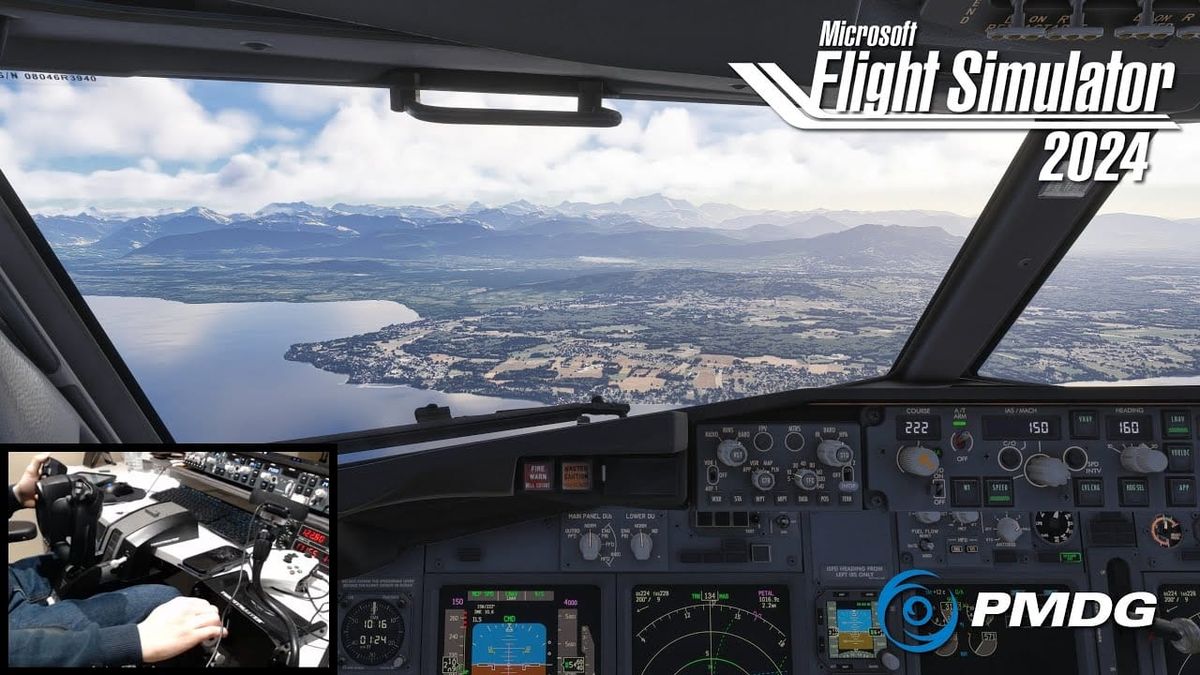
On final approach into Geneva runway 22, a 737 examiner disconnected both autopilot and autothrottle at nine miles and hand-flew the ILS approach to landing, narrating real-world technique throughout — including the precise moment to initiate the flare and how to prevent the nose dropping as thrust is reduced to idle. The approach and landing were judged convincing, with flight director guidance described as highly accurate. One specific criticism emerged: rudder behaviour on the rollout was noticeably twitchy, something the captain explicitly attributed to a simulator-specific shortcoming rather than accurate aircraft modelling.
"The rudder is a little bit twitchy. That's a bit of a Microsoft flight simism."
PMDG 737 Cabin Rebuilt from Scratch with Interactive Doors and 189-Seat High-Density Layout
The updated PMDG 737 for Microsoft Flight Simulator 2024 ships with a completely reconstructed cabin interior, built individually for each variant of the Boeing 737-800. The high-density 189-seat configuration — the maximum passenger layout used by many low-cost carriers — appears in a PMDG product for the first time. Interactive elements include operable doors secured by a functional number pad, while cabin lighting can be controlled manually or left on an automated setting. The update was demonstrated during the boarding phase using third-party ground-handling software, with passengers loaded before departure.
"This is the first time I think we've seen high density configuration with the PMDG 737 in any Microsoft Flight Simulator."
PMDG 737 Taxiing Behaviour Significantly Improved in MSFS 2024, Captain Confirms
Before departure from Stansted, a 737 captain noted that ground handling in the updated PMDG 737 had improved substantially compared with the equivalent product for Microsoft Flight Simulator 2020, which he had previously criticised. The aircraft now carries appropriate inertia during taxi, responds to differential thrust and rudder pedal inputs without jerking, and can complete tight turns at idle power in a manner consistent with the real aircraft at comparable gross weights. The update also introduced clickable trim spots on the flap lever panel, simplifying configuration during pre-departure flows.
"It now actually taxis as I'd expect it to — it's not very jerky, there's plenty of inertia, and I can actually turn on a dime."
Summarised from flightdeck2sim · 1:00:23. All credit belongs to the original creators. Streamed.News summarises publicly available video content.
Streamed.News
This publication is generated automatically from YouTube.
Convert your full video library into a digital newspaper.
Get this for your newsroom →