Original source: Eze Martínez
This video from Eze Martínez covered a lot of ground. Streamed.News selected 5 key moments and summarises them here. Everything below links directly to the timestamp in the original video.
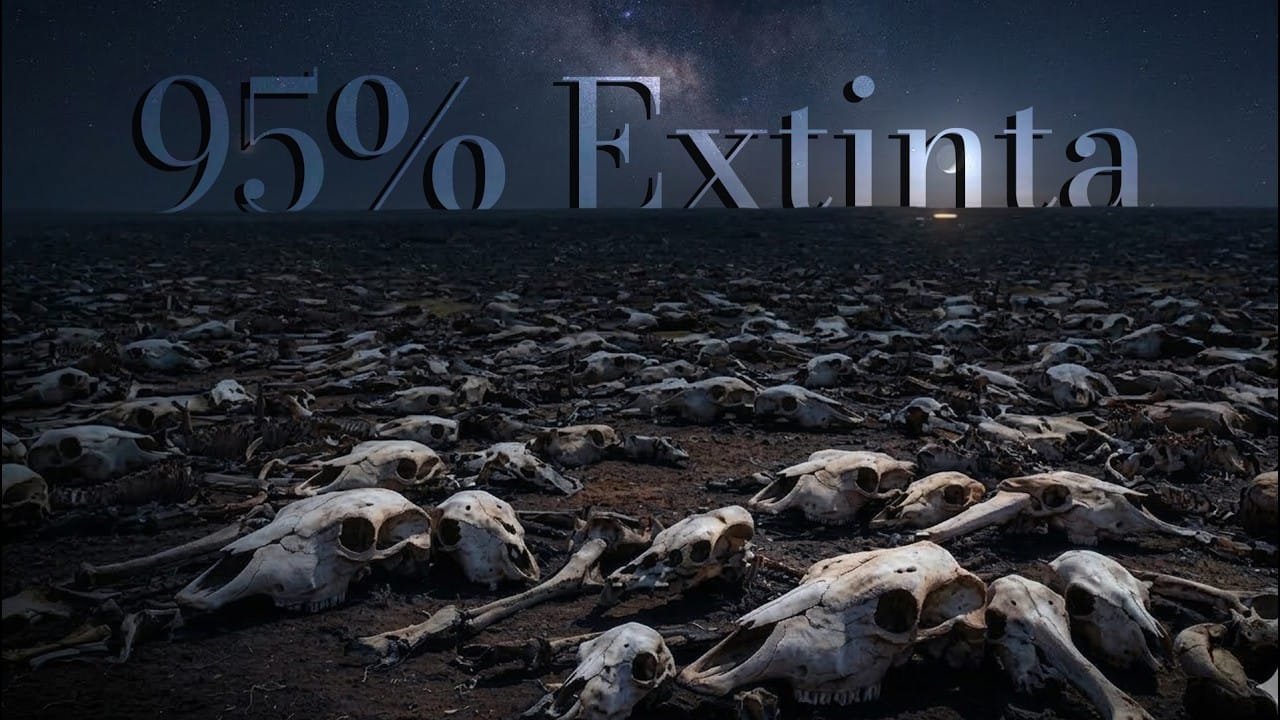
Mass extinctions aren't just history. We are living through one now. Understanding its cause and scale is crucial to grasp our planetary impact.
Humanity drives sixth mass extinction 1,000 times faster than historical rate
Earth faces its sixth mass extinction, the Holocene extinction, driven by human activity. Homo sapiens' arrival in Australia 50,000 years ago and North America 15,000 years ago directly correlates with the disappearance of large mammals like mammoths and glyptodons. The current species loss rate is an estimated 100 to 1,000 times higher than the historical average.
This catastrophic event, caused by a single species, impacts the biosphere as profoundly as the asteroid that wiped out the dinosaurs. The unprecedented alteration of climate and environment highlights humanity's vast planetary influence.
"This period's extinction rate is estimated at 100 to 1,000 times higher than Earth's historical average."
Gravity reveals hidden Chicxulub crater in Yucatán Peninsula
Scientists located the Chicxulub asteroid crater, buried under a kilometer of sediment in the Yucatán Peninsula, by analyzing gravitational anomalies. Earth's gravity isn't uniform; it varies with the mass and density of underlying materials. This principle allowed a map to reveal a near-perfect circle, the unmistakable signature of the 66-million-year-old impact.
Cenote distribution in the area reinforces the evidence, forming a ring that matches the crater's edge. This discovery shows how physical principles, like Newton's law of universal gravitation, can unveil massive geological structures hidden in plain sight.
"If we observe Earth and see more mountains, more rock, gravity is higher there than where there is water, whose density is lower than rock."
Massive Siberian volcanic eruptions caused history's largest extinction
The Permian-Triassic extinction, Earth's most devastating, stemmed from an unimaginable volcanic event. For a million years, massive eruptions in Siberia, known as the Siberian Traps, covered 7 million square kilometers with lava. This phenomenon released colossal amounts of carbon dioxide and methane into the atmosphere.
The greenhouse effect consequently raised global temperatures by 10 degrees Celsius, triggering ocean deoxygenation. This change unleashed a domino effect, annihilating most planetary life and illustrating the deep link between geological activity and global climate stability.
"The volcanic eruptions didn't last a day, a week, a month... They lasted a million years."
Global Iridium Layer First Evidence of Dinosaur-Killing Asteroid
Scientists first linked dinosaur extinction to an asteroid impact, not by finding a crater, but a thin, global rock layer. This geological strip, exactly 66 million years old, holds iridium concentrations hundreds of times higher than normal. Iridium is extremely rare in Earth's crust but common in asteroids. Its global presence in this fossil layer became the undeniable chemical proof: a massive extraterrestrial body hit Earth, spreading its debris worldwide.
"Iridium is rare in Earth's crust, but very common in asteroids."
Dinosaur Extinction Not the Worst: Four Mass Events Surpassed Its Devastation
The dinosaur extinction wasn't Earth's deadliest event. Four mass extinctions proved worse. The Permian-Triassic, the most severe, wiped out 57% of biological families, 81% of marine species, and 70% of land vertebrates. This redefines the asteroid impact's scale, showing Earth's life faced deeper cataclysms. Understanding these past events reveals ecosystem resilience and fragility.
"Four extinctions were worse than the dinosaurs'."
Also mentioned in this video
- Melomys rubicola: Last mammal declared extinct (0:01)
- Evidence of a 250-million-year-old mass extinction (3:22)
- Permian-Triassic Mass Extinction: The Great Dying (8:46)
Summarised from Eze Martínez · 14:24. All credit belongs to the original creators. Streamed.News summarises publicly available video content.