Original source: The Diary Of A CEO
This article is an editorial summary and interpretation of that content. The ideas belong to the original authors; the selection and writing are by Streamed.News.
This video from The Diary Of A CEO covered a lot of ground. 6 segments stood out as worth your time. Everything below links directly to the timestamp in the original video.
Ever wonder why learning something new feels mentally exhausting, but mastering it becomes effortless? This explanation reveals the profound ways your brain transforms with expertise.
Expert Brains Exhibit Reduced Activity in Familiar Tasks, Neuroscientist Explains
Neuroscientist Dr. David Eagleman illustrates that performing new and challenging tasks leads to widespread brain activity, particularly in areas such as the anterior mid-cingulate cortex. Conversely, an expert performing a familiar task shows significantly less brain activity, demonstrating the brain's efficiency in solidifying neural pathways with practice, thus requiring less energy. This neural efficiency is also accompanied by physical changes in the brain. Dr. Eagleman notes that pianists, for example, develop an enlarged motor cortex due to extensive fine motor activity, while violinists exhibit similar growth localized to the specific hand used for detailed work. These adaptations highlight how the brain dedicates more neural "real estate" to highly practiced skills, reflecting its capacity to physically transform based on an individual's activities.
"When I'm in novice at something my brain is using much more activity... because I'm trying to figure out the rules... you as an expert you know you got it you don't you don't need to burn much activity."
Dr. Eagleman Advocates AI for 'Vicious Friction,' Humans for 'Virtuous Friction'
Dr. David Eagleman distinguishes between "vicious friction"—mundane, repetitive tasks like data entry or tax preparation—and "virtuous friction"—challenging, thought-provoking problems that demand innovation and deeper understanding. He argues that artificial intelligence should handle vicious friction, freeing humans to engage in more complex cognitive efforts, much like calculators liberated students from rote arithmetic.
"There's vicious friction in our lives and there's virtuous friction... get rid of all the busy work. There's no honor in that."
Neuroscientist Stresses Dialogue and Shared Interests to Combat In-Group Biases
To counteract inherent in-group and out-group biases, Dr. David Eagleman emphasizes the critical role of developing strong dialogue skills and actively "complexifying" relationships. He suggests that by listening to others to understand their perspectives, even without agreeing, and by identifying shared interests beyond political or social divides—such as hobbies, family, or hometowns—individuals can challenge their predispositions.
"It's really useful to figure out how to complexify those relationships... finding those things explicitly helps the brain to keep these circuits on that are involved in seeing another person as a person."
▶ Watch this segment — 1:21:06
Childhood Fall Sparked Dr. Eagleman's Lifelong Fascination with Perception
Neuroscientist Dr. David Eagleman recounts that a childhood accident at age eight, where he fell 12 feet from a roof, ignited his career-long fascination with the brain and perception. Despite the fall lasting only 0.6 seconds, he distinctly perceived the event as happening in slow motion, prompting him to question how the brain constructs our experience of time and reality.
"When I was 8 years old, I fell off of the roof of a house... But the whole thing seemed to take a long time... I couldn't figure out why it seemed to have taken so long. So I think that got me really interested in perception."
Neuroscientist Recommends Constant Challenge for Optimal Brain Health and Cognitive Reserve
Dr. David Eagleman stresses that continuous challenge and novelty are essential for brain health and personal growth, as they actively build and strengthen new neural pathways. He advises seeking out tasks that are both frustrating and achievable, and upon mastering something, moving on to new, unfamiliar challenges to continuously stimulate the brain and foster "cognitive reserve."
"The key is challenge... you want to seek novelty to find yourself in that zone and push yourself to do things that you just haven't done before... once you become good at something, you have to drop that and take on something you're not good at. This is the best thing that you can do for your brain."
Dr. Eagleman: Cultivate Curiosity and Critical Thinking with AI to Become 'Superhuman'
To become "superhuman" with artificial intelligence, Dr. David Eagleman advises individuals to consistently ask questions driven by genuine curiosity, particularly seeking out pros, cons, and counterarguments to their own ideas. This interactive approach, he explains, forces critical thinking and creativity, which he identifies as the two most essential skills to teach the next generation, given the accessibility of vast information via AI.
"Ask it questions that you're curious about about anything. Just asking questions... I'll say, 'Here's my idea. Give me pros and cons.' You know, tell me why this is wrong. And I do that pretty much with everything that I ask it."
Also mentioned in this video
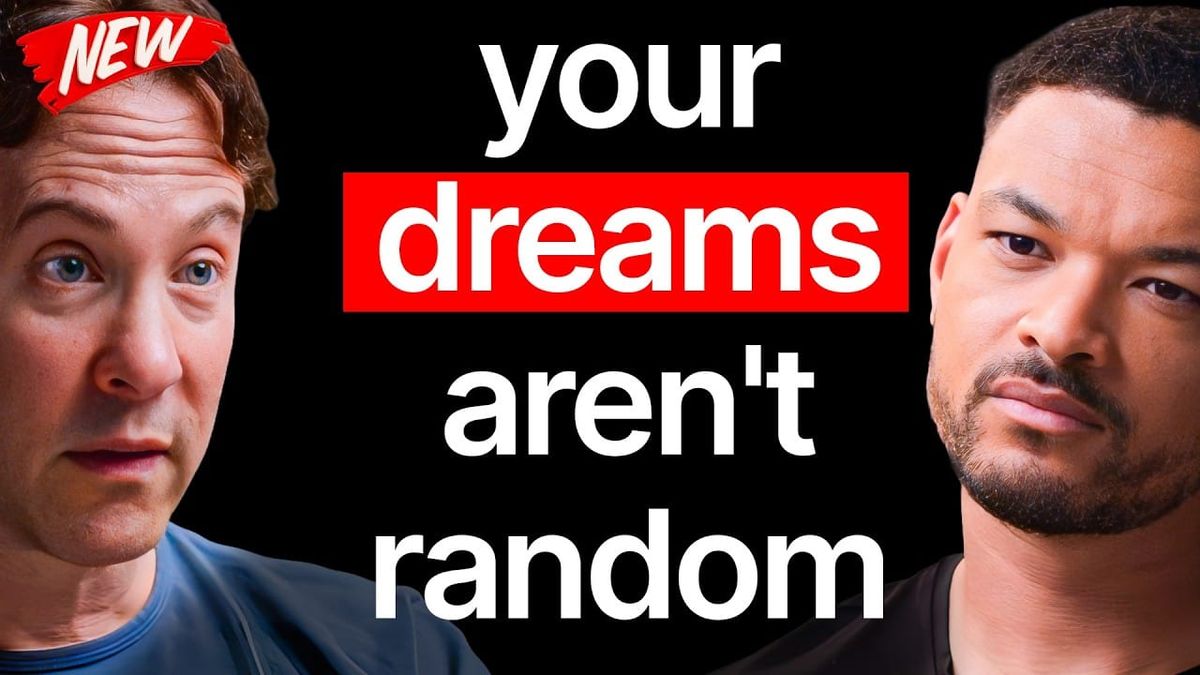
- The purpose of dreaming is to defend the visual cortex from being taken over by… (0:00)
- Our brains peaked at age two with fluid intelligence, capable of learning… (0:40)
- The speaker expresses cyber-optimism for young people, believing that AI and… (1:05)
- The concept of humans as a "team of rivals" is introduced, where various neural… (3:26)
- Challenging the naive belief of being a single, unchanging person and enabling… (5:24)
- The idea of being a single entity despite internal arguments, and Dr. Eagleman… (6:24)
- Brain plasticity, the brain's ability to mold and hold new shapes, is discussed… (7:36)
- The brain's job is to create an internal model of the world, transitioning from… (10:41)
- While the brain changes less with age, it can still change, especially when… (12:28)
- The brain peaks in neural connections at age two, followed by pruning of… (17:10)
- The brain's cortex is a "one-trick pony" that is highly fluid and adaptable, as… (21:28)
- Transforming into a more disciplined and motivated person is possible not just… (22:28)
- Exercise, sleep, and diet are crucial for brain health, as seen in rats where… (23:39)
- The internet and social media offer positive exposure to diverse fields and… (25:07)
- It is difficult to definitively assess the impact of social media on children's… (26:16)
- Led to increased knowledge and skill, contradicting concerns about AI leading… (29:43)
- People value things more if they perceive a significant amount of effort went… (33:19)
- The importance of understanding trade-offs when using AI is emphasized,… (35:33)
- The discussion revolves around AI's ability to be brutally honest and… (41:40)
- AI is increasingly making accurate creative decisions that predict human… (47:13)
- AI, trained on existing data, tends to produce content that is in the middle of… (50:12)
- AI, though inspired by the brain's neural networks, operates with "jagged… (57:47)
- While AI can replicate human actions, it lacks the internal experience of being… (1:02:06)
- AI's advanced retention capabilities might lead to a societal bifurcation, with… (1:04:46)
- The human population exhibits a spectrum of internal experiences, from… (1:09:17)
- The theory of dreaming as a defense mechanism for the visual cortex is… (1:18:00)
- To prevent dementia, Dr. Eagleman advises keeping the brain active by seeking… (1:23:09)
- Dr. Eagleman wishes for greater complexification of relationships on a global… (1:25:23)
- The current macro trend of social media algorithms pushing users into echo… (1:26:52)
- Despite the dopamine hits from "slot machine" social media, humans… (1:31:16)
Summarised from The Diary Of A CEO · 1:33:18. All credit belongs to the original creators. Streamed.News summarises publicly available video content.
Streamed.News
This publication is generated automatically from YouTube.
Convert your full video library into a digital newspaper.
Get this for your newsroom →