🌐 Lee esto en Spanish →
Original source: Escuela de Ingeniería de Fuenlabrada, URJC
This article is an editorial summary and interpretation of that content. The ideas belong to the original authors; the selection and writing are by Streamed.News.
This video from Escuela de Ingeniería de Fuenlabrada, URJC covered a lot of ground. 6 segments stood out as worth your time. Everything below links directly to the timestamp in the original video.
Have you ever imagined what would happen if diesel, the engine of the global economy, started to run scarce? This situation, already visible in several nations, presages an era of more expensive and limited energy that will radically transform our daily lives.
Global Diesel Production Falls 15% as Non-Renewable Sources Peak
Global diesel production has dropped approximately 15% below levels recorded between 2015 and 2017, severely impacting essential sectors such as transportation, agriculture, and mining. This scarcity is already evident in countries like Bolivia, where 80% of trucks are idled and mining operations, including copper and lithium, have ceased. This scenario is beginning to spread to Ecuador, Mexico, and Argentina, and is intensely observed in Nigeria, a major oil supplier to Europe.
"The problem isn't running out, but falling short. Our situation is similar to a person whose energy salary is being cut."
Planet's Radiation Imbalance Quadruples, Projecting Extreme Global Warming
The planet's radiative imbalance has quadrupled since 2004, rising from 0.37 W/m² to 1.37 W/m², equivalent to the absorption of energy from three Hiroshima bombs per second. This increase, partly associated with the reduction of sulfur dioxide (SO2) emissions due to environmental policies in China and maritime traffic, is unexpectedly accelerating climate change, according to recent scientific publications, including works by Gran Foster and Stefan Rahmstorf.
"This radiative imbalance is equivalent to the explosion of three Hiroshima-like bombs every second."
Oil Investment Plummets, Uranium in Rapid Decline, Worsening Global Resource Scarcity
Investment in oil exploration and extraction has drastically decreased by 50% since 2014, revealing a growing resource scarcity. New oil and gas discoveries have dwindled to just 3 billion barrels annually, a figure twelve times lower than global consumption, which stands at 36 billion barrels. This reliance on older fields and the cessation of exploration by major companies like Repsol and Cepsa foreshadow a decline in crude and condensate production, which is already 2% to 3% below its November 2018 peak.
"Each year, the world currently consumes 36 billion barrels of oil, which is 12 times more than what is discovered."
Global Temperature Exceeds 1.6°C Pre-Industrial Levels; 2°C Projected for Iberian Peninsula by 2037
Global atmospheric temperature has surpassed 1.6 degrees Celsius above pre-industrial levels (1850-1900), maintaining an annual average above 1.5 degrees for the past three years, indicating that the Paris Agreement's goal of limiting warming to 1.5°C is no longer viable. This increase leads to direct consequences, such as the recurrence of temperatures up to 45°C in the Iberian Peninsula, an increasingly frequent phenomenon.
"If we reach 2 degrees of global warming, in the Iberian Peninsula we will have summer temperatures of 50 degrees in some geographical points on certain days. These are temperatures incompatible with human life."
Experts Champion Degrowth as Only Political Alternative Amid Capitalism's Unsustainability
Given the urgency and inevitability of an energy transition, the current model of industrial electrical renewables is criticized as ineffective and harmful, promoting environmental and social destruction without energy or economic benefits. Faced with the inevitable scarcity and rising cost of energy, a radical reform of the social, economic, and cultural system is imperative to adapt to a slower societal metabolic rate, conditioned by material and energy limits.
"Capitalism is unsustainable. An economic system oriented towards infinite growth on a finite planet is a total absurdity."
Seven of Nine Planetary Boundaries Transgressed, Warns Stockholm Resilience Institute
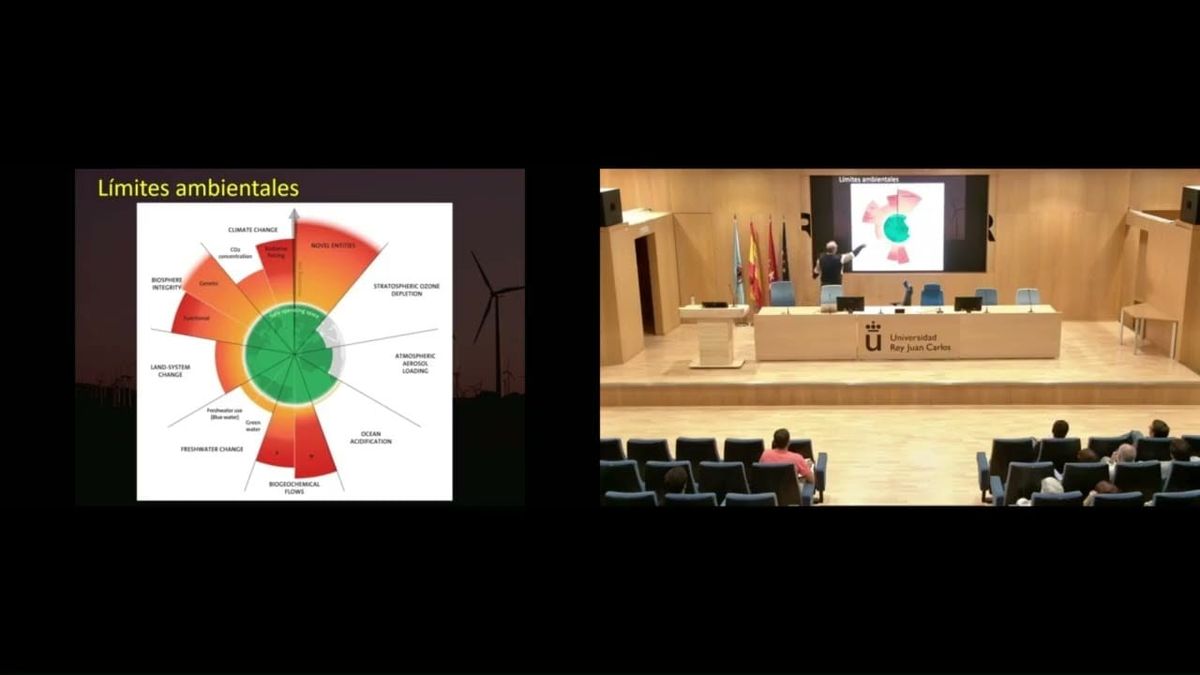
The concept of planetary boundaries, developed by the Stockholm Resilience Institute with the collaboration of over 100,000 researchers, reveals that seven of the nine critical environmental thresholds for Earth's stability have already been transgressed. The transgression of any of these boundaries represents an extinction risk for the human species, by triggering cascading processes that would render the planet uninhabitable. Returning to the safe operating space is urgent to avoid irreversible consequences.
"Of the nine planetary boundaries defined 15 years ago, we have now transgressed seven, and we cannot transgress even one."
Also mentioned in this video
- El ponente agradece la invitación y explica que la charla abordará la… (0:00)
- Se enfatiza la importancia de un enfoque holístico para abordar los problemas… (9:00)
- Se expone la preocupante situación del calentamiento de los océanos, que han… (13:12)
- Se presentan ejemplos recientes de eventos climáticos extremos en el último… (21:05)
- Se señala la necesidad de una transición energética hacia fuentes 100%… (38:40)
- Se denuncia la escasez de materiales críticos como plata, telurio, litio y… (41:12)
- El modelo de energía renovable industrial se enfoca en la electricidad, que… (46:07)
- Se propone una transición energética que aproveche la energía renovable de… (53:27)
- Se sugieren propuestas para la reindustrialización, incluyendo el reciclaje de… (56:06)
Summarised from Escuela de Ingeniería de Fuenlabrada, URJC · 1:00:50. All credit belongs to the original creators. Streamed.News summarises publicly available video content.
Streamed.News
This publication is generated automatically from YouTube.
Convert your full video library into a digital newspaper.
Get this for your newsroom →