🌐 Also available in: 🇪🇸 Español
Original source: DECODE con DaniNovarama
This video from DECODE con DaniNovarama covered a lot of ground. Streamed.News selected 8 key moments and summarises them here. Everything below links directly to the timestamp in the original video.
Understanding football's unifying power exposes the failures of current institutions to generate social cohesion. It forces us to ask what people truly need to feel part of a community — a lesson essential to building less fragmented societies.
Football beats modern institutions at building social cohesion
Football transcends entertainment to become a powerful force for belonging, binding generations and families through shared memory, narrative, and emotional heritage. It taps a deep human need to be part of something larger — illustrated by the speaker's 81-year-old mother who, no football fan herself, celebrated a team's victory by reliving family memories and passing on a sense of collective identity.
Football's ability to build a "we" stands in sharp contrast to the divisive drift of modern politics and social media. Where those fragment and polarize, football draws millions together under shared symbols, rituals, and community — delivering a cohesion contemporary society routinely fails to provide. Its secret is satisfying the innate human drive for tribal affiliation and shared purpose.
"Football is not entertainment. Football is shared memory — it's narrative, identity, the feeling that we won. It's an emotional heritage we carry to the next generation."
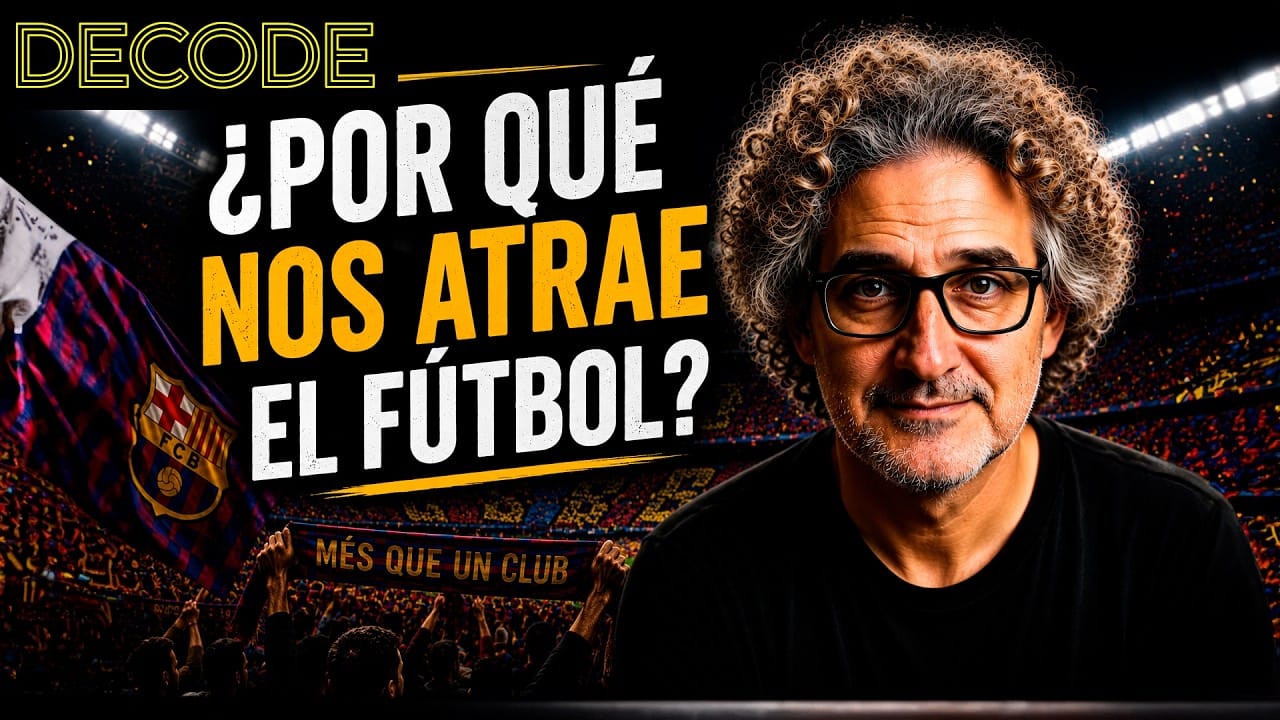
FC Barcelona acts as an integration engine for immigrants in Catalonia
FC Barcelona functions as a powerful "unity machine" for immigrants in Catalonia, offering a cultural shortcut to feeling part of the community. In a region with a high proportion of non-native residents, the club provides a shared identity for people of diverse backgrounds — Latin American, North African, Asian — who unite under one symbol and sing the same anthem, bypassing language and cultural barriers that would otherwise take years to overcome.
The phenomenon carries significant anthropological weight, replicating the role religion once played in binding societies together. In a modern world where religious identity is no longer uniform, football has partially filled that space as a tribal meeting point — supplying the symbols, rituals, narratives, and community that traditional religious structures once provided.
"For all these people, the club has become cultural belonging, shared identity, and an adoptive tribe. Many who arrived in Catalonia found in Barça one of the fastest ways to feel part of the Catalan collective."
Football forges collective identity — fans own every win and loss
Football's power to generate collective identity runs so deep that fans claim their team's victories and defeats as their own. This shows up in the phrase "we won," used by people who watched from their sofa — proof that the club's identity has been absorbed into their personal one, transforming "I" into "we." The emotional intensity is real enough to cause stress or tears, as if the result genuinely mattered to their own lives, signaling a full suspension of disbelief.
This emotional immersion shows that football succeeds not because of entertainment value or rules, but because it is a powerful "belonging machine." It explains the collective catharsis inside stadiums, where strangers embrace at the moment of victory, driven by instant communal identity. The paradox: something so apparently trivial activates deep psychological mechanisms that reinforce social bonds and primal emotions.
"Your brain has absorbed the collective identity the football machine built, and it becomes part of your personal identity. In that moment, it's no longer the Barça players' victory — you won't say 'Barça won.' You'll say 'we won,' because you are Barça."
Football mimics tribal warfare through competitive cooperation to forge identities
Football runs on "competitive cooperation": internal team unity sharpens against an external rival, peacefully replicating tribal war dynamics. This "us versus them" structure is critical for avoiding the "minimum effort problem" found in purely cooperative models — rivalry pushes players to perform at their best.
Channeling an ancestral human instinct into controlled, ritualized competition, this rivalry builds powerful collective identity. Fans choose their "tribe" and develop unbreakable loyalty, mirroring structures like nations, religions, or corporations. The model lets people experience collective pride and rivalry safely — abstracted from real violence — while satisfying a deep anthropological need for belonging and group confrontation.
"Football is, at its core, a simulation of tribal warfare — and tribal warfare is embedded in the cultural DNA of our species."
Football meets the human need for tribalism and belonging just as religion does
Football, like religion, satisfies a deep human need for belonging and tribalism. Symbols, anthems, rituals, pilgrimages, and shared narratives forge collective identity, drawing millions who wear the same colors, sing the same songs, and share intense emotional experiences. The resulting sense of "us" against "them" mirrors the mass mobilization seen in the world's great religions.
The fact that football attracts billions of followers suggests it meets a fundamental human need — far beyond watching 11 players chase a ball. It activates tribal signals hardwired into the brain, signals that persist beneath layers of civilization in their search for a clan. Football is, in essence, a cooperative structure for tribalism that channels an ancient instinct into deep social and emotional bonds.
"Football is a cooperative structure of tribalism and belonging. And that tribalism and belonging is what hooks us to the match."
Football as mirror of tribes and religions: ritualizing collective behavior
Football powerfully reflects the structures of tribes and religions through rich symbolism and deep ritualization of collective behavior. Anthems, colors, specific liturgies, pilgrimages (away trips), relics (boots of legendary players), and mythological heroes (great footballers) appear in both the religious and sporting spheres, creating shared experiences that satisfy the human need to belong to something greater.
This resemblance is no accident — these anthropological features are precisely what allow certain activities to scale to billions of followers. Like religion, football offers a social structure tailor-made for the human psyche, easing entry into community. Its mass appeal ultimately comes down to its ability to channel our innate drive for socialization and group identity into a collectively and emotionally rewarding framework.
"There are certain activities humans love because they carry the features I just described: colors, symbols, rituals. That combination is what scales to an enormous size — and the two best-known examples are, strikingly, football clubs and religions."
Football sacralizes everyday objects, turning them into collective emotional talismans
Football has a peculiar power to transform ordinary objects into genuine talismans and religious totems, loading them with sentimental and emotional value far beyond their original purpose. Scarves, jerseys, tickets from historic matches, signed balls, even patches of turf or bricks from demolished stadiums become relics carrying collective histories and memories — emotional engines that transport fans back to moments of shared euphoria.
This sacralization of objects mirrors the veneration of religious relics and reveals how deeply football activates tribal bonding mechanisms. Stadiums become temples; some even house columbaria for fans' ashes, underscoring the transcendent bond supporters form with their clubs. The value of these objects lies not in their physical form but in the collective emotional history they embody — and that is the source of football's persuasive power.
"The value is not in the object — it's in the story that object represents. That's why football is so persuasive: it has countless objects that embody those stories."
Football unites a fragmented society, cutting across ideology and class
Football has a rare ability to bring together people of different ideologies, social classes, and backgrounds — a feat increasingly uncommon in a modern society defined by fragmentation and polarization. Where social media, politics, and algorithms push individuals into ever-smaller, ever-more-hostile tribes, a football ground draws in people from left and right, separatists and unionists, wealthy and not, all singing the same chant in unison.
The sport functions as a powerful machine for belonging and unity, providing a shared symbol under which differences dissolve. The paradox is striking: in a world seemingly engineered to splinter communities, football generates a collective identity that overrides social divisions. This cohesive force meets a deep human need for togetherness, demonstrating how a single cultural phenomenon can forge a "we" amid widespread atomization.
"Football, beyond being a machine of belonging, is a machine of unity."
Also mentioned in this video
- Football as one of the most sophisticated and successful social structures (0:00)
- Football as an intrinsic part of Latin culture, with the final… (1:37)
- Football as a cooperation machine, where each player has a role… (6:27)
- Football's relevance in the modern, hyper-individualistic era… (18:06)
- Why football can move immense amounts of human emotion… (26:22)
- FC Barcelona's La Masía youth development system… (27:25)
- FC Barcelona's ownership model, where members own the club… (31:23)
- Football as one of the few 21st-century human structures that unites… (39:08)
- Collective catharsis as one of football's most important functions… (39:30)
- Football, despite its flaws, uniting millions of people for… (47:22)
Summarised from DECODE con DaniNovarama · 50:29. All credit belongs to the original creators. Streamed.News summarises publicly available video content.