Original source: Paul Davids
This video from Paul Davids covered a lot of ground. Streamed.News selected 8 key moments and summarises them here. Everything below links directly to the timestamp in the original video.
Discover the audible difference that separates a standard instrument from a masterfully crafted one. The secret lies in tuning the wood itself before a single string is attached.
Luthier Dana Bourgeois Achieves Full Harmonic Spectrum by Hand-Tuning Guitar Top
In the final stage of voicing, Dana Bourgeois's refinements to the guitar top's braces yield a series of clear, distinct musical notes when tapped. This meticulous process, guided by years of experience, ensures that the top is prepared to respond to every possible frequency. The transformation from the initial dull sound to these vibrant tones is the culmination of the luthier's craft.
This final tuning means that when strings are attached and played, the top will resonate with the full spectrum of frequencies being fed into it. This is what creates the rich, complex, and balanced sound characteristic of a high-end, hand-voiced instrument.
"When you play the guitar, every frequency is accounted for in the top... And the top will respond to the frequencies that is being fed by the strings."
Dana Bourgeois Reveals Key to 'Bell-Like' Tone: Systematically Weaken Braces Until Sound Peaks
Luthier Dana Bourgeois continues refining the guitar top by strategically weakening its internal braces to increase flexibility, primarily by trimming their ends. This methodical removal of wood audibly "opens up" the sound of the top when it's tapped. The process gradually transforms the initial percussive taps into more musical, resonant, and bell-like tones.
The crucial insight lies in knowing when to stop. Bourgeois explains that the carving is complete only when further wood removal ceases to improve the sound, ensuring the top has reached its optimal zone of flexibility without being structurally compromised.
"They're more musical, more sort of bell-like... you basically stop when the top stops improving."
Luthier Dana Bourgeois Treats Guitar Braces Like Marimba Bars to 'Play' the Wood
Dana Bourgeois demonstrates that removing even a minuscule amount of wood from a guitar top's brace can create a significant sonic difference. He explains his mental concept for this process is to tap directly over the braces, treating them as if they were individual bars on a marimba. This allows him to effectively "play" the wood and clearly hear how the tone is opening up.
This technique provides the immediate auditory feedback needed to guide the luthier's hands. By holding the top in different places, he can identify which areas remain sonically "tight" and require more work, moving methodically towards a perfectly balanced top.
"What I'm trying to do is tap over the braces because I'm actually playing them like marimba bars. Or at least, that's the concept I have in my head."
The Luthier's First Listen: Dana Bourgeois Corrects 'Thunk-Thunk' Notes in Raw Guitar Top
Before any major carving, luthier Dana Bourgeois assesses a raw guitar top's initial sound, which he describes as containing dull "thunk-thunk" notes. He identifies that some of these percussive tones are too close together in frequency, preventing the wood from ringing freely. His first step is to work on the sides of the braces to begin separating these tones.
This initial adjustment is designed to spread the resonant frequencies apart and encourage more sustain. By removing wood from the sides of the braces, he can alter the frequencies without significantly affecting the top's overall stiffness, setting the stage for more detailed tuning.
"What I'm hearing is... a little bit of thunk-thunk in there. I'm hearing some notes that are pretty close together. So, I'm going to want to try to spread those apart and get them to ring a little bit more."
The Purpose of Asymmetrical Guitar Bracing: To Mimic the Physics of String Vibration
Dana Bourgeois explains that the intentional asymmetry in guitar top bracing is a design that mimics the physics of string vibration. A low bass note vibrates slowly over a large area, while a high treble note vibrates quickly with little movement. The bracing reflects this, featuring a more flexible side for bass response and a stiffer side for the treble notes.
This clever design allows the guitar top to handle multiple modes of vibration at the same time. It's a system built to respond dynamically to the full range of frequencies, enabling the complex, layered sound that defines a high-quality acoustic guitar.
"You want the top to be able to sort of mimic that kind of movement. So, there's a stiffer side and a more flexible side."
How to Hear the Hidden Notes Inside a Single Guitar String
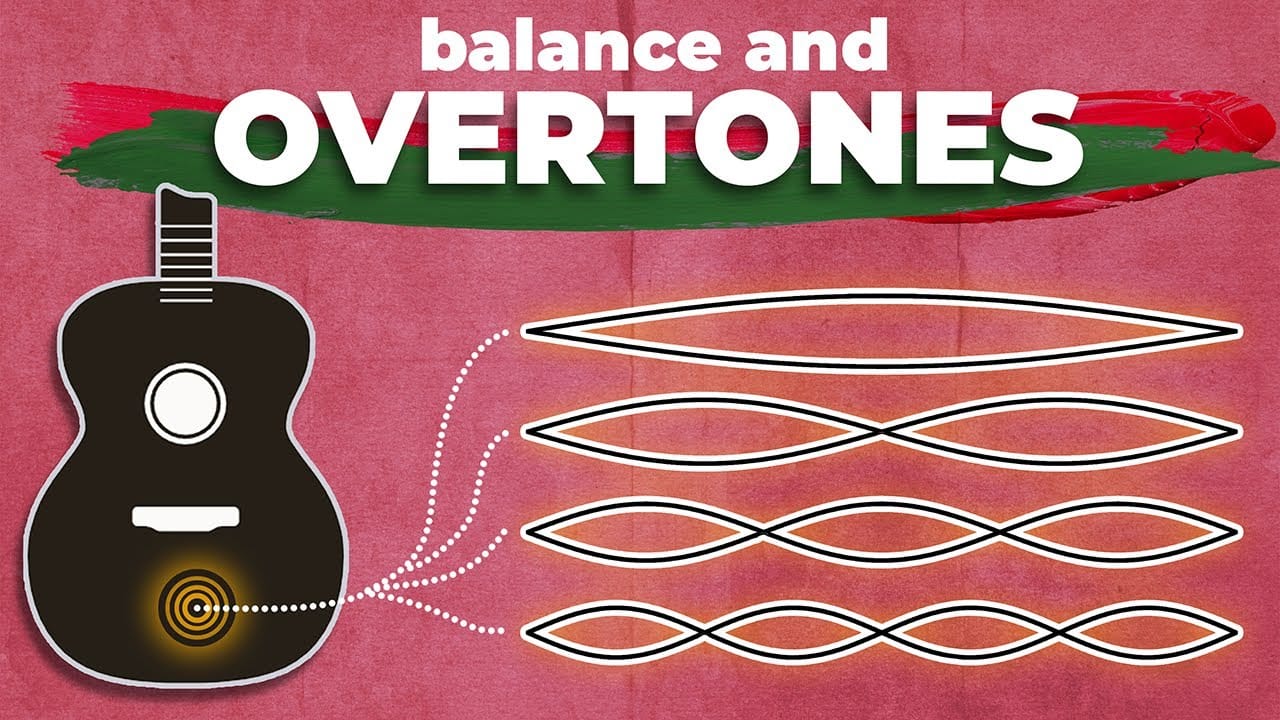
A single guitar note is actually a composite of a fundamental frequency and a series of overtones, and Paul Davids demonstrates how to hear them. By lightly touching an open E string at precise fractional points—halfway for the octave, a third for the perfect fifth, a fifth for the major third—these hidden notes can be isolated and made clearly audible.
This exercise makes the abstract concept of the harmonic series tangible for any guitarist. It's a beautiful demonstration of how a simple vibrating string naturally produces the building blocks of chords and scales, revealing the inherent musicality of physics.
"At one-third of the string, we find the perfect fifth. Now we tripled the original frequency... 1/5 of the string, it gives us a major third."
Synthesizer Reveals How Overtones Build a Rich Sound from a Simple Sine Wave
To make the concept of overtones even clearer, Paul Davids uses a synthesizer to construct a sound from the ground up. He starts with a pure fundamental tone and gradually adds subsequent overtones like the octave and the fifth. The sound immediately transforms from a thin, sterile hum into a rich, full-bodied musical note.
What's fascinating is that even when dozens of overtones are added, the human ear perceives a melody played with this complex tone as single notes, not chords. This illustrates the incredible sonic interplay that occurs within an acoustic guitar.
"You hear it as one note playing a little melody, right? We can even bring in more overtones. Let's just go crazy. 32 overtones."
Boutique Guitar Makers Aim to Make New Instruments Sound Old, Says Luthier Dana Bourgeois
The key difference between a factory-built guitar and a high-end boutique instrument lies in the hand-voicing process, which is all about maximizing a guitar's potential for rich overtones. Master luthiers like Dana Bourgeois of Bourgeois Guitars, as well as Collings and Santa Cruz, hand-voice each instrument, a meticulous step that volume production makes impossible.
Bourgeois's guiding philosophy is to make a new guitar sound like a well-played vintage one. Over decades, wood naturally stiffens, improving its tonal properties. He aims to accelerate this process through voicing, giving a new instrument the sonic character of an old one from day one.
"My whole thing has been trying to make a new guitar sound like an old guitar."
Also mentioned in this video
- A single musical note contains multiple overtones, which are visible on a… (0:00)
- His goal of achieving clear, distinct, and bell-like notes with many different… (0:40)
- Paul Davids illustrates the strength and number of overtones in piano versus… (2:33)
- His process of tapping the guitar top to identify and enhance various clear and… (3:09)
- In guitar building. (12:47)
- The video demonstrates the attention to detail a skilled luthier brings to… (13:09)
- Dana Bourgeois defines a boutique guitar as one where, despite being built in… (13:40)
- Techniques from boutique builders are improving affordable models while… (14:49)
Summarised from Paul Davids · 16:04. All credit belongs to the original creators. Streamed.News summarises publicly available video content.