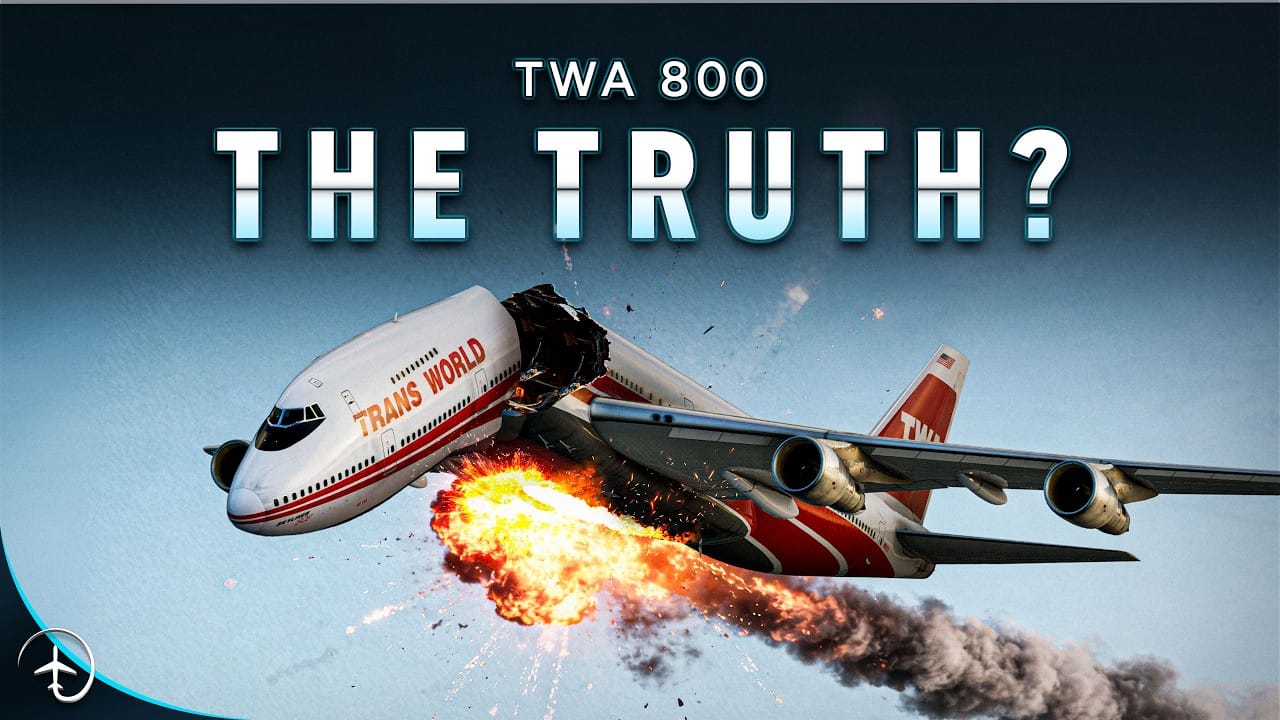
Original source: Mentour Pilot
This video from Mentour Pilot covered a lot of ground. Streamed.News selected 8 key moments and summarises them here. Everything below links directly to the timestamp in the original video.
The legacy of TWA Flight 800 is written into the design and maintenance of every modern airliner. Its investigation forced the industry to confront hidden dangers in aging electrical systems, leading to safety standards that protect passengers today.
TWA Flight 800 Disaster Prompted Mandates for Fuel Tank Inerting Systems and Sweeping Wiring Reforms
The TWA Flight 800 accident fundamentally altered aviation safety by proving that ignition sources in fuel tanks could not be completely precluded. In response, regulators mandated the installation of fuel tank inerting systems, which use nitrogen-enriched air to prevent flammable fuel-air mixtures from forming. By 2018, virtually all modern airliners were fitted with this technology, neutralizing the hazardous environment that led to the disaster.
What makes this particularly significant is how the investigation also accelerated a revolution in wiring maintenance and certification. The disaster illuminated how invisible electrical degradation posed a catastrophic threat, making latent vulnerabilities in wiring, insulation, and connectors a central element of long-term airworthiness assessments and profoundly changing how aging aircraft are maintained.
"This accident didn't so much reveal new risks, but instead illuminated how ordinary, widely-distributed conditions could interact to produce a catastrophe."
Forensic Analysis of TWA 800 Wreckage Confirmed Fuel Tank Explosion, Ruled Out Missile or Bomb
Investigators conclusively determined the cause of the TWA Flight 800 disaster by reconstructing the aircraft from recovered debris. The physical evidence presented clear signatures of an internal fuel tank explosion, including metal skin peeled outward, witness marks from colliding structural elements, and soot deposits consistent with an internal blast. This forensic fingerprint was fundamentally different from that of an external device.
Equally important was the absence of contradictory evidence. Despite exhaustive chemical and forensic analysis, no residue from high explosives or fragments consistent with a bomb or missile were found on the wreckage, systematically eliminating external blast theories and focusing the investigation on the aircraft's own systems.
"Together, all of the physical evidence eventually eliminated the possibility of an external explosive device, not through assumption, but through the methodical exclusion of all other possibilities."
Short Circuit Sent Voltage Spike Into TWA 800 Fuel System, Igniting Vapors
The final sequence of events aboard TWA Flight 800 began with a short circuit within a bundle of electrical wires as the aircraft climbed. This event, likely between a high-power cabin lighting wire and a Fuel Quantity Indicating System (FQIS) wire, sent a surge of excess electrical energy into the low-voltage fuel system. This spike caused the erratic fuel flow readings noted by the captain moments before the disaster.
The voltage surge traveled through the FQIS wiring into the center wing tank, where probes and sensors were suddenly energized beyond their design limits. Inside the tank, where fuel vapor had been heated to a flammable state, this energy created a tiny arc, providing the spark that ignited the mixture at 20:31:12.
"A tiny arc, perhaps releasing only a few millijoules of energy, now initiated a sequence of events that would be impossible to stop."
Crippled TWA 800 Climbed to 16,000 Feet After Explosion, Creating Missile Illusion for Witnesses
After the initial explosion tore away the forward fuselage, the now tail-heavy and aerodynamically unstable Boeing 747 experienced a powerful nose-up pitch. With its wings still generating lift and engines likely producing some thrust, the aircraft continued to climb, converting its forward momentum into altitude. It ascended another 2,000 to 3,000 feet, reaching a peak of nearly 16,000 feet.
This improbable climb, with the fuselage burning, created a streak of light in the sky that many witnesses on the ground mistook for a missile. The aircraft eventually stalled, rolled to the right, and entered a near-vertical descent, a trajectory that fueled persistent misinformation about the cause of the accident.
"Most of them reported seeing a streak of light shooting upwards into the sky, which if you don't know any better, sounds a lot like a missile."
Silver Sulfide Deposits on Fuel Probes Identified as Likely Ignition Trigger in TWA 800 Tank
Investigators identified silver sulfide deposits as the likely mechanism that allowed a low-energy electrical fault to ignite fuel vapors in the center wing tank. These deposits form when silver-plated copper wiring, exposed by cracks in its insulation, reacts with sulfur present in jet fuel. This chemical reaction creates a conductive pathway that reduces electrical resistance.
This condition, previously considered a maintenance nuisance that could cause faulty gauge readings, dramatically increased the risk of arcing between exposed conductors. On TWA Flight 800, these deposits provided the final link in the chain, enabling the voltage surge in the FQIS wiring to release its energy as a spark.
"Boeing had not identified this as a serious safety issue. It was more seen as a nuisance that could cause erratic readings on the fuel gauges."
Investigators Found Arcing Damage Pointing to FQIS Short Circuit as TWA 800 Initiating Event
The investigation concluded that a short circuit involving the Fuel Quantity Indicating System (FQIS) was almost certainly the initiating event for the disaster. Although the exact location of the fault could not be pinpointed due to damage, investigators found compelling evidence across multiple areas of the wreckage. This included arcing on high-power cables that had been bundled together with FQIS wiring.
Further evidence included arcing damage near a previous structural repair, where maintenance may have disturbed the wiring, and metal shavings near the location of a missing FQIS wire bundle. These physical findings collectively pointed to a scenario where high voltage jumped into the low-voltage fuel probe wiring.
"Investigators were never able to pinpoint the exact location of the initial short circuit. Instead, they acknowledged that there had been many places where a failure could have occurred."
Fuel Vapor Ignition in TWA 800 Center Tank Caused Rapid Structural Failure of Fuselage
The ignition of fuel vapor inside the center wing tank created a deflagration—a rapidly expanding flame front—that quickly overwhelmed the tank's structural limits. This overpressure caused a crucial spanwise beam to separate and slam into the front spar, a primary load-bearing component of the wing box. The impact fractured the front spar, critically weakening it.
Without the rigidity of the front spar to support it, the lower fuselage skin buckled and tore open. The chain reaction of structural failures propagated rapidly from this initial event, leading to the complete destruction of the aircraft's central structure.
"It was still releasing enormous amounts of energy so quickly that it almost immediately exceeded the structural integrity of the tank."
Massive Recovery and Reconstruction Effort Was Key to Solving TWA Flight 800 Mystery
The investigation into TWA Flight 800 was defined by one of the most meticulous recovery and reconstruction efforts ever undertaken by the NTSB. Over four years, teams used sonar and divers to retrieve nearly all of the aircraft from the ocean floor. The fragments were then painstakingly reassembled into a skeletal form of the 747 inside a hangar.
This reconstruction allowed investigators to trace failure paths and pressure waves with remarkable clarity. By examining deformation patterns, burn signatures, and structural separations on the physical wreckage, they could test every plausible theory against the evidence, ultimately confirming a fuel tank explosion was the cause.
"The lasting importance of this accident came not from how the investigators solved the puzzle, but instead in the way that the aviation industry learned from it."
Also mentioned in this video
- TWA Flight 800, a Boeing 747, experienced an unthinkable incident off the coast… (0:00)
- The incident of TWA Flight 800 became a turning point for the aviation… (0:42)
- On July 17th, 1996, the Boeing 747 for TWA Flight 800 completed a routine… (1:12)
- The replacement crew for TWA Flight 800 to Paris consisted of highly… (2:13)
- During the turnaround for TWA Flight 800, routine activities like baggage… (2:56)
- The Boeing 747-131, registered as N93119, had accumulated approximately 93,000… (3:34)
- For the New York to Paris flight, all required fuel was loaded into the wing… (5:25)
- Routine disruptions before departure included a premature fuel tank shut-off… (7:21)
- After fueling, TWA staff discovered a bag loaded without its owner confirmed on… (9:53)
- Further delays occurred when an airport service vehicle broke down behind the… (10:20)
- Two air conditioning packs, located beneath the center wing section and… (11:05)
- Jet fuel vapor, unlike liquid jet fuel, can become highly combustible and… (12:32)
- Aircraft designers focused on eliminating ignition sources within and around… (14:01)
- After 79 minutes of delays, TWA Flight 800 was finally cleared for pushback,… (15:28)
- Around 10 minutes after takeoff, as TWA Flight 800 climbed through 13,000 feet,… (16:05)
- The Boeing 747-100's fuel quantity indicating system (FQIS) uses electrical… (18:22)
- The FQIS safeguard relied on complete isolation from high voltage sources and… (20:06)
- Factors like aging insulation, maintenance disturbances, and hard-to-access… (22:06)
- The 1990 Philippine Airlines Boeing 737 accident in Manila, where a damaged… (24:22)
- On TWA Flight 800, the center wing tank contained a flammable vapor mixture,… (25:48)
- The failure of the front spar compromised the fuselage skin, leading to the… (35:04)
Summarised from Mentour Pilot · 48:08. All credit belongs to the original creators. Streamed.News summarises publicly available video content.