🌐 Also available in: 🇪🇸 Español
Original source: Antonio Páez
This video from Antonio Páez covered a lot of ground. Streamed.News selected 8 key moments and summarises them here. Everything below links directly to the timestamp in the original video.
Understanding the true nature of design as a universal planning phase — rather than a mere artistic activity — is crucial to grasping the complexity of contemporary production and its impact on every aspect of our lives.
Design as a Ubiquitous Pre-Production Phase: From the Material to the Immaterial
Design is defined as the initial and essential planning stage in the production process, in which all the characteristics of a product are configured and established before actual manufacturing begins. Unlike craft, where form emerges simultaneously with production, modern design — particularly in the industrial and digital spheres — requires an exhaustive definition of blueprints, materials, and methods prior to materialization, positioning it as an indispensable strategic phase in contemporary production.
This conception of design accounts for its boundless expansion, encompassing not only material production — such as architecture or fashion design — but also the vast field of the immaterial, including the design of web interfaces and software. Design's ability to adapt to the particularities of each domain and to the demands of each brief has been key to its consolidation as an autonomous and fundamental discipline in economic and cultural development, transcending the limitations of any predefined methodology or aesthetic.
"Design is a phase of the production process in which all the characteristics of a product are defined — its mode of production, distribution, and consumption. Full stop."
Art as Cultural Revelation: The Pure Symbolic Function
Within the realm of art, the symbolic function constitutes its sole intrinsic purpose — one stripped of any practical or instrumental utility. As Cornelius Castoriadis argues, art transcends mere service to something, revealing culture in its most pristine state, unmediated by use. This unfiltered cultural expression allows individuals to identify deeply with themselves and with their community, providing a fundamental sense of meaning to the world and to human existence itself — as evidenced by the enduring emotion evoked by the cave painting of the bison.
This capacity of art to function as a mirror reflecting cultural identity is what grants it its transcendence, setting it apart from any other human expression that may carry an aesthetic or symbolic dimension while simultaneously serving a practical purpose. The emotion and recognition provoked by a work of art — from a piece of popular culture to a classical masterpiece — spring from this direct, unfiltered connection to the collective symbolic universe, refuting any attempt to reduce it to a matter of personal taste.
"Art serves no purpose. Or, as Cornelius Castoriadis puts it, it serves far more than merely serving a purpose."
Design's Boundless Expansion Through Adaptation to External Needs
The remarkable expansion of design into nearly every area of production stems from its inherent plasticity: it possesses no pre-established intrinsic principles and instead adopts the norms and constraints of each specific field of need. This liberation from restrictive canons — such as those of Constructivism or Functionalism — has allowed it to evolve beyond certain product types, embracing a multiplicity of demands, from the functional requirements of an instrument to the symbolic imperatives of fashion.
As Charles Eames aptly put it, design serves neither an elite nor a mass, but a universal "need" — whether that be affordable, hygienic housing for vulnerable communities or a luxury yacht for high-net-worth individuals. The essence of design therefore lies in its vocation to serve any need, adopting whatever external codes and principles are relevant to each project — a quality that confers upon it an unrivalled strategic position and elasticity in social development.
"Design serves a need. Which need? Whichever one there is."
Aesthetics as a Universal Dimension of Human Behavior, Distinct from Art
One of the mechanisms behind misconceptions about design lies in the erroneous identification of aesthetics with art, despite the fact that aesthetics constitutes a universal dimension of human experience and an inescapable structural function of communication. Everyday acts such as grooming before going out demonstrate the ubiquitous presence of aesthetic practice in human behavior, reflecting an intrinsic desire to be pleasing to others and a need for communication to be attractive and receptive to its audience.
Reducing the scope of aesthetics to art alone is therefore an oversimplification that fails to recognize its fundamental role in all messages and behaviors. Moreover, not all contemporary artistic movements — such as conceptual art or certain strands of surrealism — are grounded in aesthetics; in fact, they deliberately reject it. This underscores that aesthetics is not an exclusive attribute of art, nor does art overwhelmingly operate within this domain, challenging common perception and paving the way for a more precise understanding of both spheres.
"The aesthetic function is one of the six functions of communication. A message must not only say things — it must say them beautifully, so that the receiver is open to them, surrenders to the message, and finds it compelling."
Design as an Elastic and Strategic Discipline: Responding to External Needs
Design is defined by its remarkable elasticity: it possesses no inherent methodology, fixed product type, or intrinsic aesthetic of its own. Instead, it functions as a critical phase within the production process, adapting precisely to the specific needs and constraints of each individual brief. The discipline is driven by external demands, striving for perfection in its response to the originating need — a quality that makes it an inherently strategic and indispensable field across all areas of social development.
The absence of fixed rules in design as a whole, and its capacity to adopt whichever norms are appropriate to each product, is far from a weakness — it is design's greatest strength. This flexibility allows it to operate across a vast spectrum of fields, cementing its status as an essential rather than optional profession. Its core function is to synthesize the various constraints of a given brief in order to shape a final product that optimally fulfills its intended purpose.
"Design is an empty discipline. That is to say, design in the abstract has no rules of its own — it adopts whichever rules apply to each specific product, and that is its enormous virtue and privilege."
Where Art and Design Converge: The Case of Coco Chanel and the Ballets Russes
Although art and design constitute independent conceptual universes, designed objects can, in exceptional circumstances, transcend their original function and take on artistic and aesthetic dimensions that enrich an experience. A paradigmatic example is the work of Coco Chanel, who, in the vibrant Paris of the early twentieth century, designed costumes for Diaghilev's Ballets Russes — including pieces worn by Nijinsky. These garments, initially conceived as dance attire, became works of art in their own right, infusing the performances with symbolic and aesthetic depth.
This phenomenon — the migration of design objects into the realm of art — while rare and anecdotal, illustrates how a designed product can integrate artistic components without compromising its fundamental purpose. Nevertheless, the validity of a work of design does not rest on its capacity to be regarded as art, but on its intrinsic functionality. Functionality and responsiveness to a specific need remain the primary criteria of design, not artistic status — a distinction that underscores the conceptual difference between both disciplines.
"The fact that they are two independent universes does not mean that objects from one universe cannot migrate into the other."
Creativity: A Universal Human Attribute, Not the Exclusive Domain of Art
A persistent misconception in our understanding of human production is the identification of creativity as something exclusive to art — a conceptual error that diminishes its true nature. Creativity is, in fact, a universal and indispensable human quality, inherent to survival and development across every dimension of individual and social life, from ancestral solutions in caves to contemporary technological and culinary innovations.
This capacity to imagine and bring into being something that did not previously exist manifests across multiple fields, including technology, engineering, gastronomy and, of course, art and design. Although creativity may be more or less developed in certain individuals, or more critically required in some fields than others, it is not a gift exclusive to the artistic sphere. Rather, it is a faculty inherent to the human condition, equally applicable to the resolution of utilitarian, symbolic, and aesthetic problems.
"Creativity is a gift of the human being, one that has allowed us to survive. That is to say, it is applied across every dimension of individual and social development, from the caves to the present day."
Art as Cultural Revelation and Mirror of Identity, Far Beyond Personal Taste
Art stands as a profound revelation of culture — a presence of being that enables cultural identification through the unguarded expression of aesthetic, ethical, and symbolic values. Far from a simplistic, relativist view that reduces art to mere personal preference in dehumanized, consumer-driven societies, art functions as a totem that synthesizes the pillars of a culture, offering a mirror in which human beings recognize themselves and connect with their community.
The emotion and resonance provoked by a work of art — such as the enduring magnetism of "Hotel California" or the universal tenderness of "Summertime" — do not stem from subjective appreciation, but from an inherent force that lays bare the essence of culture. This inescapable presence of being within the artistic work is what distinguishes it from a mere vulgar scrawl, demonstrating that art is an objective manifestation of collective identity that transcends individual preference.
"It is the least subjective thing in the world. It is total force — it is the presence of being, right there before me."
Also mentioned in this video
- The relationship between design and art, after more than... (0:05)
- Design is design and art is art, citing Joan Costa (0:53)
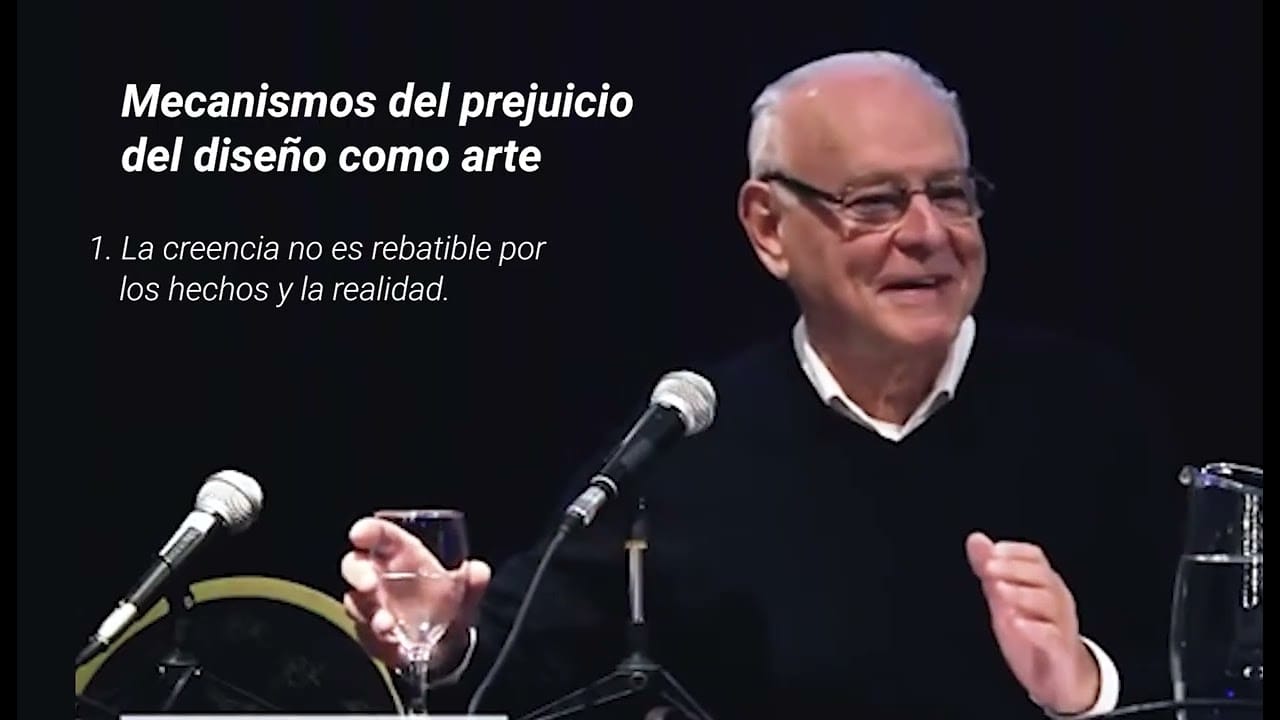
- This behavior as typical of prejudice, where facts fail to... (1:58)
- From design's beginnings, figures like Adolf Loos established... (4:42)
- The persistence of design/art confusion is considered suspicious (7:54)
- Fourth prejudice mechanism: opportunistic selection of examples (16:49)
- How to overcome the prejudice that design is art (19:09)
- Reflection on art: everything that manifests itself... (31:05)
- Migration of design objects into the art field (45:00)
- The tendency to equate design with art stems from a bias (55:01)
Summarised from Antonio Páez · 56:32. All credit belongs to the original creators. Streamed.News summarises publicly available video content.