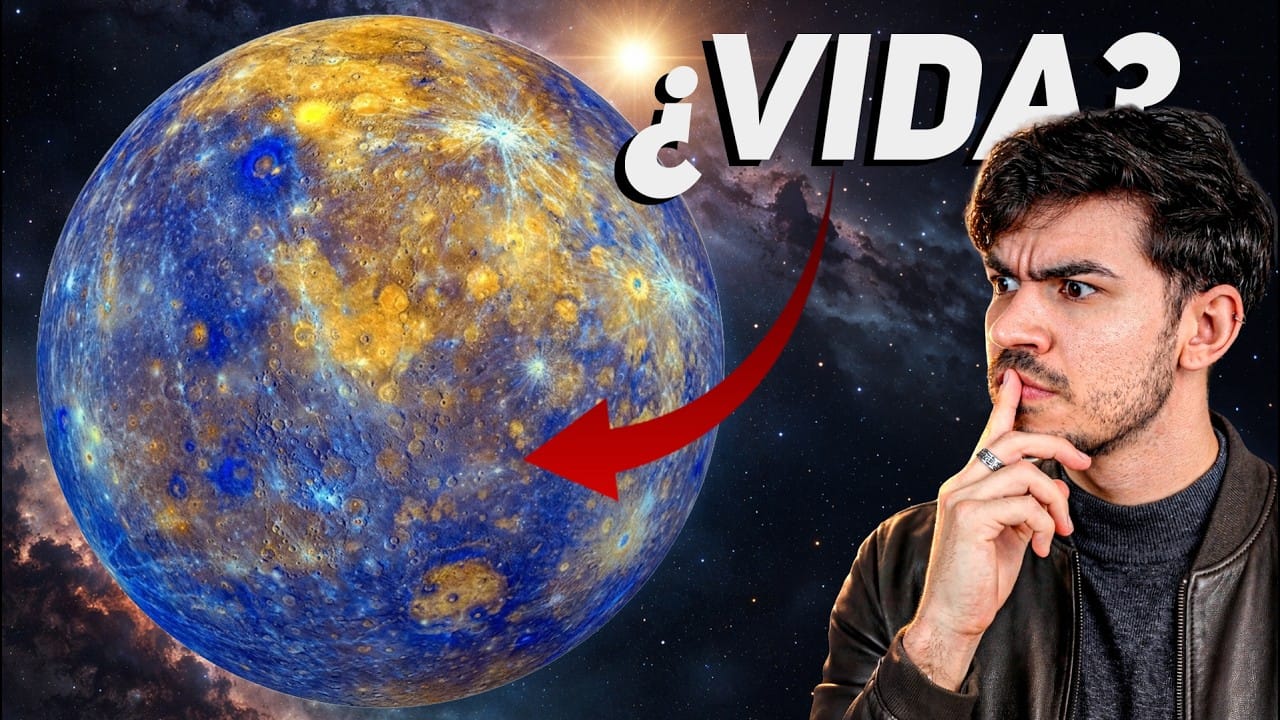
Original source: Eze Martínez
This video from Eze Martínez covered a lot of ground. Streamed.News selected 6 key moments and summarises them here. Everything below links directly to the timestamp in the original video.
Humanity's most powerful telescope now probes distant worlds. Here's how scientists seek life's building blocks light-years away.
James Webb Telescope Detects Water, Carbon in Exoplanet Atmosphere
The James Webb Space Telescope analyzes distant exoplanet atmospheres by measuring infrared light blocked as planets pass their stars. This technique reveals key life compounds like water and carbon dioxide. The observatory confirmed both elements in WASP-96b's atmosphere, proving its ability to find potentially habitable worlds. While a milestone, this finding does not confirm life. Even our solar system's Enceladus (Saturn's moon) and Europa (Jupiter's moon) have water and carbon, but no intelligent life. The discovery highlights the difference between finding life-friendly conditions and finding advanced civilizations.
"If we observe a star, watch a planet pass, and measure how much infrared light it blocks, we can find evidence of that planet's atmospheric composition."
Light Pollution, Atmosphere Force Use of Space Telescopes to Seek Life
Contrary to popular belief, no human structures are visible from space to the naked eye; only city lights betray our presence. But these lights hinder astronomy. Reflected in Earth's dense atmosphere, they create a glow, obscuring distant stars — a phenomenon known as light pollution. Atmospheric gas turbulence also distorts images, making space observatories essential. Telescopes like Hubble, Kepler, and James Webb operate in space's vacuum, overcoming these limits. They are key tools in the search for intelligent life.
"Our own lights harm our ability to see other planets. Earth has a dense atmosphere; when illuminated, this gas traps light, making the sky glow."
Fermi Paradox Questions Absence of Alien Signals in Potentially Populated Galaxy
Probabilistic calculations suggest up to 40 million intelligent civilizations in the Milky Way. Yet, no signs of their presence exist. Even if we drastically cut that to a hundred, the cosmos's absolute silence baffles scientists, who expect evidence. This contradiction — high probability of alien life versus no empirical evidence — is the Fermi Paradox. Its core question, 'where are they?', defines a great modern science enigma, given the observable universe's 100 billion galaxies.
"It is mathematically impossible that extraterrestrial life doesn't exist. So, where is everyone?"
Probabilistic calculation suggests 40 million intelligent civilizations in Milky Way alone
A new calculation, based on the Milky Way's 100 billion stars—each with at least one planet—suggests 40 million planets could host intelligent, communicative civilizations. By applying filters like habitable zones and potential for intelligent life, researchers arrived at this remarkably high figure. This raises a core question for astronomers: if our galaxy is so populated, why haven't we found anyone yet?
"If so many planets host intelligent life, even more advanced than us, why haven't we found them yet?"
Stephen Hawking warned against contacting alien civilizations
Physicist Stephen Hawking warned against contacting alien life, citing historical analogies. He believed a technologically superior civilization might prove hostile, much like Spanish conquistadors subjugating American civilizations. Such an intelligence gap could render humanity insignificant, or worse, a resource to exploit. But these warnings may come too late. In 1974, humanity sent a powerful radio message to the Hercules star cluster, detailing our DNA and solar system. Voyager probes now in interstellar space carry golden records with Earth's images and sounds, silently broadcasting our existence.
"Just as the Spanish conquered America, an extraterrestrial civilization more powerful than us would likely want to conquer us."
Astronomers detail two main methods for detecting invisible exoplanets
Astronomers employ two primary techniques to confirm the existence of planets they cannot directly observe. The first detects a star's subtle "wobble," caused by an orbiting planet's gravitational pull. Both bodies orbit a common barycenter; the visible star's motion reveals its invisible companion. The second method, known as planetary transit, precisely measures a star's brightness over time. If a planet passes before the star from our viewpoint, it blocks a small part of its light, causing a periodic, measurable dimming. Combining both techniques has led to thousands of exoplanet discoveries.
"If we can't see a planet, but we can see its star, we observe its movements. If the star wobbles, it likely means a planet is there."
Also mentioned in this video
- Mapping 4424 exoplanets & 56 solar systems (1:13)
- Hubble, Kepler, JWST Telescope Orbits (3:49)
- Hypothesis for the Fermi Paradox (9:39)
- Humanity's Astounding Technological Level (13:40)
Summarised from Eze Martínez · 15:10. All credit belongs to the original creators. Streamed.News summarises publicly available video content.