Original source: Eze Martínez
This video from Eze Martínez covered a lot of ground. Streamed.News selected 6 key moments and summarises them here. Everything below links directly to the timestamp in the original video.
How did engineers build bridges, ships, and rockets before pocket calculators? This ingenious device held the answer, turning multiplication into a simple gesture.
Slide Rule: Mechanical Ingenuity Transformed Multiplication
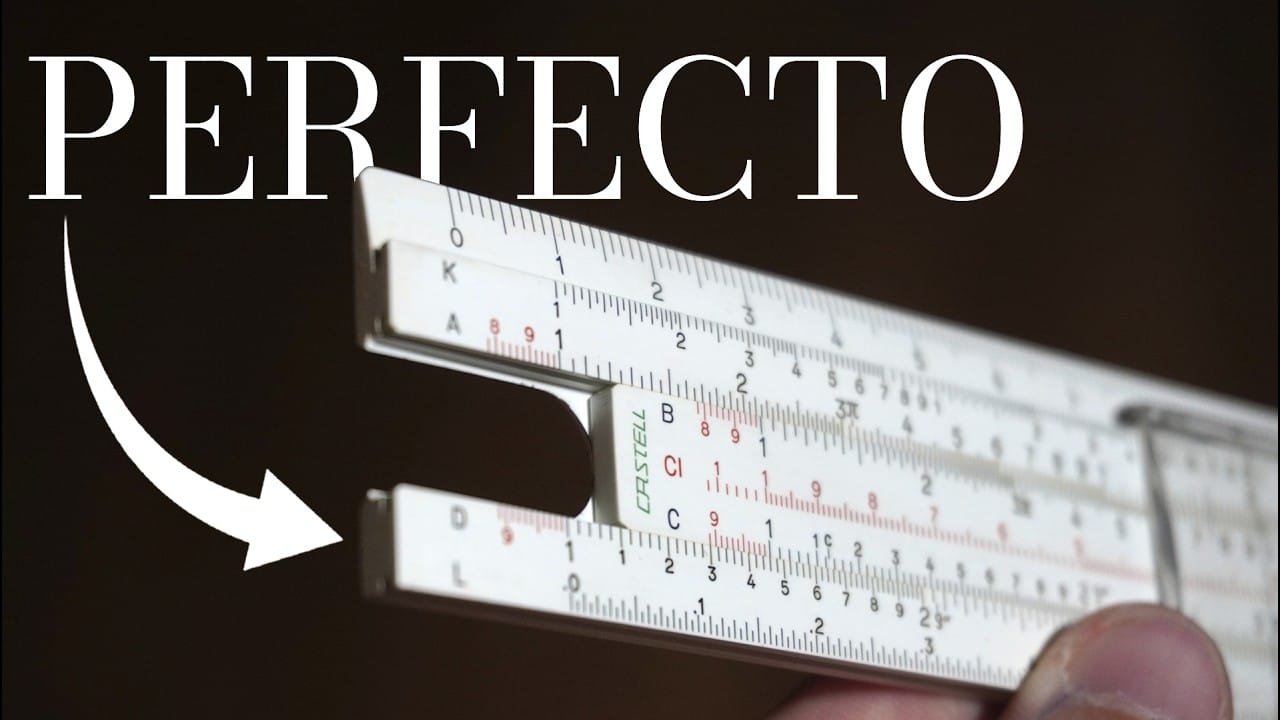
Before digital, engineers and scientists relied on the slide rule. This device used logarithmic scales to turn complex multiplication and division into simple mechanical movements. To multiply, like 2 by 4, align one movable scale over another. This physically adds the logarithmic distances, yielding a fast, reasonably accurate result. Mathematician Pierre-Simon Laplace called it an "admirable artifice" that reduced months of work to days, effectively doubling an astronomer's life. The slide rule demonstrated logarithms' power, simplifying otherwise tedious, error-prone calculations and driving centuries of scientific and technical progress.
"An admirable artifice that, by reducing the work of many months to a few days, doubles the life of the astronomer and spares him the errors and fatigue inseparable from prolonged calculations."
Logarithmic Scale: How a Line Turns Multiplication into Distance Addition
Logarithms' essence appears on a straight line: the logarithmic scale. Here, distance from the origin represents a number's logarithm, not its value. This clever design transforms multiplying two numbers, like 2 by 3, into simply adding their corresponding distances on the line to find the result, 6. This physical representation proves a fundamental mathematical identity: the logarithm of a product equals the sum of its factors' logarithms. This principle allows tools like the slide rule to function, showing how an abstract concept can have direct mechanical application for complex problems.
"We discover the identity that the logarithm of products equals the sum of the logarithm of factors."
Table Method Simplifies Division, Square Roots to Addition, Subtraction
The two-column method—one arithmetic, one geometric—simplifies more than multiplication. Division, as the inverse operation, uses subtraction of arithmetic column values. For example, 256 divided by 32 becomes a simple 8 minus 5. To calculate a square root, like 256, take its arithmetic value, 8, and divide it by two. This technique shows how a precalculated system transforms three distinct operations—multiplication, division, and roots—into basic addition and subtraction. The system converts higher-level calculus problems into mechanical look-up and simple arithmetic, a conceptual precursor to modern computing.
"Three operations: multiplication, division, and roots, just by looking at a table."
Two-column method turns multiplication into addition
A two-column system converts multiplication into simple addition. One column lists an arithmetic progression (0, 1, 2, 3...), adding one at each step. The other creates a geometric progression (1, 2, 4, 8...), multiplying by two. To multiply 8 by 64, locate their arithmetic column equivalents: 3 and 6. Sum them (3+6=9). The result, 512, sits next to 9 in the geometric column.
This method demonstrates logarithms' fundamental principle. It reveals a direct link between multiplication in one system and addition in another, simplifying complex, error-prone calculations. This laid the foundation for one of history's most powerful mathematical tools.
"We just transformed multiplication into addition."
John Napier's 20-Year Quest to Perfect Logarithm Tables
Simple logarithm tables, which multiply by two, leave large gaps, preventing calculations for intermediate numbers. To make the tool universally useful, construct the geometric progression with a number much closer to one, like 1.001. This adjustment creates a far denser table, covering nearly all numbers needed for practical calculations.
This refinement proved no trivial task. Scottish mathematician John Napier dedicated 20 years to meticulously calculating these high-precision tables. His monumental effort provided astronomers, navigators, and scientists a tool that drastically accelerated knowledge.
"Yes, John Napier took 20 years to complete this table."
From Natural to Base-10 Logarithms: The Key Adjustment that Standardized Calculation
Refining the two-column method with infinitesimal steps naturally leads to the natural logarithm system, based on 'e'. In this system, 10 corresponds to a counterintuitive value of roughly 2.302. While mathematically pure, this result proves impractical for everyday decimal calculations.
A final adjustment solves this: divide all logarithm column values by the natural logarithm of 10. This simple normalization transforms the system into base-10 logarithms, where 10 precisely equals 1. This created the standardized, user-friendly tool that dominated calculation for centuries.
"What we just discovered is now called the natural logarithm."
Also mentioned in this video
- Eze Martínez recounts childhood anecdote (0:00)
- Method for summing number sequences (1:26)
- Difficulty of complex multiplications and divisions (2:55)
- Presenter highlights importance of logarithms (13:20)
Summarised from Eze Martínez · 14:08. All credit belongs to the original creators. Streamed.News summarises publicly available video content.