🌐 Also available in: 🇪🇸 Español
Original source: DECODE con DaniNovarama
This video from DECODE con DaniNovarama covered a lot of ground. Streamed.News selected 8 key moments and summarises them here. Everything below links directly to the timestamp in the original video.
Have you visited a destination and barely recognized it? This analysis exposes how tourism pressure is gutting the cultural identity of the world's most treasured places.
Mass tourism is killing the cultural soul of destinations
A flood of tourists gradually reshapes destinations, bending local industries to meet visitor expectations. The result: generic souvenir shops, fast-food chains, and a cultural identity hollowed out. Barcelona's Sagrada Família is a clear example — coach infrastructure and commercial sprawl have stripped away its original character.
This process turns destinations into tourist traps, where culture gets reduced to whatever is pretty, easy, and convenient for rapid consumption. Authenticity gives way to replicability, and the complexity of a place is flattened into a homogenized, surface-level experience.
"The industry around a place reshapes itself to serve those who visit. The place adapts to survive — not by choice, but because the sheer weight of tourist numbers simply crushes these spaces."
Mass tourism is making every destination feel the same
Mass tourism shows no sign of slowing. A steady stream of new traveler-sending countries fuels a perpetual "call effect," and destinations like Venice keep absorbing ever-larger crowds despite efforts to curb them.
The knock-on effect: everything surrounding a tourist landmark becomes identical, erasing the uniqueness that drew visitors in the first place. Globalization turns places into replicable products. Beauty and distinctiveness don't scale — and travelers increasingly arrive somewhere new only to feel they've seen it all before.
"The world keeps getting more uniform. Every landmark is unique — but everything around it is identical to the thousand other landmarks of that kind scattered across the globe."
Put down your phone and seek the unexpected — the keys to an authentic travel experience
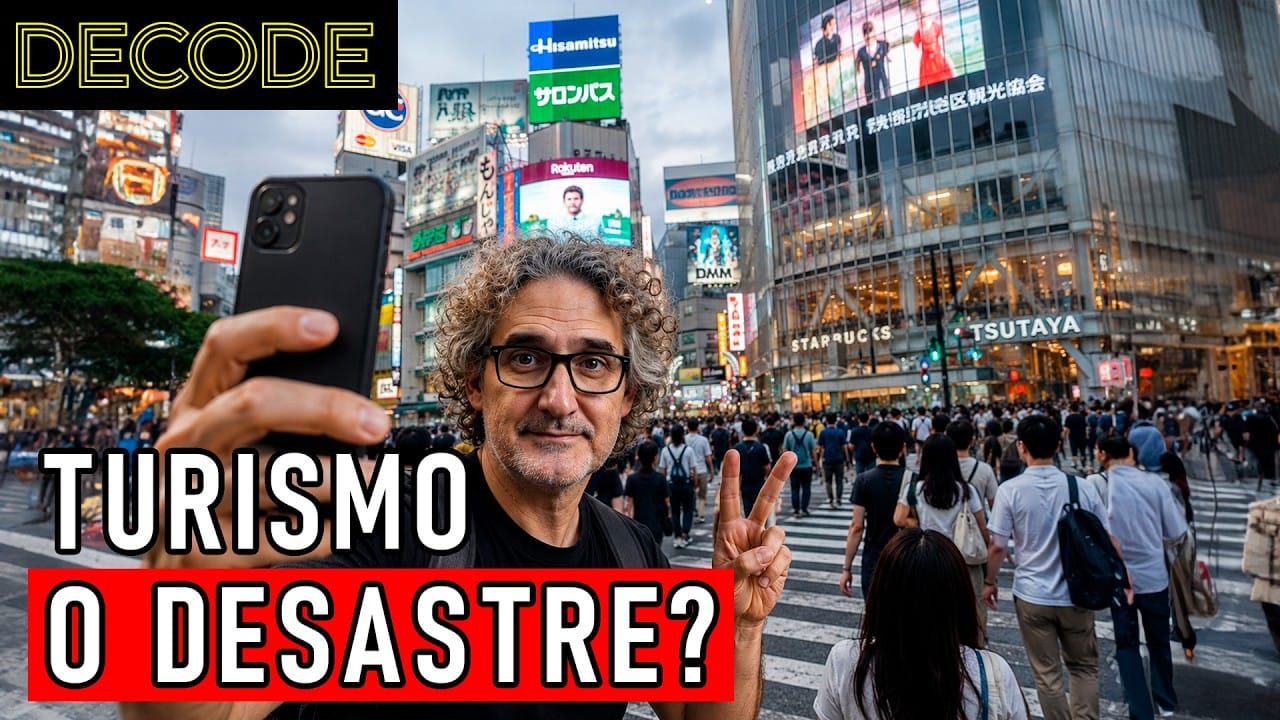
Reclaiming authenticity in crowded destinations comes down to two practical shifts. First, build a personal bubble — learn to tune out the crowds, even at the Sagrada Família or Shibuya. Second, hunt for hidden corners and off-script paths within those same sites, stepping away from the prescribed route to find quieter moments.
The most powerful advice: ignore your phone. Stop being a photographer and become a visitor again. Hold off on photos until the end, let the place actually land on you, and recover the sense of wonder that turns a visual checklist into a genuine experience.
"Ignore your phone. The moment you do, you stop being a photographer or an Instagrammer and go back to being a visitor — the way we all used to travel."
Algorithms and social media turn travel into a FOMO-driven obligation
Digital platform algorithms shape tourist destinations by prioritizing viral, popular content — reinforcing "social proof" and FOMO (fear of missing out). This pushes travelers onto preset routes and sends them chasing the identical shot at places like the Eiffel Tower, turning travel from genuine experience into a social obligation to fit in.
The result: tourists follow the crowd like rats after the Pied Piper — visiting overcrowded, joyless places not for pleasure but to prove they were there. Destinations become mere photo backdrops, stripped of their essence, and travelers become consumers of a prefabricated experience rather than real explorers.
"Algorithms don't show us the best — they show us what's already working, because algorithms run on engagement, on grabbing your attention. And the best way to grab your attention? Show you what's already viral, what's already a hit."
The obsession with appearances is stripping iconic destinations of their soul
Today's obsession with appearances and "designed-to-share" experiences is degrading tourist destinations, reducing them to sets built for quick consumption. Iconic spots like Barcelona's Las Ramblas and the Eiffel Tower are losing their vitality and authenticity as visitors chase the perfect shot — think the plastic-champagne toast beneath the tower.
This mass behavior reshapes the place itself, scraping away genuine culture. Las Ramblas went from a vibrant local market to a tourist container lined with generic souvenir shops. The very qualities that made these places special are being destroyed, leaving behind a shallow existence built for social media snapshots.
"In this appearance-obsessed world, we've stopped living and started producing an experience designed to share with friends and look good. What happens is that these places lose their life, their complexity, their authenticity."
Shared photos and viral trends homogenize travel — and speed up its decay
Modern tourism inflicts three damaging effects that accelerate a destination's decline. First, every photo shared on social media becomes a reinforcement signal, pulling more people toward that spot and amplifying the tourist herd effect. Second, repeated poses and framing — the iconic Eiffel Tower shot, the view of Mount Fuji from Chureito Pagoda — create imitation trends that produce queues of hundreds chasing the same image.
This dynamic not only homogenizes the visual experience of travel but causes overcrowding and powerful "call effects" that attract even more visitors. Japan's response says it all: a supermarket modified its premises to block tourists from crowding in for the same Mount Fuji shot — proof of how individual behavior compounds into a collective problem.
"Our visits accelerate three harmful effects on these places. First, we speed up the flow of people — every photo you take and share on social media becomes a reinforcement signal. Second, we are creating trends."
Mass tourism is turning unique destinations into copy-paste products
Global tourism is converting destinations into replicable products, erasing the difference and unpredictability that made them special. Authentic local shops vanish, replaced by global franchises like Starbucks that can outbid them on rent. The result: "the moment everything is accessible, nothing stays special."
The core problem is that beauty and uniqueness don't scale. A place built for a handful of people loses its magic when overrun by thousands. Only what is "easy, repeatable, and safe" survives mass appeal — stripping destinations of the quirks and rough edges, however strange or uncomfortable, that gave them their original pull.
"The moment everything is accessible, nothing stays special. Beauty — and above all uniqueness — doesn't scale. The moment you take a place built for 50 or 100 people and turn it into a place for 100,000, it's over. We've blown it."
"Confirmation tourism" turns historic sites into photo backdrops
Algorithmic pressure and social proof are reducing tourist destinations to mere backdrops — photocall sets that confirm you were there, with the image trumping any genuine experience. The Mona Lisa at the Louvre is a prime example: the painting is barely visible behind a wall of raised phones, exposing the real purpose of the visit.
One proposed fix — duplicating monuments to increase "photographic bandwidth," building replica rooms where tourists snap their shot and leave — only deepens the problem. It turns cultural heritage into a Disneyland assembly line where possession of an image is the only goal, with no real presence or connection to place.
"We are turning places into stage sets. One expert said that in the future we will have to duplicate monuments to provide more bandwidth — so that, as if in some kind of mass Disneyland, tourists go to their assigned room, take the photo, and leave. Because at the end of the day, the photo is all we want."
Also mentioned in this video
- Host starts the video in Shibuya, Tokyo, describing how... (0:00)
- The video's main theme (1:29)
- Tourists travel to a pre-experienced version of places,... (2:01)
- Host compares mass tourism to a replicable system like... (4:33)
- How tourist behavior, focused on taking photos and... (10:02)
- Host concludes that authenticity is lost through mass consumption and... (16:19)
- Tourists themselves are acknowledged as part of the problem, as the act... (16:57)
- Host proposes two ways to regain a sense of wonder (24:51)
- Host concludes we can't change the world, but we can change how we see it,... (30:07)
Summarised from DECODE con DaniNovarama · 32:43. All credit belongs to the original creators. Streamed.News summarises publicly available video content.