🌐 Also available in: 🇪🇸 Español
Original source: Nate Hagens
This video from Nate Hagens covered a lot of ground. Streamed.News selected 8 key moments and summarises them here. Everything below links directly to the timestamp in the original video.
Understanding these immense material flows is crucial because disruptions in water, food, or building materials don't just affect distant economies—they can directly impact the cost of your groceries, the stability of your home, and the reliability of essential services, revealing the hidden dependencies of modern life.
Water, Food, and Construction Materials Form Civilization's Core Material Fluxes
Tad Patzek identifies water, food biomass, and construction materials as the three most critical material fluxes sustaining human civilization. Annually, 4,000 cubic kilometers of fresh water are withdrawn, with agriculture accounting for 70% of this volume. Concurrently, global agriculture yields 10 to 12 billion tons of food biomass, while 50 billion tons of aggregates like sand, gravel, cement, and steel are consumed for infrastructure.
The massive scale of these material flows underscores the biophysical foundation of the human superorganism. The reliance on such vast quantities of natural resources reveals the profound entanglement of economic activity with planetary carrying capacity. Disruptions in any of these core fluxes — whether due to geopolitical instability affecting desalinated water supplies or climate-induced agricultural failures — pose an existential threat to societal stability and complexity.
"The number one material flux in human economy is water. And water withdrawals are used mostly for agriculture but also for industry and for domestic use."
Power, Not Just Energy, Dictates Human Fate, Says Biophysical Economist
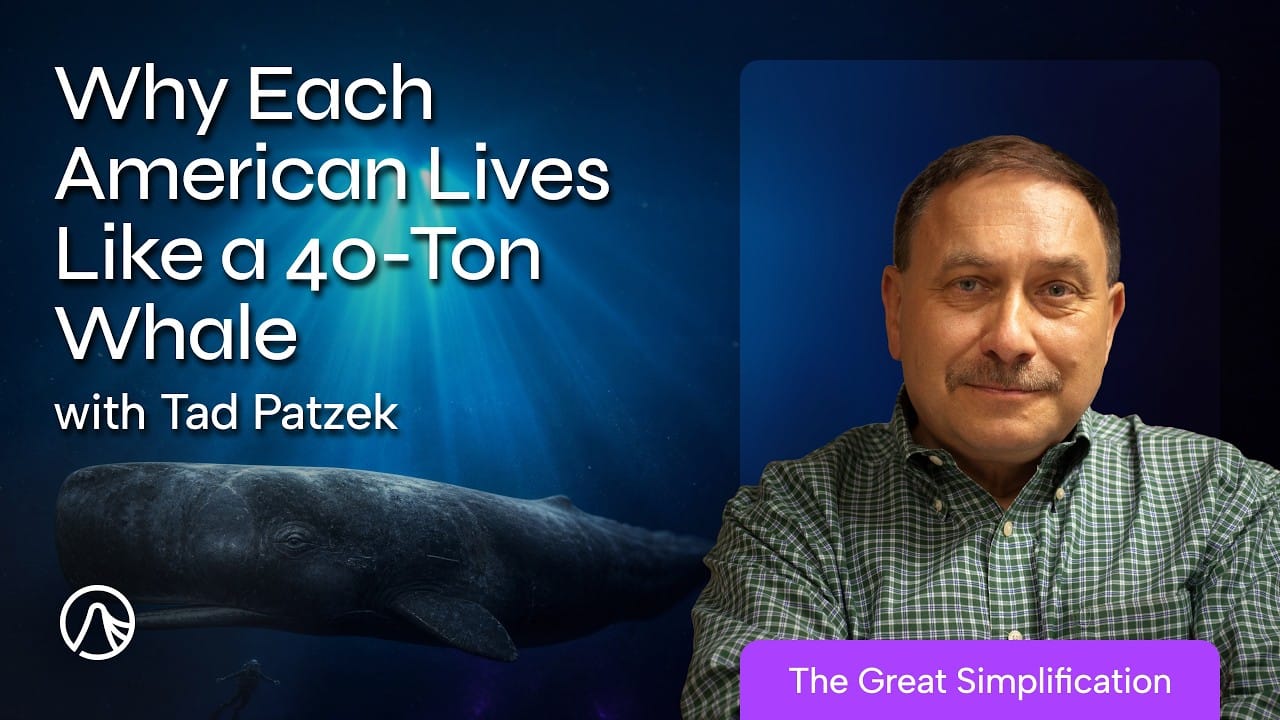
Tad Patzek argues that power—energy per unit time—is the fundamental physical variable governing human destiny, rather than mere energy. He states that the average American commands approximately 10,000 watts of continuous power, 100 times the metabolic power needed for basic survival. This level of consumption is metabolically equivalent to a 40-ton sperm whale.
This extraordinary power throughput, vastly exceeding basic needs, imbues modern societies with inherent brittleness and susceptibility to systemic failure. The continuous demand for such high power levels drives resource extraction and waste generation, leading to an increasing fragility within the complex human superorganism, making it vulnerable to disruptions in energy supply and biophysical limits.
"Power is the single physical quantity that ultimately determines human fate. An average American consumes approximately 10,000 watts of continuous power… that's about a 100 times more than we need to stay alive."
Subtle Energy Imbalance Drives Climate Crisis, Dwarfing Human Economy
Tad Patzek highlights a profound, counterintuitive truth about climate change: the anthropogenic perturbation of Earth's energy balance is remarkably small—between 0.7 and 1 watt per square meter. This imbalance represents less than half a percent of the average incoming solar power (240 watts per square meter).
Despite its small instantaneous magnitude, this persistent disequilibrium accumulates an enormous amount of heat on the planet over decades. Integrated globally, this translates to 300 to 500 terawatts of primary power, a quantity 20 times larger than the entire human economy. This illustrates that global heating is driven not by the immediate scale of human power use, but by the long-lasting, cumulative disruption to Earth's fundamental energy balance.
"The anthropogenic perturbation of this balance… is very small compared to the total energy of the system. It's between 0.7 and 1 watt per square meter… that one watt on average per square meter of planet surface translates into 300 to 500 terawatts of primary power. And so that's 20 times the human economy."
Humanity Overshoots Earth's Carrying Capacity by Factor of 5 to 8, Says Patzek
Tad Patzek concludes that humanity has overshot Earth's carrying capacity by a factor of 5 to 8, based on a thought experiment on sustainable population. Starting with 2.5 billion people living under 1900s conditions, he adjusts for modern life expectancies and GDP, which reduces the sustainable population to 1 billion. Further considerations for modern organic agriculture suggest an optimal range of 0.5 to 1.5 billion people who could live comfortably and for an extended period.
This analysis underscores the immense biophysical strain imposed by current consumption patterns and population levels. The implication is that present societal complexity and material throughput are fundamentally unsustainable, requiring a drastic realignment of human activity with ecological limits to avoid further systemic breakdown and secure long-term well-being.
"With this optimistic assumption, 1 to 1.5 billion people, we have overshot by a factor of 5 to 8, which we mentioned earlier in our conversation. So humanity... could be only weakly unsustainable if we kept our numbers at or below 1.5 billion people."
▶ Watch this segment — 1:05:05
AI Requires Massive Fossil Fuel Infrastructure, Risks Systemic Fragility, Warns Expert
Tad Patzek debunks the popular notion of AI as a cost-free, ethereal intelligence, revealing its deep reliance on a massive fossil fuel-based infrastructure. AI data centers consume 100 to 300 megawatts of electricity, demanding extensive mining, manufacturing, and power grid stability. This immense power draw interferes with grid availability for citizens and exacerbates resource throughput.
Patzek warns that AI's optimization-driven nature centralizes decision-making, reduces systemic redundancy, and accelerates resource extraction. By making supply chains more efficient but less resilient, AI increases societal fragility, diminishing human control over critical systems and potentially leading to more profound negative impacts on the biosphere.
"The popular perception is that AI is this nebulous, godlike intellect floating above humanity with no cost. What we forget is that behind that floating version is a giant infrastructure... one data center for AI will consume between 100 to 300 megawatts of electricity."
▶ Watch this segment — 1:15:02
Power, Not Just Energy, Defines Advanced Societies and Civilization's Endurance
Tad Patzek emphasizes that power, defined as energy per unit time, is the single most critical physical quantity driving civilization. Advanced societies are characterized by their vast surplus power, which extends far beyond the minimum requirements for survival, enabling a multitude of non-essential societal functions. In Patzek's framework, agriculture and defense are identified as the only two organized systems fundamentally necessary for the long-term persistence of any civilization.
This perspective reframes societal complexity as a direct consequence of available power, highlighting the biophysical underpinnings of human organization. The focus on power underscores that a lasting civilization must prioritize the continuous and reliable throughput of energy to sustain its core functions, rather than merely possessing a large energy reserve, which contributes to the inherent fragility of the human superorganism.
"Power is the single most important physical quantity that drives our civilization. And in fact the complexity behind most social questions can ultimately be reduced to that one variable: the power flowing through a society."
Cumulative CO2 Emissions Project 2-3 Degrees Global Heating by 2100, Six Degrees on Land
Tad Patzek asserts that cumulative CO2 emissions are the primary driver of climate breakdown. Current atmospheric CO2 levels stand at approximately 430 ppm, with the potential to reach 700 ppm. Under a "lowish scenario," this trajectory projects an average planetary heating of 2 degrees Celsius by 2050 and 3 degrees by 2100. Critically, these global averages translate to roughly 6 degrees of heating on land, where most human populations reside, leading to intensified heat waves.
This substantial land-based heating will create profound and pervasive impacts, transforming human habitats and severely stressing essential infrastructure, agriculture, and public health systems. The long-lasting disequilibrium in Earth's energy balance, driven by accumulating CO2, signals a future marked by escalating environmental trauma, moving far beyond mere inconvenience to fundamentally reshape the human experience.
"The mostly sole reason of the global climate breakdown and all its derivative manifestations is the cumulative emissions of CO2 into the atmosphere... we will expect to have 2 degrees on average of planetary heating by 2050 and 3 degrees of planetary heating by 2100. But 3 degrees on average... is 6 degrees for land."
Climate Change Impacts Shift from Inconvenience to Traumatizing Events, Warns Patzek
Tad Patzek stresses the urgency of collective attention to climate change, noting that its accumulating and increasingly frequent effects are moving beyond mere inconvenience towards traumatizing events. These impacts include unaffordable home insurance in many regions, escalating food prices due to widespread agricultural disruption, and widespread grid failures caused by heat overload. Furthermore, infrastructure such as buildings, roads, and dams are silently degrading due to shifts in soil moisture dynamics.
These interconnected stressors reveal the systemic fragility of modern society when confronted with a changing climate. The long-term, quiet damage to foundational systems, combined with more visible extreme events, signals an accelerating decline in the human condition, making present and future resource competition and instability unavoidable.
"These effects are accumulating and will be more frequent and it will actually go beyond causing inconvenience to most people. If you are a homeowner in many places... you may not be able to get home insurance."
Also mentioned in this video
- The issue of modern society's focus on policy and politics while neglecting the… (0:00)
- Tad Patzek provides historical examples of societies' access to power, noting… (9:01)
- Tad Patzek contrasts the nature of renewable energy sources, which are… (11:46)
- The global industrial civilization as a "fossil amoeba" that continuously… (13:13)
- Tad Patzek clarifies that the discussion is about power fluxes, not merely… (18:11)
- Public discussion about energy and materials is detached from physical reality… (25:49)
- The public's detachment from energy realities, treating energy systems as… (27:16)
- Tad Patzek details several major disconnects between public perception and… (29:12)
- Ecological overshoot and its relationship to the carrying capacity of Earth,… (33:31)
- Tad Patzek defines free energy as the part of energy directly convertible into… (37:20)
- Global heating intensifies extremes by reshaping the frequency, intensity, and… (39:31)
- Applying a thermodynamic energy imbalance approach to planetary boundaries… (47:41)
- The challenge of reducing per capita power consumption from 10,000 watts,… (1:02:52)
- Tad Patzek cautions against relying on technology as a savior, explaining that… (1:11:00)
- Possible human and planetary futures, starting with an optimistic scenario… (1:17:46)
- Individuals must modify their personal, family, and social behavior to limit… (1:21:50)
- Difference by paying attention to their impact on the planet, imagining… (1:23:28)
- Addressing global challenges is not solely up to politicians, but rather… (1:26:08)
- Building a better society. (1:29:29)
- If he could wave a magic wand, he would make humans less myopic and more caring… (1:31:34)
Summarised from Nate Hagens · 1:35:16. All credit belongs to the original creators. Streamed.News summarises publicly available video content.