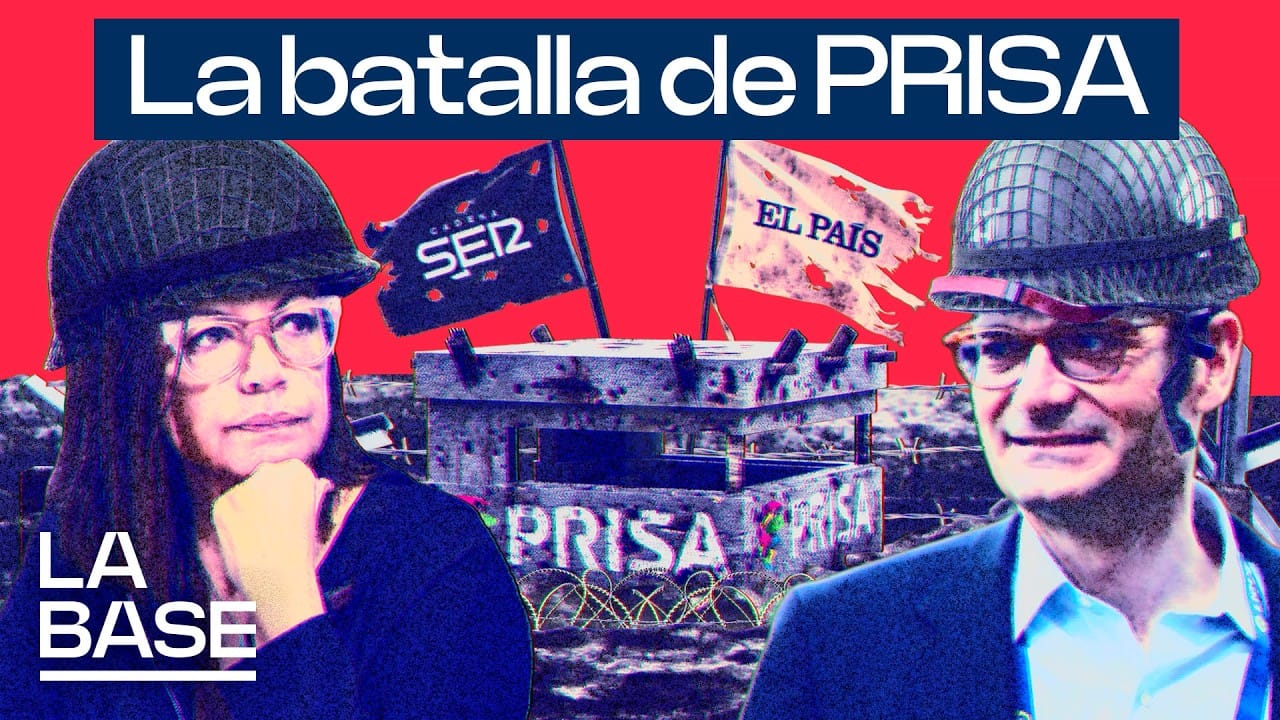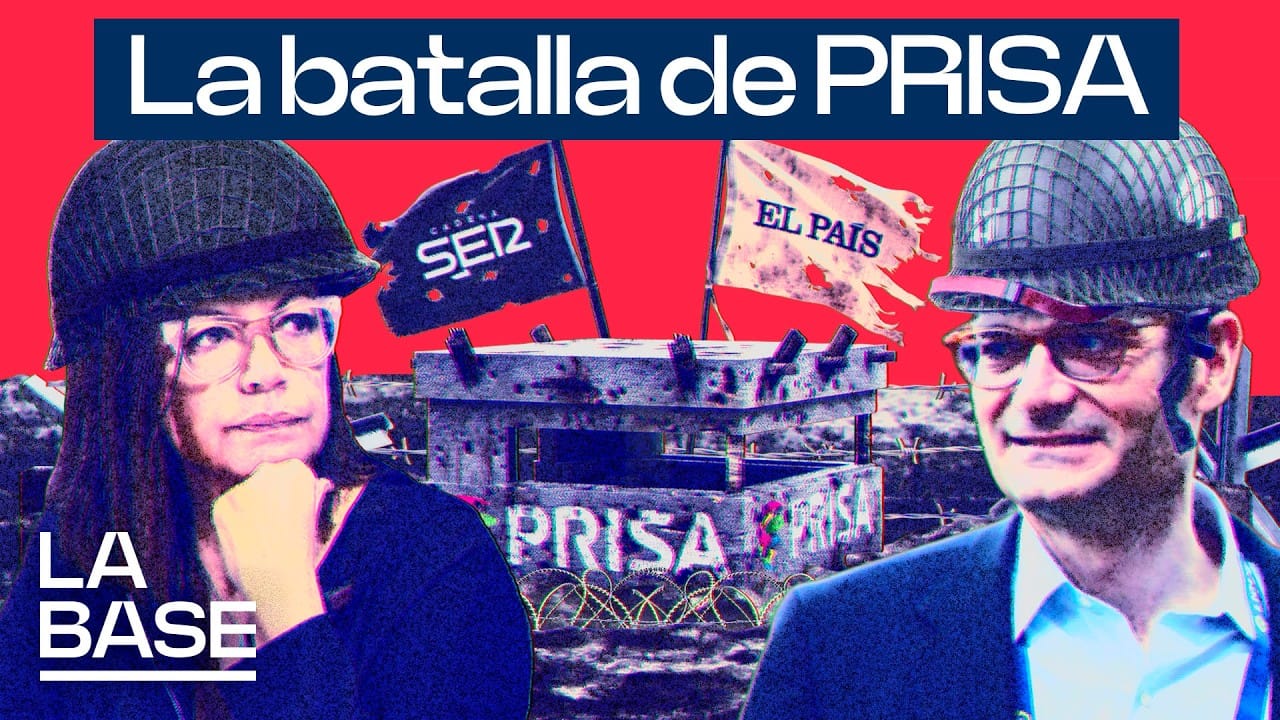
Original source: La Base
This video from La Base covered a lot of ground. Streamed.News selected 8 key moments and summarises them here. Everything below links directly to the timestamp in the original video.
Spain's leading media group is restructuring, but this is more than just business. It shapes the information ecosystem where the country's political and ideological battles unfold.
Oughourlian's Prisa plan: boost profits by €520 million, cut debt
Joseph Oughourlian unveiled Prisa Media's new strategy. It aims for a €520 million profit boost, 800,000 El País subscribers, and reduced group debt. The plan includes Latin American expansion, cementing Oughourlian's control and neutralizing internal shareholder dissent. This consolidation and Prisa's growing distance from the PSOE prompted a government reaction. Madrid granted a DTT license to a new channel led by former Prisa executive Miguel Contreras, seen as a key link to Moncloa. Prisa's power reshuffle now sparks a strategic realignment in Spain's media landscape.
"Prisa Media aims to monetize and diversify revenue, targeting a €520 million profit increase and €25 million in cash flow."
'The Objective' article foreshadowed Oughourlian, Àngels Barceló clash at SER
Hours before Àngels Barceló announced her departure from Cadena SER, 'The Objective' digital outlet revealed a direct confrontation between the host and Prisa's main shareholder, Joseph Oughourlian. According to the report, Oughourlian told Barceló that "ownership sets the editorial line," making her contract renewal conditional on accepting a subordinate role. The publication, which also speculated Barceló's possible move to RTVE and replacement by Carlos Alsina, highlights that the conflict extended beyond professional disagreement, becoming a battle for editorial control of Prisa's flagship. It underscores the maxim that press freedom ultimately belongs to the owner.
"Ownership sets the editorial line. [...] If she doesn't comply, her contract won't renew. Oughourlian made that clear."
El País portrays Cuba as collapsing, downplays US blockade
An analysis of El País headlines on Cuba reveals a narrative portraying the island as collapsing, depicting President Miguel Díaz-Canel as "the face of dictatorial power." The coverage relegates U.S. intervention to a secondary "shadow," rather than the crisis's central element. Prisa's media strategy reduces the economic blockade to a mere "excuse," aligning de facto with Washington's foreign policy interests. The aim is not to inform about Cuba's complex reality but to validate an external agenda that presents Cuba as a failed state requiring intervention.
"The shadow of a possible U.S. intervention appears as a secondary, lateral fact, not as the central element of Cuba's crisis."
El País's Editorial Line in Latin America: Against the Left, for Corporate Interests
El País's reporting on Latin America follows a clear editorial line: it systematically opposes left-wing governments. It champions the interests of major Spanish corporations, the monarchy, and external interventions. Specific examples, like coverage of Nicolás Maduro's alleged kidnapping or Cristina Kirchner's conviction in Argentina, highlight this stance. The newspaper draws parallels with Lula da Silva's case, but avoids the term 'lawfare,' showing selective political prosecution. Prisa's coverage is more than news; it's a tool for geopolitical influence, defending a neocolonial agenda.
"Prisa, through El País and other outlets, has a very clear editorial line in Latin America: when in doubt, always against the left, always with the interests of large Spanish corporations, always with the King of Spain, always with imperialist aggressions."
'La Siete' Launches: New DTT Channel Aims for PSOE-Aligned Progressive Audience
A new DTT channel, 'La Siete,' has received a license. This political and business venture, backed by former Prisa executive Miguel Contreras, aims to capture the progressive, PSOE-aligned media space. With €25 million, 'La Siete' seeks to fill a void left by La Sexta, which has shifted focus from political analysis and debate. Described as a 'Canal Red with more money,' the new channel will engage directly in the 'cultural battle,' targeting a specific audience and advertising share. Its launch reflects the realignment of Prisa and Atresmedia, highlighting the struggle for narrative control within Spain's media landscape.
"They'll be like a 'Canal Red' but with more money, and obviously without Canal Red's editorial line, which is clearly left-wing. But they will basically focus on the cultural battle."
Prisa Rests on Two Pillars: Spanish Media and Latin American Education
Grupo Prisa operates with two strategic divisions: Prisa Media, handling its news and entertainment outlets, and Santillana, its educational arm. Prisa Media generates 81.5% of its revenue in Spain, aiming for digital expansion. Santillana, however, drives the group's profitability, especially in Latin America. This dual structure lets Prisa exert influence through distinct yet complementary channels. It shapes news in the Spanish market and educational content in key Latin American markets like Brazil, Mexico, and Colombia. The business is thus not just media-driven, but also cultural and ideological on a transnational scale.
"Santillana is the group's educational engine and is booming in Latin America. Prisa Media is the news and entertainment benchmark here in the Spanish media market."
Pepa Bueno case, TDT channel grant reveal power play after Barceló exit
Àngels Barceló's situation mirrors Pepa Bueno's: after her 2025 removal from El País leadership, Bueno moved to anchor RTVE news. This pattern exposes a "revolving door" between media and political power, stripping away claims of journalistic independence. The government further revealed this dynamic by granting a DTT channel to shareholders opposing Joseph Oughourlian at Prisa. These moves are not isolated; they represent a reconfigured alliance where media outlets act as political players, vying for control of the public agenda.
"It's very instructive when everyone's masks fall, and all the nonsense about journalistic independence. Cards face up, for everyone to see."
El País frames Cuba narrative from Washington, excludes island voices
El País's Cuba coverage isn't isolated reporting; it builds a narrative supporting US strategy. The newspaper portrays Cuba as a nation on the brink of collapse, translating White House decisions into journalistic interpretation. It grants almost exclusive focus to US sources and Miami exile figures. Consequently, Cuban voices—academic, institutional, or popular—are systematically weakened, excluded, or ridiculed. This frames Cuba as an object of external evaluation, not a society with its own actors and dynamics, showing clear editorial subordination to a foreign geopolitical agenda.
"Cuban voices [...] appear either weakened, directly excluded, or ridiculed as legitimate sources to interpret Cuba's national reality."
Summarised from La Base · 52:37. All credit belongs to the original creators. Streamed.News summarises publicly available video content.