🌐 This article is also available in Spanish.
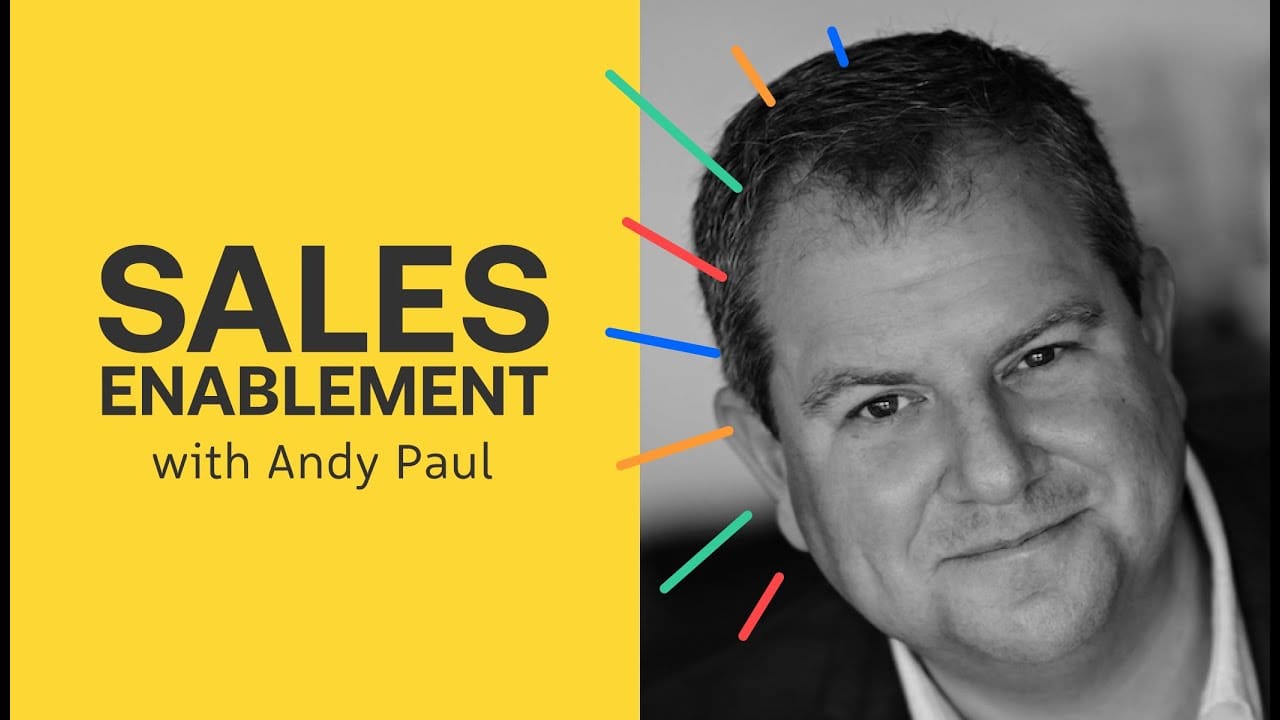
Original source: Sales Enablement Podcast with Andy Paul
This article is an editorial summary and interpretation of that content. The ideas belong to the original authors; the selection and writing are by Streamed.News.
This video from Sales Enablement Podcast with Andy Paul covered a lot of ground. 5 segments stood out as worth your time. Everything below links directly to the timestamp in the original video.
If you've ever rolled your eyes at another 'revolutionary' sales framework, Weinberg's back-to-basics argument — built from watching real deals get done at Walmart — might be worth your time.
Sales Consultant Mike Weinberg on Why He Almost Never Entered the Profession
Mike Weinberg stumbled into sales reluctantly, convinced by his father's career at Revlon that the job meant driving economy cars and hawking nail polish. What changed his mind was accompanying the founder and CEO of SlimFast on visits to Walmart in Arkansas and Target in Minneapolis, where he watched sales unfold as a form of consultancy — understanding a customer's business well enough to help them win — rather than pressure or manipulation. That reframing launched a career that eventually produced a bestselling book he himself worried was too basic to earn respect from sales veterans. Instead, it took off, because readers were exhausted by a market flooded with weekly proclamations that everything had changed and traditional prospecting was dead.
"The world is just craving blunt truth today — because there's so many new sales processes of the week and new toys or tools of the day and everyone telling us that everything has changed and nothing is the same."
Rushing to the Demo Is Slowing Down Your Sales Cycle, Weinberg Argues
Premature product demonstrations rank among the most common self-inflicted wounds in technology sales, according to Mike Weinberg. When prospects raise their hands through inbound marketing and ask to see the product immediately, many sales teams comply — skipping discovery entirely and presenting features to someone whose real priorities, buying criteria, and decision-makers they don't yet understand. The result is what Weinberg calls 'spray-and-pray' selling: blasting out everything and hoping something sticks. Rather than accelerating a deal, this approach stalls it, often forcing a second, more tailored demo and adding weeks to the cycle. The structural incentive in many tech firms — using the demo as the handoff moment between an SDR and an account executive — bakes this mistake directly into the sales process.
"You spray it all out on everybody and you pray that you hit on something relevant. That's not selling, that's pitching."
Weinberg Warns That Challenger Sale Hype Is Making Salespeople Worse at Listening
Mike Weinberg offers a pointed critique of the Challenger Sale methodology and the broader 'insight selling' movement: the ideas are valid, but the prescription to teach and challenge customers is being handed to the wrong people at scale. Weinberg's concern is that salespeople already skew toward talking too much and jumping into presentation mode. Coaching them to lead with provocative insights and 'professorial' teaching risks accelerating that tendency and further crowding out the discovery conversations that actually reveal what a customer needs. Both Weinberg and podcast host Andy Paul agree the approach works — but only for a thin stratum of experienced salespeople with the expertise and intellect to genuinely reshape a buyer's thinking. When applied broadly, the insights become scripted talking points rather than real challenges, stripping the method of its value.
"If we start feeding them the line that they need to come off as professorial and teach and share insights, that's gonna destroy their ability to do good discovery work."
The Real Reason Sales Teams Miss Targets Has Nothing to Do With Talent or Process
Weinberg calls it his 'dirty little secret' as a consultant: the dominant reason companies fail to win new business is not their pitch, their sales process, or the quality of their people. It is simply that the people assigned to sell spend very little time actually doing it. They manage customer service fires, join safety committees, deliver doughnuts to existing clients, and react to whatever lands in their inbox — anything but the disciplined work of hunting for new accounts. Weinberg says the first corrective move when taking over a sales team is to give every rep a written business plan with specific goals and a finite, strategic list of target accounts. The second is to audit what percentage of their working hours genuinely goes toward proactive selling. He argues that companies see measurable revenue lifts simply from those two interventions, before any changes to technique or process.
"The number one cause I find in almost every company of why they don't pick up more new business is really simple — it's not the story, it's not the sales process, it's not the wrong talent. The people that are supposed to be selling spend very little time actually trying to sell new business."
Revenue Per Hour of Selling Time Is the Metric Most Sales Teams Ignore
Andy Paul and Mike Weinberg converge on a framework borrowed from manufacturing economics: true sales productivity should be measured as revenue generated per hour of actual selling time, not by pipeline volume or quota attainment alone. Paul points out that most organisations focus almost entirely on freeing up sales reps' calendars so they can sell more hours — a valid step, but one with a hard ceiling. At some point the clock runs out. The complementary priority, which he argues is often neglected, is improving what a rep produces within each selling hour through better training, deeper product knowledge, and sharper skills. Weinberg connects this back to calendar discipline: when he asks salespeople to review 30 days of calendar entries and count actual selling meetings, they are routinely shocked by how little time appears.
"How much revenue are you producing per hour that you're actually selling? That is the ultimate measure of sales productivity."
Also mentioned in this video
- Mike Weinberg y Andy Paul discuten cómo las tendencias de venta "novedosas" a… (3:37)
- Mike Weinberg elogia la creciente especialización de los roles de ventas en las… (5:23)
- Mike Weinberg identifica su contenido escrito como la herramienta de ventas más… (23:43)
- Mike Weinberg revela que su asistente virtual, Mary de EA Help, es la… (24:56)
Summarised from Sales Enablement Podcast with Andy Paul · 28:22. All credit belongs to the original creators. Streamed.News summarises publicly available video content.
Streamed.News
This publication is generated automatically from YouTube.
Convert your full video library into a digital newspaper.
Get this for your newsroom →