🌐 Lee esto en Spanish →
Original source: MUNDO CERO
This article is an editorial summary and interpretation of that content. The ideas belong to the original authors; the selection and writing are by Streamed.News.
This video from MUNDO CERO covered a lot of ground. 6 segments stood out as worth your time. Everything below links directly to the timestamp in the original video.
Did you know the era of abundant oil passed almost two decades ago? Discover how the gradual decline of vital energy resources is redefining our future, not with an abrupt end, but with a slow yet inevitable transformation of our economy and society.
The World Confronts the Decline of its Primary Energy Sources: Conventional Oil Peaked in 2005
The depletion of energy raw materials is not a sudden event but a process of gradual decline after reaching an extraction peak. Conventional crude oil peaked in 2005 at 70 million barrels per day, a figure that has since fallen to approximately 60 million. Including all liquid fuels, the extraction peak was recorded in November 2018 at 84.6 million barrels per day and has since decreased by 3-4%, with projections of a faster decline as fracking matures.
This decline pattern also affects other critical resources: uranium extraction, vital for nuclear energy, reached its geological peak in 2016 and had decreased by 23% by 2022, with an additional 50% drop projected by 2040. Meanwhile, natural gas is projected to reach its extraction peak around 2025, while coal, the most polluting, could see its peak between 2030 and 2035. This continued decline in the availability of major fossil and nuclear fuels anticipates a landscape of growing scarcity and global energy complexities.
"Things never end abruptly. What happens is that you reach maximum extraction, and from there, it starts to decline; less and less is extracted."
Resource Depletion Leads to Price Volatility and Global Recession
The depletion of energy resources is more akin to an annual salary reduction than an abrupt halt in availability, explains the expert. This gradual decrease in the extraction capacity of raw materials with inelastic demand, such as fossil fuels and uranium, generates increasing price volatility. People are forced to consume these essential resources to a breaking point, leading to a cycle of rising costs, demand destruction—factory closures and job losses—and an eventual fall in prices.
This volatility dynamic, where supply cannot meet demand at stable prices, has kept the global economy trapped in cycles of slowdown and recession since 2008. Countries like Germany have experienced recession in 2023 and 2024, and the European industrial sector generally suffers from rising costs and raw material scarcity. This scenario highlights how the decrease in our 'energy salary' directly affects the capacity to maintain the pace of economic activity and social well-being.
"The depletion process is more like someone whose salary is being cut, right? Imagine your salary being cut by 2 or 3% every year."
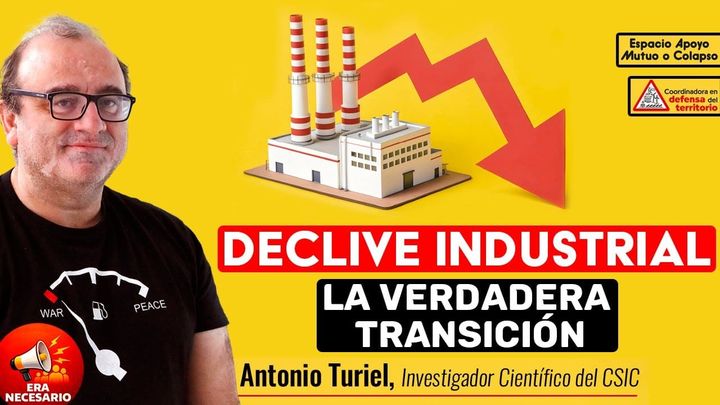
Spain Deindustrialized: Renewable Energy Surplus and Falling Electricity Consumption Since 2008
There is widespread confusion that mistakenly identifies 'energy' with 'electricity,' when the latter represents only between 20% and 23% of final energy consumption globally and in Spain. Most energy consumed comes from petroleum-derived fuels, and a significant portion is difficult or impossible to electrify. Surprisingly, electricity consumption in Spain and other European Union countries has been steadily falling since 2008, primarily due to deindustrialization and economic crisis, not solely efficiency or self-consumption.
This trend is exacerbated by the paradox of renewable generation overcapacity: Spain has 128 GW of installed electrical power for an average demand of 26.5 GW and peaks of 41 GW, with plans to reach 150 GW by 2030. This extreme redundancy leads to 'curtailments,' where energy is not produced due to lack of demand, and to quality issues due to the intermittent and asynchronous nature of electricity generated by wind and photovoltaic sources. Solar panel inverters, for example, must mimic the grid waveform, which can amplify disturbances and generate system instability.
"People tend to imagine electricity as a kind of liquid flowing through a pipe, but that's not what it is. Electricity is a wave."
Degrowth as an Alternative to Impoverishment and Ecofascism
The concept of degrowth proposes a planned, democratic reduction in energy and material consumption to reach a sustainable level, decoupling well-being from economic growth. This perspective arises from the inevitable decline in resource access and environmental problems. The goal is not indefinite decline but a "landing" into ecological and social balance. It is recognized that while countries like Spain will need to reduce consumption, other regions or sectors might require targeted growth to achieve equity.
Far from implying poverty, degrowth is presented as the way to avoid impoverishment and ecofascism in a world of limited resources. Constant growth in the current context generates economic and social destruction. Therefore, democratic planning is advocated, involving citizens and businesses to manage adaptation to this new reality, ensuring a dignified standard of living for all. Failing to do so, the current path leads to social unrest and the rise of authoritarian solutions that benefit a few at the expense of the majority.
"The degrowth proposal is: we are going to make a controlled descent to a sustainable level."
▶ Watch this segment — 1:03:09
Energy-Intensive Industries Most Affected by Fossil Fuel Decline
The decline in fossil fuel availability severely impacts industrial sectors with high energy consumption. Among the most affected are heavy industries, such as steel production—exemplified by ArcelorMittal closing factories in Europe—aluminum, cement, and fertilizers, all dependent on large quantities of energy, particularly natural gas. The chemical sector also suffers due to its requirement for large inputs of fossil fuels.
In addition to these directly energy-intensive industries, a second category of sectors is hit by the need for cheap processed raw materials. The automotive sector is one of the main affected, exposed to multiple risks associated with the general increase in raw material and energy costs. Others, such as home appliances and electronics, also experience varying degrees of impact, demonstrating the cascading economic effects of energy scarcity.
"All sectors that consume large quantities of energy are severely affected. For example, steel, aluminum production, cement, fertilizers, the chemical sector."
Critique of Spain's Data Center Bubble Without Clear Business Model
In Spain, the proliferation of data centers is occurring without a clear business model, driven by the mistaken belief that 'infrastructure creates industry.' This strategy, reminiscent of the dot-com bubble that burst in the early 2000s, assumes that investment in infrastructure will automatically generate demand, without planning that defines how data processing will be monetized. Experts question the real purpose of these centers beyond vague promises about artificial intelligence, pointing to the lack of tangible economic objectives to justify their massive construction.
It is suggested that the emphasis on data centers could be linked to keeping the 'renewable bubble' afloat and allowing large investors to exit their positions before an inevitable collapse. This speculative activity has a clear expiration date: June 2026, when the execution of Next Generation EU funds concludes. The expert predicts that data center development will halt abruptly by that date, or even earlier, due to possible changes in European Commission regulations.
"It's this very Spanish vision of believing that infrastructure creates industry."
Also mentioned in this video
- Se presenta la idea de que el decrecimiento es lo opuesto al empobrecimiento y… (0:00)
- El anfitrión da la bienvenida a Antonio y le pregunta sobre el estado actual de… (0:46)
- Se discute el alto consumo de electricidad de la inteligencia artificial y se… (19:54)
- Antonio argumenta que el modelo de transición energética ha fracasado y que la… (29:02)
- Antonio advierte sobre una segunda burbuja renovable, la de la biomasa y el… (36:26)
- Antonio explica que la sostenibilidad en un pueblo no es posible con el estilo… (40:43)
- Antonio argumenta que, aunque se pueden mantener niveles de vida similares con… (46:58)
- Antonio enfatiza la necesidad de ser ciudadano activo y organizado, y que es la… (52:28)
- Antonio destaca la importancia de formarse y comprender el mundo para tomar… (59:01)
- Antonio recomienda a varios autores y pensadores expertos en decrecimiento y… (1:08:26)
Summarised from MUNDO CERO · 1:11:26. All credit belongs to the original creators. Streamed.News summarises publicly available video content.
Streamed.News
This publication is generated automatically from YouTube.
Convert your full video library into a digital newspaper.
Get this for your newsroom →