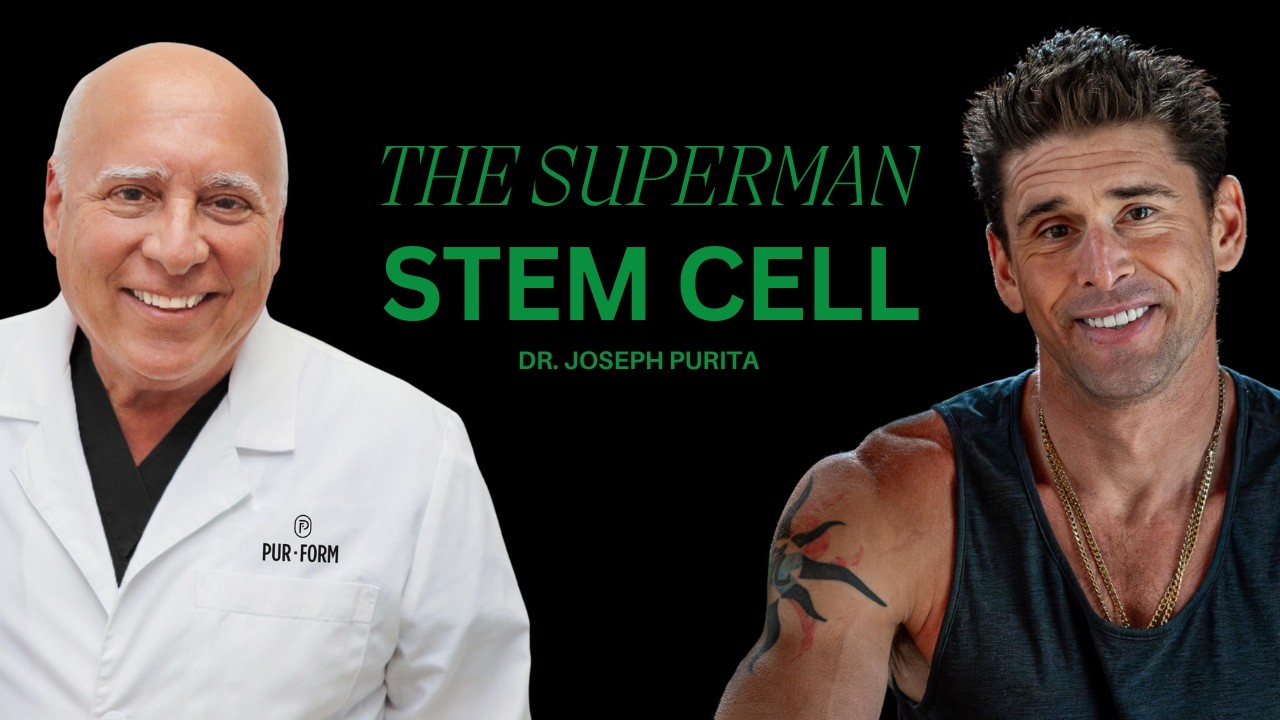
Original source: Ben Greenfield Life
This video from Ben Greenfield Life covered a lot of ground. Streamed.News selected 8 key moments and summarises them here. Everything below links directly to the timestamp in the original video.
The difference between patching a problem and building a new solution exists even at the cellular level. What does it mean for a stem cell to not just signal for repairs, but to become the replacement part itself?
MUSE Cells Regenerate Tissue Through Phagocytosis, Outpacing MSCs' Repair Function
A critical distinction exists between tissue repair and true regeneration. While mesenchymal stem cells (MSCs) primarily enact repairs through paracrine effects—releasing growth factors and exosomes—MUSE cells possess a more advanced capability. It's important to understand their mechanism: they perform phagocytosis, engulfing damaged or diseased cells to analyze their unique transcription factors.
This analysis provides the instructions for the MUSE cell to then differentiate and become that specific cell type. The idea here is to move beyond simple signaling and achieve genuine tissue replacement, a function that traditional MSCs cannot perform on their own.
"They're basically with this phagocytosis going after the bad dead tissue, taking it in, analyzing it, looking at its transcription factors, and they can become that cell. MSCs cannot become the cell that you put it in."
MUSE Cells Exhibit Superior Homing Ability, Bypassing Lung Entrapment Common with MSCs
When administered intravenously, a significant challenge for mesenchymal stem cells (MSCs) is their tendency to become trapped in the lungs due to their size and the capillaries' adhesive nature. Here, they undergo apoptosis to release beneficial growth factors, but few actually incorporate into target tissue. It's interesting because MUSE cells, despite being a similar size, largely avoid this fate.
The key difference lies in their powerful homing ability, driven by receptors on the cell membrane, which acts like a magnet to pull them from the lungs toward sites of injury. This results in a dramatically higher tissue incorporation rate—at least 15% for MUSE cells versus less than 1% for MSCs.
"They don't really get trapped in the lungs because they have such a strong homing ability that they just get pulled out of the lungs, whereas MSCs will stay there."
MUSE Cells Present Low Tumor Risk Due to Lack of Telomerase and Teratoma Formation
A primary concern with pluripotent cells—cells that can differentiate into any tissue type—is the potential for tumor formation, or tumorogenicity. It’s important to understand that MUSE cells are considered a safer alternative to other advanced cell types like induced pluripotent stem cells (IPS cells). The key distinction is that MUSE cells do not have high amounts of telomerase, an enzyme associated with cellular immortality and cancer.
Furthermore, MUSE cells do not form teratomas, a type of tumor. This inherent safety profile suggests they could eventually replace IPS cells for many clinical applications, offering pluripotency without the associated cancer risk.
"The Muse cell does not have high amounts of what we call telomerase... and they don't have the ability to really form tumors. They don't form teratomas or anything like that."
MUSE Cells Poised to Revolutionize Regenerative Medicine, Anecdotal Evidence Shows
After two decades of working with mesenchymal stem cells (MSCs), Dr. Joseph Purita predicts that MUSE cells are positioned to revolutionize the field of regenerative medicine. He equates his current perspective on MUSE cells to his initial excitement about MSCs 20 years ago, suggesting a paradigm shift is underway. The unique regenerative capabilities of these cells are expected to become a central focus of advanced therapies.
An illustrative case involved one of his partners with a persistent hip problem that did not respond to intravenous infusions of her own culture-expanded MSCs. However, after a single intravenous treatment with MUSE cells, her condition significantly improved within two weeks.
"I've been doing this field a long time and with MUSE cells I'm at the point where I was maybe 20 years ago with MSCs. It's going to revolutionize things."
Photoactivation of Stem Cells and Novel NAD+ Protocols Used to Prime Body for Regenerative Therapy
To optimize the biological terrain for stem cell therapy, a protocol involving pre-treatment of the cells and the patient can be employed. The idea here is to photoactivate the therapeutic cells using a device that exposes them to specific light frequencies; for example, blue light can increase exosome production, while red light enhances mitochondrial health and ATP output. This process occurs in the syringe just minutes before injection.
For the patient, NAD+ IVs are used, with tolerability enhanced by administering trimethylglycine (TMG) and having the patient sip coffee. This multi-faceted preparation aims to optimize both the therapeutic cells and the recipient's systemic environment.
"For stem cells, if we hit them with a blue light, we can actually increase the amount of exosomes they're producing."
Hydrogen Therapy Valued for Antioxidant Properties and Ability to Penetrate Mitochondria
Hydrogen is considered a cornerstone therapy due to its potent antioxidant and anti-inflammatory properties. It's interesting because, unlike many other antioxidants such as vitamin C, hydrogen can readily cross the blood-brain barrier and, critically, penetrate the mitochondrial membrane. This allows it to exert its protective effects directly at the primary site of cellular energy production and oxidative stress.
The idea here is to ensure maximum potency and bioavailability. To achieve this, a clinical practice involves bubbling hydrogen gas directly into water for the patient to consume immediately, as pre-packaged hydrogen water often loses its hydrogen content by the time it is purchased.
"When you look at a lot of the antioxidants like vitamin C and things like that, they have trouble getting into the mitochondria. Hydrogen gas has no trouble getting into that."
MUSE Cells Identified as 'Superman of Stem Cells' for True Tissue Regeneration
A unique subpopulation of stem cells known as MUSE cells—Multi-lineage Stress-Enduring cells—are gaining attention for their superior capabilities. It's important to understand the distinction set forth by Dr. Arnie Caplan, who defined traditional mesenchymal stem cells (MSCs) not as true stem cells but as 'medicinal signaling cells.' These MSCs primarily work through a paracrine effect, sending signals to help repair tissue.
MUSE cells, however, go a step further. Discovered by accident when they survived a lab experiment that killed other cells, they not only repair but can also truly regenerate tissue. This key functional difference positions them as a more powerful tool in regenerative medicine.
"He was calling them not stem cells. He said, 'No, these are really what we call medicinal signaling cells.' A MUSE cell on the other hand, yes, it can repair tissue, but more importantly, it can regenerate tissue."
MUSE Cells, Harvested from Umbilical Cords, Show Potential for Collagen Regeneration in Joints
For individuals with arthritic joints suffering from collagen breakdown, MUSE cells offer a potential pathway for regeneration. While not a cure, the therapeutic goal is to arrest the degenerative process and stimulate regrowth by calling in other supportive cells to the site of injury. This is accomplished by preparing the local environment to be more receptive to repair and growth signals.
It’s important to understand that MUSE cells are typically sourced from umbilical cord tissue, a rich and vibrant source of young cells. From this tissue, the cells are isolated and then culture-expanded to generate the quantities needed for effective therapeutic doses.
"Look, we're not going to cure you, but we hopefully can arrest the process and maybe regrow something. But again, it's because you're calling in other cells."
Summarised from Ben Greenfield Life · 46:33. All credit belongs to the original creators. Ben Greenfield Press summarises publicly available video content.