Original source: Mentour Pilot
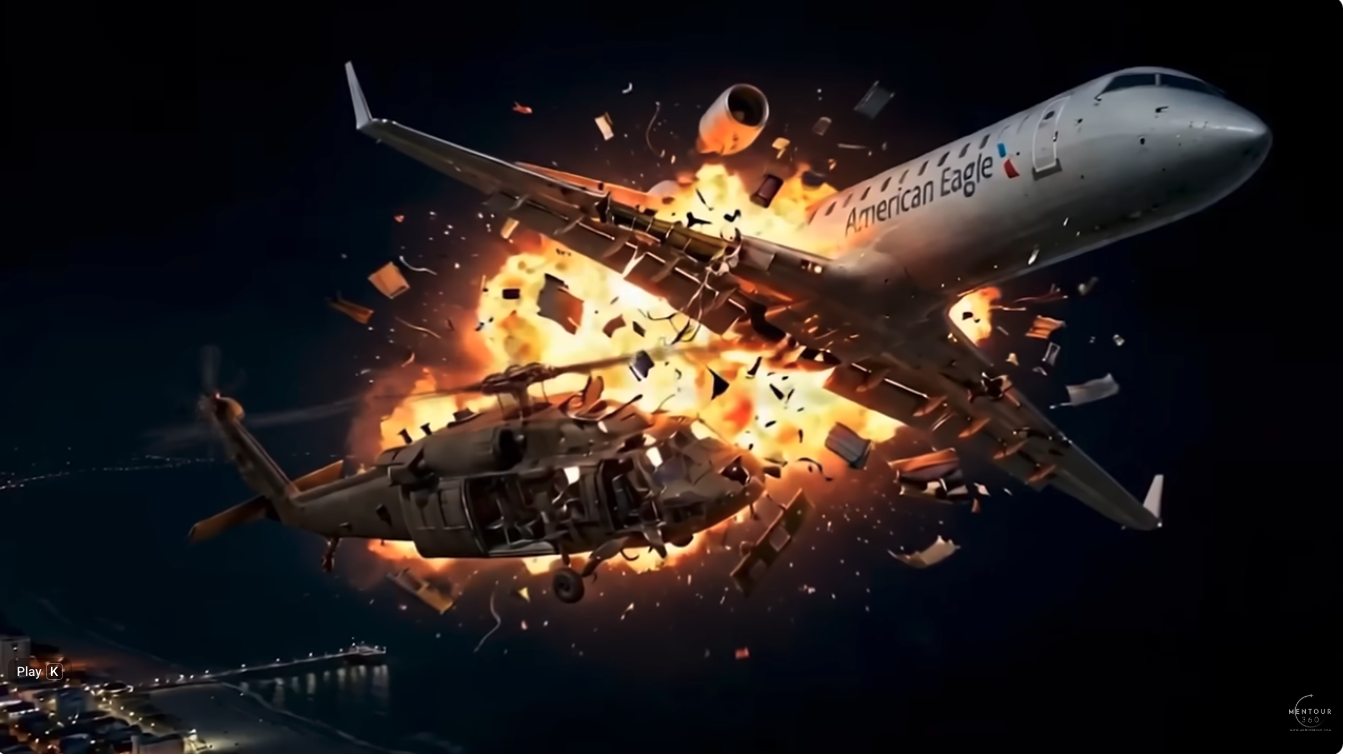
This video from Mentour Pilot covered a lot of ground. Streamed.News selected 8 key moments and summarises them here. Everything below links directly to the timestamp in the original video.
The final analysis of this collision reveals how political decisions made on the ground can directly compromise air safety. It serves as a stark warning against prioritizing convenience over established safety margins.
Visual Separation, Tech Delays, and Political Pressure Cited as Core Failures in Mid-Air Collision
An analysis of the collision concludes that reliance on visual separation in complex, nighttime environments is an inadequate safety measure. The investigation also identified a critical lag in the regulatory implementation of superior collision-avoidance technologies like ACAS-X and ADS-B, which are designed to provide more precise, predictive warnings and could have alerted the crews to the evolving conflict.
More broadly, the findings condemn the practice of allowing political pressure to drive airport growth beyond its safe operational capacity. This points to a fundamental breakdown in safety management systems, where known operational risks were tolerated and formal safety suggestions were denied for political reasons, progressively eroding safety margins over time.
"This would be the last time that I ever hear of a safety suggestion having been denied for political reasons."
▶ Watch this segment — 1:02:00
Years of Near-Misses at DCA Preceded Collision; Safety Requests Denied on National Security Grounds
The airspace around Washington's DCA had a documented history of dangerous proximity events, with over 4,000 instances of aircraft coming within minimum separation between January 2018 and the time of the collision. Of these, 348 were deemed critical—averaging more than five per month—yet the volume of formal reports from pilots and controllers did not trigger a systemic safety review by the FAA or the military.
This inaction pointed to a severe deficiency in safety management. A formal 2013 request from DCA air traffic controllers to move the hazardous Helicopter Route 4 away from the Runway 33 approach path was explicitly denied after security agencies cited "national security" concerns, effectively prioritizing those interests over mitigating a known and repeated collision risk.
"In 348 of those, they had been what's called 'critical'. That's over five times per month."
Garbled Radio Call Led Helicopter to Misidentify Airliner, Accept Flawed Visual Separation
A critical miscommunication occurred when poor radio quality caused the helicopter crew to miss the controller's advisory that the CRJ airliner was "circling" for Runway 33. Believing the airliner was on a standard approach for a different runway, the pilots likely misidentified another aircraft's landing lights and incorrectly reported having the CRJ in sight, leading them to accept visual separation based on a false premise.
This event underscores the inherent unreliability of the 'see and avoid' principle, especially at night in a congested area while using night vision goggles with a limited field of view. The procedure had become a routine shortcut at DCA to manage traffic flow, fostering a complacency that overlooked the high potential for human error in correctly identifying aircraft.
"It is likely that the instructor pilot, upon hearing this message, now looked up, saw the landing lights for the traffic that were lining up to land at DCA, and therefore replied, 'PAT 25 has traffic in sight, requesting visual separation.'"
NTSB Faults FAA for Unsafe Helicopter Route and Failure to Mitigate Known Risks in Final Report
The National Transportation Safety Board's final report identified the probable cause of the mid-air collision as a systemic failure by the Federal Aviation Administration. The NTSB concluded the FAA erred by allowing a helicopter route to be placed in close proximity to an active runway approach path, and subsequently failed to adequately regulate, review, or evaluate these helicopter routes over time.
This systemic oversight, combined with a failure to mitigate the known and documented risks of mid-air collisions in the area, resulted in 57 new safety recommendations. Among the most direct was the call to permanently abolish the problematic Helicopter Route 4, which placed crews on a collision course by design.
"The probable cause for this accident was found to have been the FAA allowing placement of a helicopter route in close proximity of an active approach path to a runway, together with an inability to regulate, review or evaluate helicopter routes."
▶ Watch this segment — 1:00:30
Controller Overload, Altimeter Error, and Warning Fatigue Led to Final, Unseen Collision Course
With the local controller's attention divided among twelve aircraft, he operated on the flawed assumption that the helicopter and airliner were maintaining visual separation. Concurrently, a known but uncorrected altimeter error on the helicopter caused it to fly approximately 100 feet higher than its instruments indicated, placing it directly in the airliner's path unbeknownst to its crew.
This convergence of human and technical failures went undetected by all parties. A conflict alert in the tower was likely dismissed due to its frequency creating 'warning fatigue,' and a TCAS alert in the airliner's cockpit came too late and without vertical guidance, leaving both crews unaware of the imminent collision.
"A warning system that sounds too often eventually stops working since people start taking it less seriously."
DCA Helicopter Corridors Offered Only 75 Feet of Separation from Airliner Paths
The complex helicopter routes around DCA were a significant latent safety threat, created not by the FAA but adopted with unclear risk assessment. The procedures for navigating these visually-defined routes, particularly Route 1 and Route 4, placed helicopters perilously close to fixed-wing approach paths. 1. Route 1: Followed visual landmarks like the Potomac River and Memorial Bridge south toward Hains Point at a maximum altitude of 300 feet. 2. Route 4: Required helicopters continuing south from Hains Point to descend to a maximum of 200 feet to fly under the approach path for Runway 33. The design provided as little as 75 feet of vertical separation from an airliner on a standard three-degree glideslope, a dangerously small margin that created a false sense of security for pilots following the published procedures.
"Even if a helicopter would maintain the maximum altitude as indicated on their chart, that would only give 75 feet of separation from the three-degree approach path into Runway 33 at DCA."
Superior Collision Avoidance Technology Was Stalled for Years by Bureaucracy, Analysis Shows
The standard Traffic Collision Avoidance System (TCAS) has significant limitations, providing non-directional warnings that require pilots to interpret visual displays under pressure. A far superior system, ACAS-X, uses modern ADS-B data to provide specific, directional voice commands and predict aircraft trajectories, which greatly improves situational awareness and reduces false alarms.
Despite its clear safety benefits and having its technical standards completed by 2018, widespread adoption of ACAS-X was stalled for years. Bureaucratic delays in regulatory approval, coupled with the lack of a mandate for airlines to upgrade, meant the life-saving technology was not widely implemented.
"When something is not mandatory, and it costs money, it likely won't happen."
Congress Pressured DCA to Add Flights Despite Physical Limits, Increasing Airport Congestion
A significant contributing factor to the hazardous congestion at Washington's National Airport (DCA) was direct political pressure from the U.S. Congress. For many years, Congress mandated an increase in the number of controlled flight slots, overriding protests from airport officials who warned of the operational strains this would cause on the facility's limited infrastructure.
Because DCA is located on a peninsula, it has no physical room to expand by adding runways or taxiways to accommodate more traffic. The politically-driven increase in flight volume on a space-constrained airport directly led to the routine operational pressures and procedural shortcuts that eroded safety margins.
"Congress had, for many years, been pushing through more and more flight slots in spite of protests from airport management, seemingly in order to win votes."
Also mentioned in this video
- The video opens by describing a fictional mid-air collision on January 29,… (0:01)
- The captain and first officer of PSA Airlines Flight 5342, a CRJ 700, are… (0:26)
- The crew of a Sikorsky UH-60L military helicopter, callsign PAT-25, from the B… (2:55)
- The CRJ700 aircraft's TCAS II version 7.0 system is explained, including its… (6:58)
- The Sikorsky UH-60L military helicopter's features are detailed, including its… (13:45)
- The flights of both PAT-25 and Flight 5342 are traced up to the point where… (17:40)
- Washington National Airport (DCA) is described as a highly central and… (19:03)
- Air traffic control at DCA, specifically Potomac TRACON and the tower,… (23:07)
- The air traffic controllers on duty in the DCA tower are introduced, including… (30:03)
- PAT-25 attempts initial contact with DCA tower, revealing initial communication… (34:12)
- PAT-25 successfully contacts the tower, requesting to proceed via Route 1 to… (36:43)
- PAT-25 deviates from its route, making a critical westward turn before… (39:22)
- Flight 5342's pilots, after initially expressing reluctance, accept a… (41:55)
- Inside PAT-25, pilots discuss turbulence and the visual obscurity caused by… (45:57)
- The CRJ pilots, unable to see the helicopter against city lights, execute a… (59:12)
Summarised from Mentour Pilot · 1:04:32. All credit belongs to the original creators. Streamed.News summarises publicly available video content.