🌐 Also available in: 🇪🇸 Español
Original source: Nate Hagens
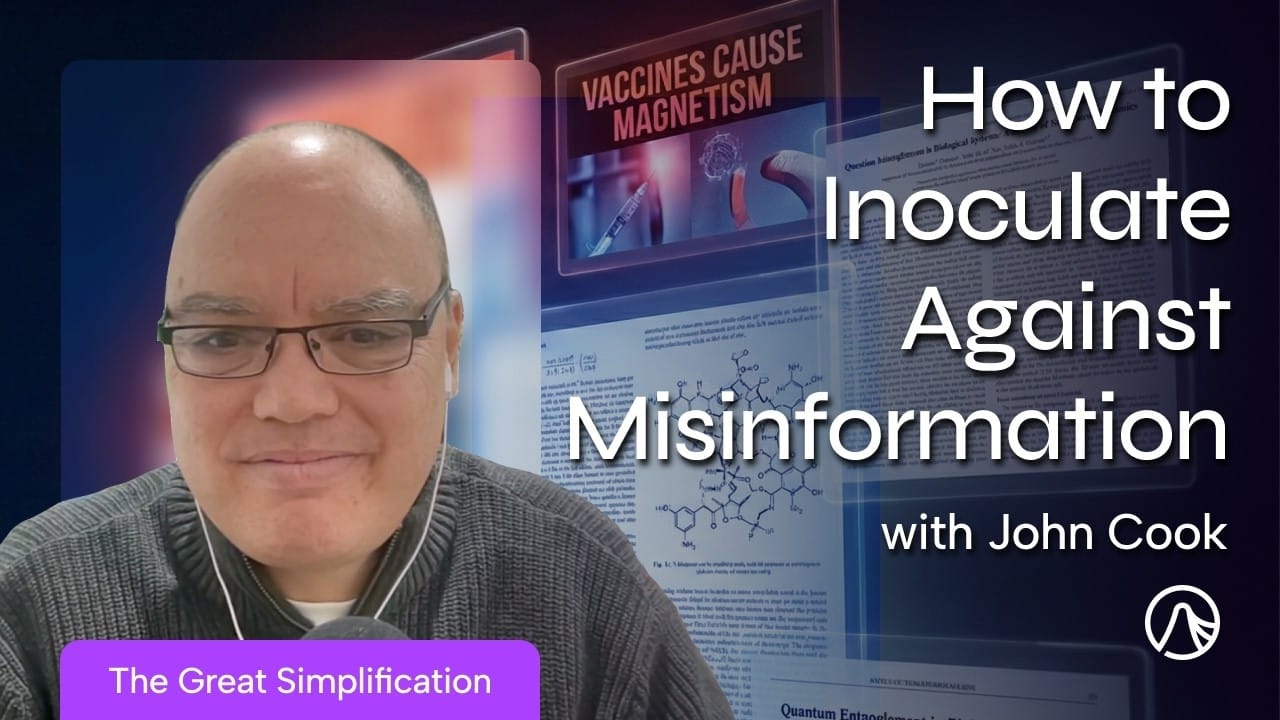
This video from Nate Hagens covered a lot of ground. Streamed.News selected 8 key moments and summarises them here. Everything below links directly to the timestamp in the original video.
Understanding the mechanisms of deception can offer a universal defense against manipulative narratives, fostering a more informed and less polarized public discourse.
Explaining Misinformation Techniques Neutralizes Polarizing Effects, Study Finds
Research demonstrates that explicitly explaining misleading techniques, such as the use of "fake experts," can neutralize the polarizing impact of misinformation across the political spectrum. In an experiment, participants were first educated about the "fake experts" tactic using historical tobacco industry misinformation. When subsequently exposed to climate misinformation that employed the same technique, its persuasive effect was significantly reduced, irrespective of the participants' political leanings.
This finding suggests that a fundamental human aversion to being tricked transcends ideological divides. By focusing on the manipulative tactics themselves, rather than the contentious subjects they are applied to, it is possible to build public resilience against disinformation. Such an approach offers a potential pathway to depolarize complex issues by appealing to a shared value of intellectual honesty.
"The human aversion to being tricked is the same across the political spectrum."
Cranky Uncle Game Successfully Adapts to Global Cultures, Increases Vaccine Acceptance
The 'Cranky Uncle' game, designed to inoculate players against misinformation, has been successfully adapted for diverse cultural contexts, including East Africa, West Africa, and Pakistan. Through co-design workshops, local nuances in character appearance and content resonance were incorporated. The adapted versions demonstrated significant effectiveness, with over half of vaccine-hesitant players shifting to vaccine acceptance after engaging with the game.
This outcome underscores the potential of culturally tailored educational tools in addressing public health challenges exacerbated by misinformation. By combining factual information with an understanding of deceptive logical fallacies, the game effectively builds resilience against anti-vaccine narratives, highlighting the critical role of accessible, interactive learning in fostering informed decision-making within communities.
"More than half of those people switched to vaccine acceptance by the end of playing the game."
▶ Watch this segment — 1:01:01
Information Deficit Model Fails to Address Cultural Biases in Science Communication
The 'information deficit model,' which posits that simply providing more facts will resolve controversies, is fundamentally flawed in science communication. This approach often overlooks how individuals filter and interpret information through their unique cultural lenses and cognitive biases. While factual information remains necessary, it is insufficient on its own to shift entrenched beliefs, especially on topics where motivated reasoning plays a significant role.
This limitation highlights a critical challenge for effective communication on complex issues like climate change. The human superorganism, operating within its cultural matrices, often prioritizes social identity and pre-existing worldviews over objective data. Consequently, a more nuanced understanding of human psychology and social dynamics is required to bridge the gap between scientific consensus and public perception, moving beyond a mere recitation of facts.
"Facts do matter. Education matters. Like, we just have to recognize that they're necessary but not sufficient."
Climate Change Argument of CO2 Lag is a False Dichotomy, Says Expert
The argument that rising temperatures cause rising CO2, rather than the reverse, is a 'false dichotomy' that oversimplifies Earth's climate history. While ice core data show temperature increases often precede CO2 rises in geological records, this relationship is not exclusive. Earth's orbital changes initiate gradual warming, which then triggers the release of CO2 from natural reservoirs, creating a reinforcing feedback loop where both temperature and CO2 drive further warming.
This complex interplay reveals that climate dynamics are rarely attributable to a single cause. Present-day global warming, however, is occurring at a rate significantly faster than these natural, millennia-scale orbital cycles, unfolding over mere decades rather than hundreds of thousands of years. This rapid pace points to an additional, anthropogenic forcing that differentiates current warming from past natural climate shifts, underscoring the urgent biophysical constraints facing the human enterprise.
"It's a false dichotomy... In this case, they're saying either CO2 causes temperature or temperature causes CO2, but it has to be one or the other. When actually it's both."
Cranky Uncle App Adapted for Vaccine Education, Addresses Top Myths
The 'Cranky Uncle' app, originally designed to counter climate misinformation, has been successfully adapted for vaccine education following a partnership with UNICEF. A survey of common vaccine myths revealed that eight of the top ten fallacies were already incorporated into the game's framework. Only two new logical fallacies, 'appeal to nature' and 'false cause,' needed to be added to comprehensively address prevalent vaccine-related misinformation.
This rapid adaptation demonstrates the underlying universality of many deceptive communication techniques across different topics. By focusing on the structural patterns of misinformation, rather than just specific claims, tools like Cranky Uncle can offer a scalable defense mechanism. This approach helps individuals identify flawed reasoning, fostering a more critical engagement with information, which is essential for collective health and societal coherence.
"Eight of the top ten [vaccine] fallacies were already in the game."
Climate Misinformation Shifts from Science Denial to Attacking Solutions and Scientists, AI Study Reveals
Recent research utilizing AI to analyze climate misinformation over a 20-year span reveals a significant strategic shift. Historically, misinformation campaigns focused on denying the science of climate change, such as arguments about CO2 lag in ice cores. However, current trends indicate a pivot towards simpler, more prevalent arguments that primarily attack climate solutions and the scientists themselves. This represents a lower bar for deception, being easier to formulate and disseminate than complex scientific counter-arguments.
This evolution in misinformation tactics reflects an adaptive strategy to maintain doubt and delay action within the human superorganism. As the scientific consensus on climate change becomes increasingly undeniable, the focus shifts to undermining the proposed energy throughput transitions and the integrity of those advocating for them. Understanding these evolving patterns is critical for developing effective inoculation strategies, as the fight against misinformation continues to adapt to new biophysical and social realities.
"Climate misinformation is transitioning to be more and more about attacking climate solutions and less and less about science denial."
▶ Watch this segment — 1:05:52
Cognitive Biases Render Intent Behind Misinformation Irrelevant for Defense
Cognitive biases and motivated reasoning are inherent to human perception, making it challenging to discern whether misinformation stems from genuine error or deliberate disinformation. However, this distinction becomes less critical for defense, as both forms of misleading content typically employ the same set of manipulative 'FLICC' techniques. These techniques, whether used consciously or not, manifest as observable patterns of deception, such as invoking fake experts or cherry-picking data.
This commonality in method provides a practical focal point for building public resilience. Instead of trying to determine the intent of the disseminator, which is often unknowable and resource-intensive, efforts can be concentrated on teaching individuals to recognize and counter these universal misleading tactics. By equipping the human superorganism with the capacity to identify FLICC techniques, it can become more robust against the pervasive flow of misleading information, irrespective of its origin or underlying motivation.
"If you are intentionally deceiving people or if you are self-deceiving, the outcome on the outside is the same. You use the same techniques."
Small Atmospheric CO2 Concentrations Still Drive Significant Climate Impacts, Expert Explains
The argument that carbon dioxide (CO2) cannot significantly affect climate because it constitutes a mere four parts per hundred thousand (0.04%) of the atmosphere is misleading. This line of reasoning ignores that even tiny fractions of certain substances can have profound effects, akin to how minuscule blood alcohol levels or trace amounts of arsenic can be lethal. Scientific measurements confirm that CO2 actively traps heat, directly contributing to warming.
This highlights a common misunderstanding of biophysical systems, where the magnitude of a component does not always correlate with its impact on systemic function. Earth's energy balance is sensitive to changes in atmospheric composition, and even small alterations to potent greenhouse gases can induce significant shifts in global temperature. The human enterprise must grapple with the reality that what appears quantitatively small can have disproportionately large, systemic consequences for planetary habitability.
"We know that tiny fractions can have large effects. And so we know that CO2 causes warming because we measure the heat being trapped by CO2."
Also mentioned in this video
- Misinformation is polarizing, but by discussing specific misleading techniques… (0:00)
- Realizing that his initial approach to science communication on Skeptical… (2:15)
- John Cook clarifies that the backfire effect is distinct from motivated… (3:24)
- Science communication messages must be tailored to different audiences,… (7:59)
- His 'logic-based inoculation' approach from his PhD, which involves explaining… (11:50)
- The FLICC acronym (Fake Experts, Logical fallacies, Impossible Expectations,… (17:24)
- John Cook illustrates several FLICC techniques (18:46)
- Social media, the pursuit of dopamine and attention, and the desire to be… (20:39)
- John Cook reflects on the human brain's struggle to cope with complex,… (28:47)
- John Cook deconstructs the argument that current climate changes are natural… (31:40)
- The 'CO2 is good for plants, so warming is a good thing' argument by stating… (36:34)
- An abnormally cold winter disproves global warming, labeling it an 'anecdote… (37:31)
- The effect of factual communication can fade over time, requiring 'booster… (39:48)
- While there is some exaggeration or oversimplification in climate communication… (43:14)
- His misinformation game, Cranky Uncle, initially preached to the choir but… (45:51)
- The Cranky Uncle game inoculates people against FLICC techniques through a… (47:09)
- John Cook shares his observation that political social identity, rather than… (49:16)
- The difficulty of self-assessing one's own biases and susceptibility to… (54:34)
- John Cook categorizes the public into the convinced, the undecided, and the… (59:04)
- The surprising finding that the Cranky Uncle game was more effective with older… (1:03:21)
- The virulent attacks he faced after publishing research confirming a 97%… (1:08:21)
- John Cook reflects on the personal toll of systematic attacks on his work,… (1:10:19)
- John Cook advises listeners to contribute to addressing climate change by… (1:12:45)
- John Cook expresses concern about the backslide of democracy and attacks on… (1:15:57)
- John Cook expresses his intense interest in the potential of fiction,… (1:18:10)
Summarised from Nate Hagens · 1:22:33. All credit belongs to the original creators. Streamed.News summarises publicly available video content.