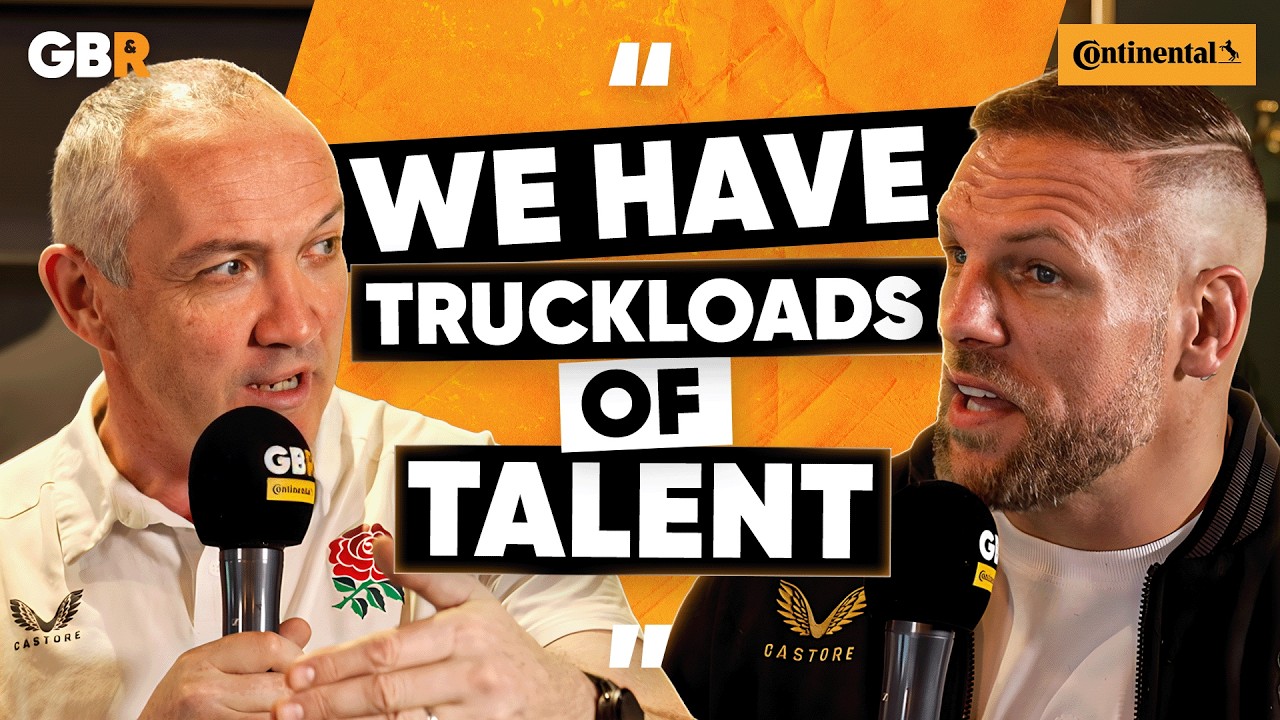
Original source: The Good, The Bad & The Rugby
This video from The Good, The Bad & The Rugby covered a lot of ground. Streamed.News selected 8 key moments and summarises them here. Everything below links directly to the timestamp in the original video.
Recent results may paint a bleak picture, but the view from inside the RFU suggests a golden generation might be just around the corner. Is this the long-term vision that will return England to the pinnacle of world rugby?
RFU Director Conor O'Shea Declares English Rugby in 'Incredibly Strong Place' Despite Recent Setbacks
Conor O'Shea, the RFU’s Director of Performance Rugby, asserts that English rugby is in an "incredibly strong place" despite recent Six Nations defeats. He points to the success of the Red Roses and the men's team reaching the World Cup semi-final as evidence of underlying strength. O'Shea highlights a new generation of "special" young players like Guy Pepper, Henry Pollock, and Chandler Cunningham-South who are developing.
This core group of emerging talent has the potential to form the backbone of the England side for the next decade, through the 2027 and 2031 World Cups, he argues. The current period is about nurturing this potential through the inevitable hard times of international sport, guided by the team's experienced veterans.
"The group of young players that are coming together will grow and can be together for not just 2027 or 2031; we could start naming a 2035 side."
Jamie George Reveals Data Showing Lapses in Effort Fueled 'Tough Conversations' in England Camp
England captain Jamie George acknowledges the deep frustration within the squad following recent poor performances. He reveals that while the team is creating opportunities according to their game plan, a failure to capitalize on them is the central issue. "Tough conversations" are being had, reinforced by GPS data showing specific lapses, such as players running at only 40% of their maximum speed.
This highlights a brutally honest, data-driven culture where underperformance is confronted directly. George explains this negative reinforcement, while "horrible" to experience, is necessary fuel to ensure such mistakes are not repeated in crucial upcoming matches.
"You're running at 40%... and the expectation for us is to be flat out. When you're watching it, you know, it hurts... you're almost embarrassed about putting that out there on the field."
Kevin Sinfield 'Questioned the Spirit of the Group,' Says Jamie George
Jamie George has highlighted the pivotal role of defence coach Kevin Sinfield in resetting the team's mentality after poor performances. Sinfield directly "questioned the spirit of the group," a challenge that George says has not been levelled at the team for a very long time. This intervention set the tone for a renewed intensity going forward.
George believes these challenging moments are where you learn the most about people and insists the issues are "very fixable." He sees such tests of character as crucial for growth, expressing confidence that the squad will deliver a performance in Rome that people can be proud of.
"He was questioning the spirit of the group and that's something that hasn't really been questioned for a very long time. The way that he spoke set the tone for the intensity of the way that we want to play going forward."
Italy's Transformation Earns Praise as a Polished, Exciting Force in World Rugby
Italy has transformed from a merely physical side into one of the most exciting and competitive teams in world rugby. Their recent performances against France and a victory over Scotland highlight a new-found polish and ability to create "magical moments." Star players like prop Simone Ferrari, centre partnership Juan Ignacio Brex and Tommaso Menoncello, and captain Michele Lamaro are leading the charge.
This evolution marks a significant shift in the Six Nations landscape, where Italy is now a genuine threat to every opponent. The development of world-class players across the pitch signals the success of a long-term strategy to build a consistently competitive side.
"Brex and Menoncello are probably one of the best centre partnerships in world rugby, carving people up. I just love that excitement."
RFU Did Not Lose a Player Generation to COVID Cuts, Insists Conor O'Shea
Conor O'Shea has pushed back against the notion that a generation of English talent was lost due to pathway cuts during the COVID-19 pandemic. He credits the tireless work of development coaches like John Pendlebury for maintaining the talent pipeline. O'Shea detailed a strategy of prioritising experience over results, such as sending a younger U18 side to tour South Africa.
This approach underscores a philosophy where player development is not always about winning at junior levels. By challenging young players against older opposition, the RFU aims to accelerate their growth and prepare them for the rigours of professional and international rugby.
"It's not always about winning. For instance, last year we go to South Africa with the under 18s... with a team that is 12 months younger against teams that are 12 months older. It's not about going there to win, it's about giving them experience."
Jamie George Cites 'Shell Shock' and Low Energy as Key Factors in Ireland Defeat
The most disappointing aspect of the Ireland game was that "energy levels were really low across the board," according to England captain Jamie George. He suggested the team looked "shell shocked" after their early opportunities and confident game plan failed to produce points. This failure to capitalize on a strong start appeared to drain the team's collective energy.
As a result, the team's reaction was out of character, highlighting a mental fragility that the leadership group is now working to understand and rectify. For George, it stands as a key lesson in resilience and the need to maintain intensity even when a match doesn't go to plan.
"The difficult thing in the Ireland game and what was really disappointing was that the energy levels were really low across the board. So you do then reflect back and you think, why?"
Jamie George Admits He 'Used to Dread' England Camps, Now Champions New Team Culture
England captain Jamie George has revealed he "used to dread driving into Pennyhill Park" for national camps between 2018 and 2020, saying he would often prefer to stay in his room to avoid coaches. This experience has made him passionate about transforming the team's environment into a positive and authentic space.
He now works to ensure players feel they can be themselves, contrasting the current "buzzing" team room with a past where he felt the need to hide. This cultural shift is aimed at making the England experience the "best time of your life," fostering a better environment for performance.
"I used to dread driving into Pennyhill Park at times. I used to hate it... I would much rather spend time in my room than I would in the team room because I don't want to be seen by any of the coaches."
Conor O'Shea Recalls 10-Year Plan Pitched to Sergio Parisse to Build a Competitive Italy
Former Italy coach Conor O'Shea revealed his tenure began with a brutally honest conversation with captain Sergio Parisse, laying out a 10-year vision. O'Shea told Parisse they wouldn't "win much" in the short term, but the work they started in 2016 would lead to a "competitive Italian side" by 2026.
This long-term strategy, which required immense patience and the tireless background work of figures like Franco Oion* and Steven Aboud, is now bearing fruit. The current success of the Italian team is the realisation of that foundational plan laid out nearly a decade ago.
"I remember sitting down with Sergio... and said if we're sitting beside each other in 10 years time, in 2026, watching a competitive Italian side, the work we do in the next few years will lead us to that."
Summarised from The Good, The Bad & The Rugby · 1:06:59. All credit belongs to the original creators. The Good the Bad and the Rugby summarises publicly available video content.