Original source: Finding Mastery
This article is an editorial summary and interpretation of that content. The ideas belong to the original authors; the selection and writing are by Streamed.News.
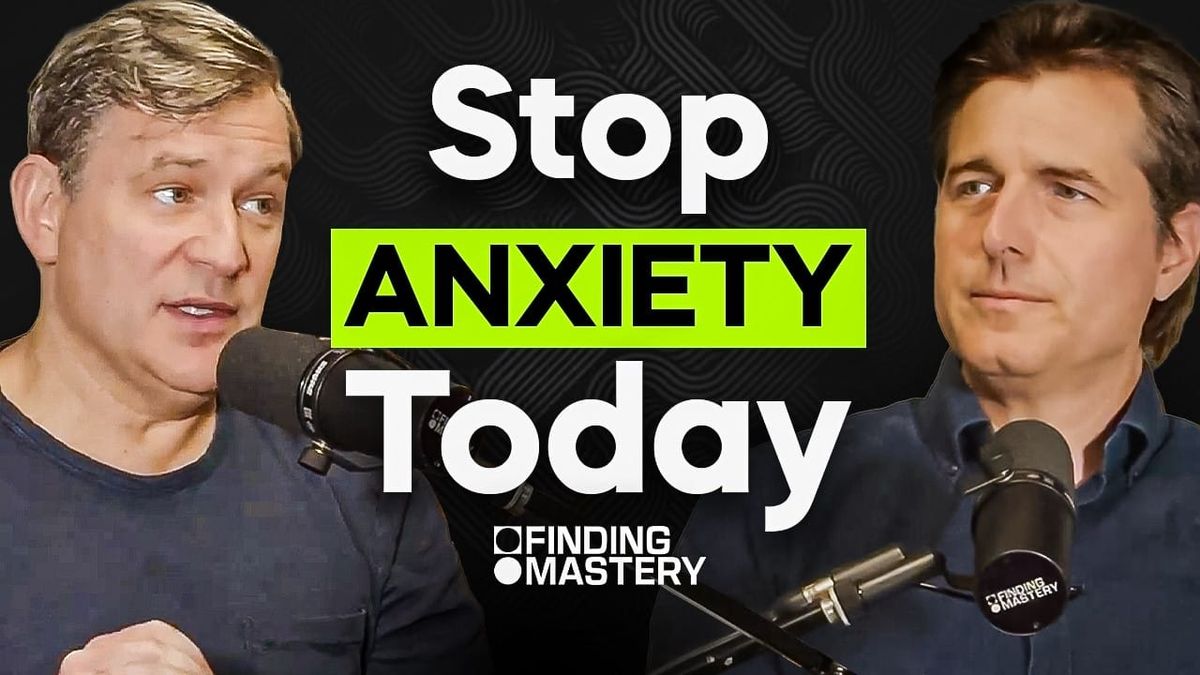
This video from Finding Mastery covered a lot of ground. 6 segments stood out as worth your time. Everything below links directly to the timestamp in the original video.
Ever wonder how one decision could drastically alter your life's trajectory? Dan Harris considers the profound impact of embracing mindfulness, revealing a stark vision of the person he might have become without it.
Dan Harris Reflects on a Life Without Mindfulness, Citing Grandfather's Volatile Example
Author and podcaster Dan Harris speculates on an alternate reality where he never embraced mindfulness, believing his life would have become "pretty gnarly." He envisions continuing an ambitious ascent in the financially declining news industry, leading to intense stress and frustration from being consistently passed over for top anchoring positions. This unmanaged ambition, coupled with pre-existing predispositions for overwork and irritability, would have negatively impacted his family life.
Harris draws a direct parallel to his grandfather, Robert Johnson, a smart but volatile figure known for unpredictable outbursts. Harris recognizes similar tendencies in himself and concludes that mindfulness provides the crucial "tools" to control these dispositions, preventing a potentially unhappy existence for himself, his wife, and his son. He notes that without these practices, he would have been consumed with self and prone to "scary" though not "volcanic" emotional displays.
"If I hadn't found this stuff, I would have gone probably hardcore down that route of trying to advance in the news industry... I in the stress of that situation with my pre-existing predelections for overwork and irritability, it could have gotten pretty gnarly."
Dan Harris Redefines 'Love' as a Skill Set for Personal Happiness and Global Issues
Author and podcaster Dan Harris reveals a significant evolution in his contemplative practice, now focusing intensely on "love" as a comprehensive set of skills. Moving beyond a purely clinical approach to self-awareness, Harris defines this broader understanding of love to include self-compassion (viewed as constructive self-talk), social fitness (maintaining relationships), and paying attention to micro-interactions with strangers, such as a barista or tradespeople. He believes cultivating these skills can inject "massive doses of happiness" into daily life.
Harris argues that this expanded concept of love is not just for individual well-being but is crucial for addressing pressing global challenges like suffering, social polarization, and climate change. He emphasizes personal agency in this interconnected world, advocating for directing energy towards one's immediate "orbit" rather than solely consuming news. This reorientation towards "the warmth piece" of human experience is the subject of his upcoming book, highlighting a shift from his initial, more clinical engagement with mindfulness.
"I started to think about love really broadly understood as a whole set of skills from self-love… How I act and I'm lucky. I mean people put microphones in front of me. So how I act actually does have some significance. But even if that weren't the case, how I am, what am I a vector of in my family and in my workplace and in my community, like that really matters."
▶ Watch this segment — 1:01:13
Dan Harris Details Ongoing Battle with Panic Disorder, Utilizes Exposure Therapy for Flights
Despite years of practicing mindfulness, Dan Harris continues to battle panic disorder, particularly when flying and using elevators. While a beta-blocker effectively manages his anxiety for public speaking by capping his heart rate, it proves insufficient for his intense fear of planes and elevators. He notes that a difficult co-founder separation and being out of practice during the pandemic intensified these struggles, leading to a recent severe panic attack during a flight in 2021 or 2022.
To address this, Harris has engaged in exposure therapy with his therapist, Paul Green, taking terrifying unmedicated flights on small commuter planes to Washington D.C. Now flying alone, he uses very small doses of clonazepam, explaining it provides just enough comfort to manage the anxiety without completely numbing it. He describes a careful balancing act, aiming to avoid both total avoidance of triggers and pushing too hard, which could lead to re-traumatization.
"For elevators and airplanes, I really struggle and a beta blocker is not going to cut it... I did like four of those and I was able to do it but it was still really hard and now I'm kind of on my own and so like I flew yesterday I was on my own. I take a really small dose of clonazepam."
Dan Harris Recounts Public Panic Attack That Launched His Meditation Career
Dan Harris traces the origin of his career shift from a 21-year tenure at ABC News to becoming a meditation advocate to a seminal public panic attack on Good Morning America in 2004. This distressing event, which has garnered millions of views online, led him to a psychiatrist who diagnosed his recreational drug use. Harris explains he had self-medicated with cocaine and other drugs for depression after reporting from war zones post-9/11, though he was not high during the broadcast.
This personal crisis ultimately became a catalyst for change, guiding Harris to discover meditation, which he found incredibly helpful. He chronicled this journey in his 2014 book, 10% Happier, which subsequently transformed into a podcast and a meditation app. After attempting to balance his news career with his new venture, Harris fully retired from ABC News four years ago to dedicate himself full-time to his work promoting mindfulness and happiness.
"The story that most people associate with me... is that I used to be at ABC News as an anchor, correspondent... probably the thing I'm best known for in my 21 years at ABC News was having a panic attack on Good Morning America... That panic attack actually turned out to be... that moment sent me on this weird windy thing where I ultimately ended up finding meditation."
Handshakes Before Games Reduced Gang Violence in Dr. Gervais's 'Late Night Sports' Program
Dr. Michael Gervais spent 18 years running "Late Night Sports," a program for high school and college-aged athletes from different gangs. In this initiative, participants learned sports psychology principles and applied them during competitive basketball games. Gervais discovered that a remarkably simple intervention — requiring every player to shake hands with all opponents before and after each game — had a profound impact.
This mandate transcended rivalries, as participants prioritized playing over feuding, leading to a significant reduction in violence and a fostering of cooperation within the gym. Gervais emphasizes that while the concept of such an intervention might not be new, its consistent practice, involving eye contact and brief physical connection, proved powerful in diminishing polarization and tribalism, demonstrating how shared cooperative activities can bridge deep societal divides.
"And that one intervention, they were to play in this gym, you had to shake each other's hand... And then they go dap their team and then it'd be like a great game and I eye contact and a brief physical contact changed the trajectory of the propensity of violence in that gym."
Dan Harris Uses Third-Person Self-Talk to Combat Panic Attacks
When faced with an impending panic attack, particularly during stressful situations like flying, Dan Harris identifies self-talk as his most effective immediate coping mechanism. He references scientific research on self-compassion and inner chatter, including work by Ethan Kross at the University of Michigan, which suggests that addressing oneself like a good friend, mentee, or child can yield powerful psychological and physiological benefits.
Harris specifically highlights the enhanced effectiveness of using third-person self-talk, like "Dan, you're not going to die," over first-person statements. He explains that this technique channels the same compassionate and reassuring energy he would use when speaking to his own son, helping to reframe the situation and remind himself that his brain is overreacting to non-dangerous stimuli. This strategy, he notes, works in conjunction with mindfulness by helping him identify early signs of disregulation.
"In the moment right before I'm going to freak out, actually self-talk is the most useful thing for me... It does actually supercharge it if you refer to yourself in the third person."
Also mentioned in this video
- Experiencing a panic attack on Good Morning America, revealing it stemmed from… (0:00)
- His initial skepticism about meditation, influenced by his ex-hippie parents,… (4:39)
- Dr. Michael Gervais emphasizes the importance of how one refocuses during… (9:22)
- Dr. Michael Gervais emphasizes the foundational role of mindfulness,… (13:52)
- Dr. Michael Gervais explains that psychological agility, for his clients, is… (18:08)
- Dr. Michael Gervais commends Dan Harris for his diligent work in psychological… (25:06)
- Dan Harris expresses skepticism about fully extinguishing his fear, preferring… (27:19)
- Dan Harris recognizes his consistent pattern of working at his edge throughout… (31:19)
- Dan Harris shares his thoughts on the current media landscape, including the… (41:50)
- Intimidation, acknowledging that such pressures are not new in history but… (45:54)
- The difficulty of hating someone up close, advocating for more personal… (47:52)
- Increased atomization, disconnection, and ideological self-sorting make it… (52:31)
- Dan Harris shares his personal strategy of listening to podcasts and reading… (55:56)
- Dr. Michael Gervais explains his 'Ideal Competitive Mindset' (ICM) in… (57:11)
- Dr. Michael Gervais discusses the idea of 'pebble in the pond' for healing and… (1:05:56)
- Dan Harris jokes about being part of a 'lineage of thieves' regarding his… (1:10:03)
Summarised from Finding Mastery · 1:13:18. All credit belongs to the original creators. Streamed.News summarises publicly available video content.
Streamed.News
This publication is generated automatically from YouTube.
Convert your full video library into a digital newspaper.
Get this for your newsroom →