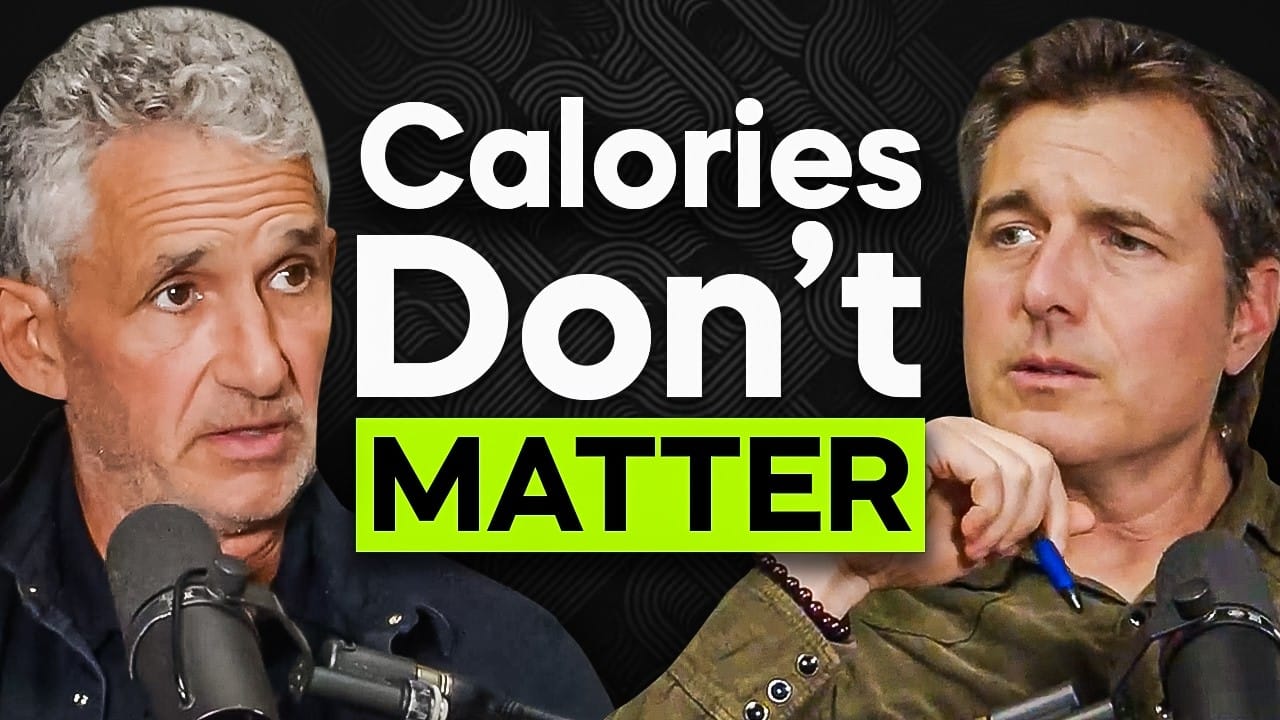
Original source: Finding Mastery
This article is an editorial summary and interpretation of that content. The ideas belong to the original authors; the selection and writing are by Streamed.News.
This video from Finding Mastery covered a lot of ground. 6 segments stood out as worth your time. Everything below links directly to the timestamp in the original video.
Ever wonder if your mood is tied to what you eat? The emerging science on gut-brain connection suggests dietary changes might be a powerful, often overlooked, tool for mental well-being.
Gut-Friendly Diets Outperform Antidepressants for Mild Depression, Says Dr. Tim Spector
Dr. Tim Spector highlights overwhelming research demonstrating a significant link between gut health and mental well-being. Studies have shown that gut-friendly diets and specific probiotics can improve symptoms of mild to moderate depression more effectively than traditional antidepressants, even before measurable changes in the gut microbiome. This improvement is rapid, often appearing within days, and is linked to a reduction in neuroinflammation. The connection is so profound that in animal models, transferring stool from an anxious human to a sterile mouse can induce anxiety, which can then be reversed with antibiotics. Dr. Spector's own research at ZOE, a direct-to-consumer science company, supports these findings, showing that dietary changes and prebiotics significantly improve mood and energy, challenging conventional approaches to mental health care.
"The research is overwhelming that the state of your gut plays a huge role in your mental state... we've seen big improvements compared to the control group in terms of mood and energy and hunger... they happened before anything else."
▶ Watch this segment — 1:00:10
Healthy Gut Microbiome Deemed Essential for Human Health, Influencing Everything from Mood to Cancer Risk
Dr. Tim Spector asserts that a healthy gut microbiome is not merely beneficial but essential for human existence, having co-evolved with us to provide critical chemicals and vitamins, such as B vitamins and vitamin K2, which the body cannot produce itself. These microbes are also vital for generating brain neurochemicals like serotonin and dopamine, and they act as key messengers for the immune system, without which it cannot function normally. Research, including data from over 300,000 gut tests conducted by ZOE, demonstrates that individuals with poor gut health face a significantly increased risk of numerous conditions. These include a two to three times higher risk of metabolic diseases like obesity, type 2 diabetes, and heart disease, along with elevated risks for dementia, depression, stroke, certain cancers, accelerated aging, and food allergies, underscoring the pervasive impact of gut health on overall well-being.
"We can't exist without healthy gut microbes... they provide key chemicals that our body can't produce itself, key vitamins... and they also produce many brain neurochemicals... and they're key messengers for our immune system."
Gut Microbes Directly Influence Obesity and Anxiety, Studies Show
Dr. Tim Spector details groundbreaking microbiome research that utilized sterile mouse models to establish a direct causal link between gut microbes and health conditions. In these experiments, researchers transplanted stool samples from human twins—one obese, one lean—into mice raised in a microbial vacuum. The mice that received microbes from the obese twin subsequently became fatter, while those receiving samples from the lean twin did not. This research extended beyond physical traits, demonstrating that transferring stool from an anxious human could induce anxiety in a mouse, a significant effect that could then be reversed with antibiotics. Dr. Spector notes that the impact on brain states like anxiety appears even more pronounced than on weight, highlighting the direct and profound influence of gut microbiota on both physiological health and mental state.
"The first experiments they did, they took some twins, one was obese, one was skinny, and they gave those to the mice. And sure enough, the one that got the obese microbes got fatter than the other one."
Gut Inflammation and Stress Locked in Two-Way Relationship, Influencing Mental and Physical Health
Dr. Tim Spector describes a crucial two-way relationship between gut inflammation and stress, where the state of gut health directly influences brain disorders, and conversely, stress exacerbates gut inflammation. This dynamic creates a complex, circular system where psychological factors, such as childhood traumas, can lead to chronic physiological stress, priming the immune system to overreact. When these predispositions combine with a poor diet, the effects are amplified, further driving physiological inflammation that signals distress to the brain. This interconnectedness links psychological theories with measurable physiological responses, suggesting that the gut not only transmits information to the brain but also senses its directives, making it a central emblem for the interaction between mental state and physical well-being.
"You've got inflammation in your gut which can make brain disorders worse and you've got things like stresses which can make your gut inflammation worse. So it's a two-way street."
▶ Watch this segment — 1:04:41
Identical Twins Reveal Gut Microbiome as Key to Disease Randomness, Shifting Focus from Genetics
Dr. Tim Spector’s interest in gut health began in 2009, stemming from disillusionment with genetics as the sole explanation for disease. Through his extensive twin study, established in 1993 with 15,000 twins, he discovered that even genetically identical twins, who shared environments, possessed vastly different gut microbiomes, with only about 25% similarity in species composition. This stark difference suggested that environmental factors, rather than just genetics, played a critical role in health outcomes. This finding was a "wow" moment for Dr. Spector, leading him to consider the gut microbiome as a potential "missing link" in understanding why one identical twin might develop a condition like cancer, rheumatoid arthritis, or depression while the other does not. The revelation challenged the prevailing notion that every microbe was harmful and provided a fresh perspective on the "randomness of disease" that genetics alone failed to fully explain.
"We... found that the microbiome was different in identical twins. And that was wow... 75% were different... that could be really fascinating, could be the reason why one twin gets a disease... and another one doesn't."
Dr. Tim Spector's Health Crisis Exposes Flaws in Conventional Nutritional Advice
In 2005, Dr. Tim Spector experienced a personal health crisis, suffering a micro-stroke that left him with double vision, high blood pressure, depression, and chronic fatigue. This event spurred him to intensely research nutrition, leading to a profound realization that much of the prevailing government dietary advice at the time, across both the US and UK, was deeply flawed and lacked scientific grounding. Dr. Spector found that recommendations to consume low-fat, high-carb, and heavily processed foods, along with advice for frequent snacking and never skipping breakfast, were largely baseless. He posits that these guidelines were influenced by the food industry, allowing companies to market "crap food" under the guise of health. This personal and professional journey highlighted a significant disconnect between public health recommendations and actual scientific evidence in nutrition.
"Everything out there at the time... was complete rubbish. Everything on the internet, you know, the government advice... for example, we should be eating low-fat foods... no scientific evidence to back this up at all."
Also mentioned in this video
- Poor gut health is linked to numerous diseases including type 2 diabetes, heart… (0:00)
- The misconception of calorie obsession for weight loss, arguing that focusing… (1:41)
- Dr. Spectre emphasizes that food quality, not just calories, is crucial for… (8:22)
- Dr. Spectre defines ultra-processed food as any food modified with extra… (10:15)
- Dr. Spectre explains that many common foods like store-bought breads, most… (12:12)
- Dr. Spectre discusses the challenge of identifying ultra-processed foods due to… (14:26)
- Dr. Spectre expresses concern about the appalling state of gut health in… (18:22)
- Dr. Spectre explains that good nutrition means feeding your gut microbes a… (21:02)
- The average American consumes three cups of coffee daily, making it a major… (23:13)
- Dr. Spectre outlines key principles for gut health, starting with eating a… (26:17)
- The second principle for gut health is to eat the rainbow, focusing on colorful… (28:17)
- Dr. Spectre clarifies that lightly steamed vegetables offer more nutrients than… (29:54)
- Dr. Spectre advises on selecting high-quality extra virgin olive oil by… (32:28)
- Dr. Spectre cautions against fake supermarket sourdough and advises choosing… (35:50)
- Dr. Spectre recommends choosing whole grain versions of bread, rice, pasta, and… (38:44)
- Dr. Spectre recommends consuming three fermented foods daily, beyond the 4Ks,… (40:22)
- Dr. Spectre explains that salt sensitivity is not universal and is often… (43:00)
- Dr. Spectre advises eating kale in moderation and encourages exploring the… (46:15)
- Dr. Spectre reiterates the importance of three fermented foods a day to reduce… (48:05)
- Dr. Spectre notes that the minimum effective amount of fermented foods like… (52:42)
- Dr. Spectre advises caution with mass-produced kombuchas, noting many contain… (54:50)
- Dr. Spectre introduces time-restricted eating (intermittent fasting) as a… (1:09:52)
- Dr. Spectre emphasizes eating quality whole plant foods over quantity and… (1:13:22)
- Dr. Spectre discusses alcohol, acknowledging its neurotoxic effects but noting… (1:15:58)
- Dr. Spectre concludes the discussion by recommending prebiotics over probiotics… (1:18:19)
Summarised from Finding Mastery · 1:20:19. All credit belongs to the original creators. Streamed.News summarises publicly available video content.
Streamed.News
This publication is generated automatically from YouTube.
Convert your full video library into a digital newspaper.
Get this for your newsroom →